CP 5.5 - Differentiating inverse trigonometric functions
Inverse trigonometric functions turn ratios back into angles. You will derive their derivatives, use the chain and product rules in compound expressions, and keep track of the branches and domains that make the answers valid.
Inverse functions and their branches
How can stay finite as approaches , while its gradient grows without bound? The angle approaches , but the sine graph is flattening there. Reversing a nearly horizontal graph produces a nearly vertical one.
You already know
An inverse function reverses a one-to-one function. Trigonometric functions need restricted domains to have inverses. The chain rule differentiates as , and the product rule gives . Angles in calculus are in radians.
Sine and cosine repeat, so an inverse must choose one angle from many possibilities. The standard choices are called their principal branches.
Principal inverse trigonometric functions
is the angle in whose sine is , for .
is the angle in whose cosine is , for .
is the angle in whose tangent is , for any real . These are inverse functions, not reciprocals.
For example, , whereas is a different expression. Also, on , but only when is in the chosen branch. For , it returns , not .
[DIAGRAM: asset_name: Principal arcsine and arccosine branches; asset_slug: 9fm0-cp55-inverse-branches; caption: Arcsine increases and arccosine decreases, with finite endpoint values and steepening gradients; description: Equal-width panels show y=arcsin x on x from -1 to 1 and y from -pi/2 to pi/2, and y=arccos x on x from -1 to 1 and y from 0 to pi. Closed endpoint dots mark all four finite endpoint values. Labels state derivative formulas apply for -1<x<1.]
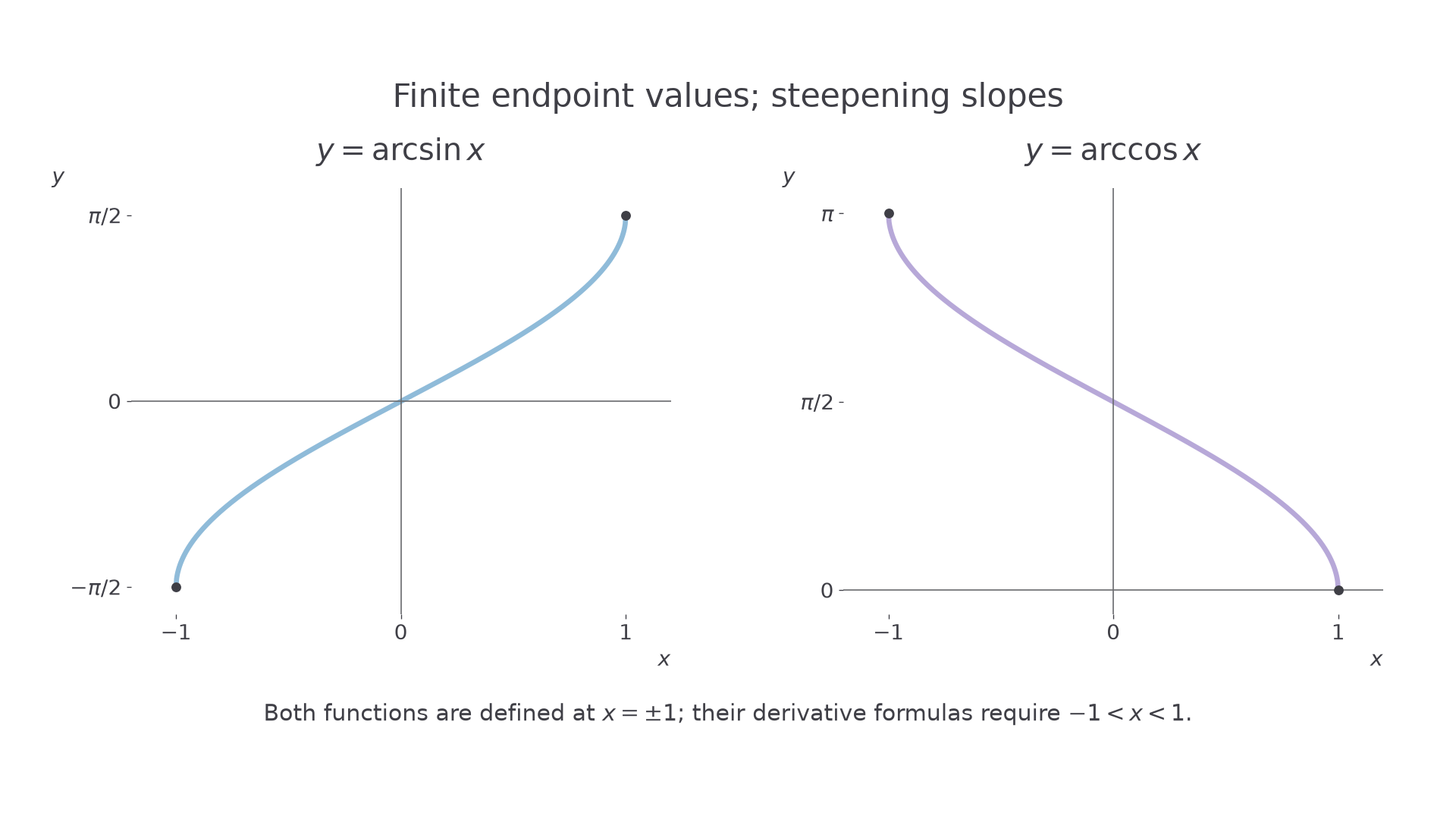
The branch choices also determine signs. If , then . If , then . This is why the square roots in the derivatives below are positive in the interior of the domain.
Key idea
An inverse-trigonometric derivative depends on a genuine inverse branch. Keep the angle range in mind before replacing a trigonometric expression by a square root.
Check the order of the function and inverse in this calculation.
Arcsine and the chain rule
Differentiate the equation defining the inverse rather than trying to guess its derivative. Put , so . Implicit differentiation gives
Here for the interior branch , so the positive square root is the correct one.
Derivative of arcsine
In the formula booklet.
For a differentiable inner function , the chain rule gives , where . This chain-rule version is not listed separately in the formula booklet: derive it from the standard derivative.
Worked example 1: a scaled argument
Question. Differentiate , stating where the derivative is valid.
Plan. Use the arcsine derivative with , then multiply by .
Why this step? Replacing by changes both the numerator through the chain rule and the denominator through .
Answer. , for .
Check. At , the slope is . The horizontal compression of the arcsine graph doubles its original slope of there.
Worked example 2 adds one algebraic term to the same function. The product rule now joins the chain rule, and a useful cancellation appears.
Worked example 2: a compound expression
Question. Differentiate , giving your answer in simplest form.
Plan. Differentiate arcsine as before, use the product rule on the second term, then combine over one denominator.
Why simplify? The numerator is , so one factor cancels against the square root. Leaving unrelated terms hides the structure.
Answer. , for .
Check. At , the arcsine term contributes and the product contributes , giving .
The endpoint values of exist, but its separate derivative is not finite at those endpoints. State derivative domains using strict inequalities; do not substitute into a formula whose denominator vanishes.
Watch out
Wrong: . Right: . Both the chain factor and the squared inner argument matter.
Change the inner scale once more in the matched question.
Arccosine and the negative sign
Arccosine is decreasing, so its derivative must be negative. Put . Then , and implicit differentiation gives . On the principal branch, in the interior.
Derivative of arccosine
In the formula booklet.
With an inner function, multiply this by . A decreasing inner function can therefore make the whole composite increase: the negative signs multiply.
Worked example 3: a linear inner function
Question. Differentiate .
Plan. Use the negative arccosine derivative and multiply by the inner derivative .
Why retain the minus? As increases, the angle with that cosine decreases.
Answer. .
Check. The derivative is negative throughout the stated interval, matching the decreasing graph.
Worked example 4 changes only the sign of the inner argument. That reverses the graph's direction.
Worked example 4: a decreasing inner function
Question. Differentiate .
Plan. Apply the same formula, now multiplying by .
Why this step? The arccosine function decreases and its argument decreases, so the composite increases.
Answer. , for .
Check. At , the gradient is , the opposite of Worked example 3's gradient.
There is an exact connection behind the opposite signs: on . Their derivatives cancel in the interior. Although each gradient becomes unbounded near an endpoint, their sum is a constant everywhere. This identity is not in the formula booklet: it follows from complementary angles on the principal branches.
Watch out
Wrong: change the sign inside when differentiating . Right: ; the extra minus belongs in the chain factor, not inside the squared quantity.
Use a different scale in the final sign check.
Arctangent with a compound argument
Arctangent works for every real argument. If , then , so . Using removes the angle and gives a rational expression.
Derivative of arctangent
In the formula booklet.
For , the chain rule gives . Square the complete argument before simplifying; if , the denominator contains .
Worked example 5: a squared argument
Question. Differentiate .
Plan. Retain the outside factor, differentiate arctangent, then multiply by .
Why this step? The denominator uses the square of , while the numerator uses its derivative. These are different operations.
Answer. , for every real .
Check. The original function is even, so its derivative should be odd. The answer has that symmetry.
Worked example 6 changes only the scale inside arctangent. That scale appears once in the numerator and squared in the denominator.
Worked example 6: scaling the squared argument
Question. Differentiate .
Plan. Use inner derivative and square the whole argument .
Why this step? , so keeping in the denominator would mix up scaling and squaring.
Answer. , for every real .
Check. At , the derivative is . Direct chain factors give too.
The opening question now has an explanation: near , the factor approaches zero while approaches the finite angle . A finite function value does not guarantee a finite derivative.
Watch out
Wrong: differentiate as . The denominator must contain the square of the whole argument: . Right: .
After applying the chain rule, simplify using identities only where the chosen inverse branch justifies them.
Exam tip
When asked for simplest form, remove inverse-trigonometric expressions left inside ordinary trigonometric functions where the principal branch permits it. For example, , not an unresolved function of an angle.
Finish by changing the inner scale once more.
Quick Recap
- Use the principal branches: arcsine and arccosine have arguments in , while arctangent accepts every real argument.
- The standard derivatives are , and , respectively.
- For a compound argument , replace by and multiply by .
- Keep branch signs, square the whole argument, and simplify product-rule expressions fully.
Arcsine stays finite at its endpoints, but its graph becomes vertical there because the inverse sine slope contains a denominator tending to zero.