CP 6.5 - Where a line meets a plane
Substituting a line into a plane reduces a spatial intersection to one equation. You will find the intersection point, distinguish a parallel line from one contained in the plane, and determine constants from a specified intersection condition.
Finding the intersection point
Can a straight line meet a flat plane infinitely many times? Usually there is one crossing, but the equation will reveal the exceptional case too.
Begin with . Its coordinates are . On the plane , these must add to , so the parameter is found from a single linear equation.
You already know
A point on a line uses the same parameter in all three coordinates. A point belongs to exactly when its position vector satisfies that scalar-product equation.
The general substitution exposes the same structure.
Line-plane intersection equation
For line , , and plane , ,
If , then
Substitute this parameter back into the line to obtain the point. Not in the formula booklet: learn it.
You can simply substitute the coordinate expressions rather than memorise the fraction. It is the same linear equation.
Worked example 1: a unique crossing
Question. Find where meets .
Plan. Insert all three coordinate expressions into the plane, solve for , then return to the line.
Why this step? identifies a location along the line; it is not itself a coordinate triple.
Answer. The intersection is .
Check. , so the point lies in the plane as well as on the line.
Worked example 2 changes only the plane constant, from to . Its orientation stays fixed while its intersection moves along the line.
Worked example 2: a parallel plane at a different position
Question. Find where the same line meets .
Plan. Update the right-hand side, then calculate the new point.
Why this step? Keeping the old point would ignore the plane's changed position, even though its normal is unchanged.
Answer. .
Check. , and the displacement from the previous intersection is , parallel to the line.
A line segment needs one further check: its parameter must lie in the segment's permitted interval. An infinite line may cross a plane beyond the end of a specified segment.
Watch out
Wrong: use different parameters in , or stop after finding . Right: substitute the same solved parameter into all three coordinates and state the point.
Move the plane to a third parallel position.
Parallel to a plane or contained in it
If the line direction is perpendicular to the normal, substitution removes the parameter completely, leaving either a true identity or a contradiction.
For example, always satisfies
It lies entirely in , but never meets . The direction is the same in both cases; the anchor decides which geometry occurs.
| Substitution result | Geometric conclusion |
|---|---|
| A non-zero multiple of remains | One intersection point |
| A true statement independent of | The whole line lies in the plane |
| A false statement independent of | The line is parallel to, and separate from, the plane |
[DIAGRAM: asset_name: The three line-plane intersection cases; asset_slug: 9fm0-cp43-intersection-cases; caption: A unique parameter, an identity and a contradiction describe three different geometries; description: Three exact cross-section diagrams show a clay line crossing a blue plane trace once, a clay line lying within the plane trace, and a clay line running parallel above it. The panels are labelled one point, contained, and separate and parallel, with corresponding labels one parameter value, every parameter value, and no parameter value]
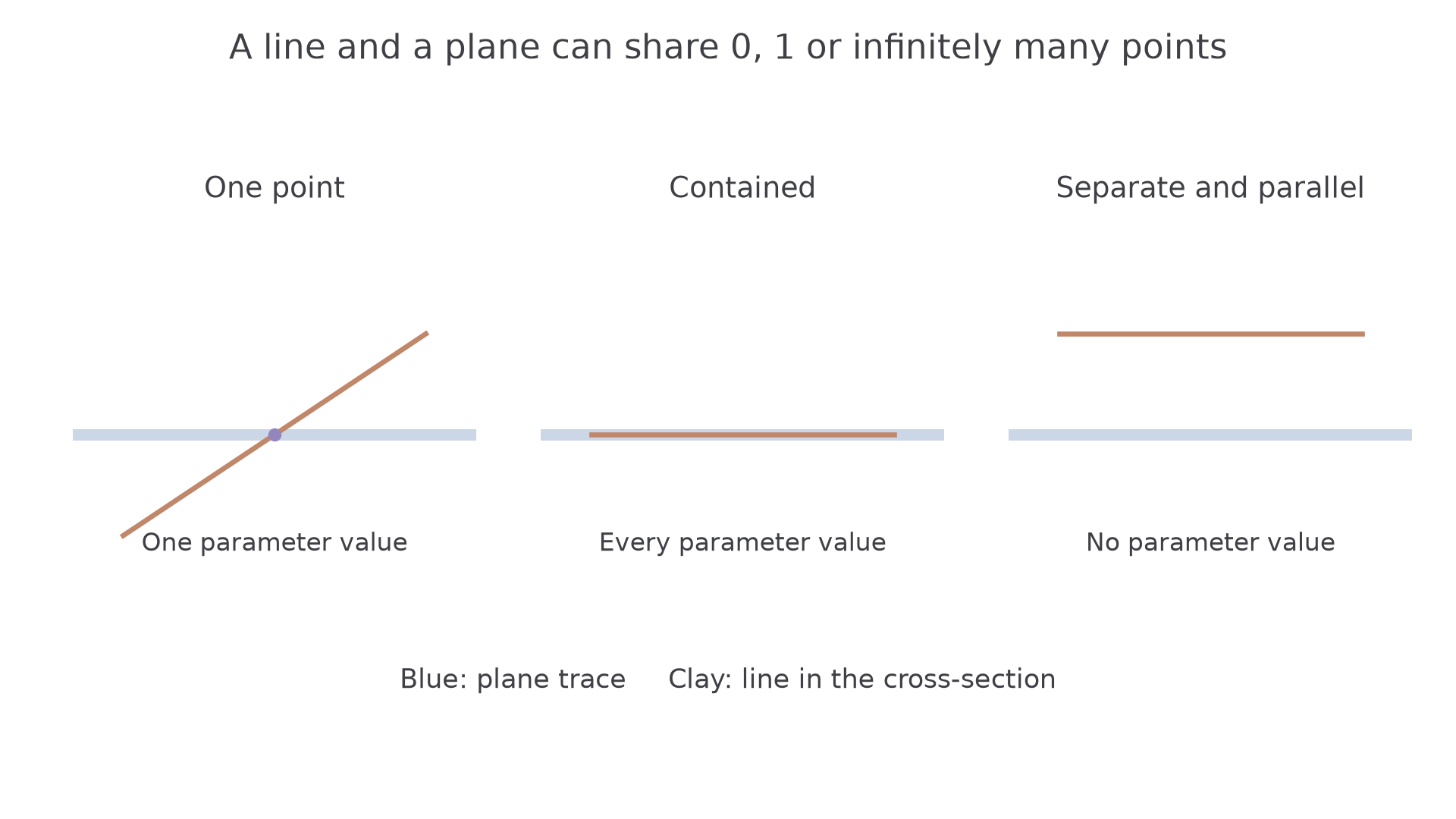
The scalar-product form says the same thing. If , compare with . Equality means contained; inequality means separate. These classification consequences are not in the formula booklet; derive them from the substituted equation.
A line contained in a plane
A line is contained in a plane when every point of the line belongs to the plane. Its direction is parallel to the plane and one, hence every, anchor lies in it. A separate parallel line has the same directional condition but no points in the plane.
There is a useful surprise here: a line and a plane can have zero, one or infinitely many common points, but never exactly two. If two distinct line points satisfy a linear plane equation, every point obtained by continuing along their displacement satisfies it too.
Key idea
A zero direction-normal product tells you that the line cannot cross the plane transversely. Test an anchor to distinguish containment from separation.
The opening question has its answer: a line can meet a plane infinitely many times by lying in it. Check the anchor before concluding that there is no meeting.
Determining a constant from the intersection
A specified coordinate of the intersection can determine an unknown constant in the line, provided you use both the line and plane conditions.
For , the first coordinate gives . Once a target value of fixes , the plane equation can determine . The unknown constant describes a family of lines; the running parameter locates a point on one line.
Worked example 3: prescribing the first coordinate
Question. The line meets at a point with . Find .
Plan. Use the given first coordinate to find , then substitute the full point into the plane.
Why this step? The coordinate condition fixes the parameter, while plane membership fixes the line's constant; they play different roles.
Answer. .
Check. The point is , and .
Worked example 4 changes only the prescribed first coordinate, from to .
Worked example 4: selecting another member of the line family
Question. Keep the same line family and plane, but require the intersection to have . Find .
Plan. Recalculate the parameter and then the plane constraint.
Why this step? Changing the target point does not mean replacing the fixed parameter by the running parameter .
Answer. .
Check. The point satisfies the plane and the chosen line.
Here on every line in the family, so meeting always gives . This is a helpful check derived from the equations, not an extra memorised formula.
Watch out
Wrong: treat and as interchangeable. Right: selects which line you have; selects a point along it. Write the two conditions separately before solving.
Use a third prescribed coordinate to select another line.
Quick Recap
- Substitute a line's coordinate expressions into the plane and solve for its parameter.
- Return to the line to calculate the actual point.
- A vanished parameter gives either a whole line in the plane or a separate parallel line; test the remaining statement.
- Distinguish a fixed constant selecting a line from its running parameter selecting a point.
A line can meet a plane infinitely many times: the substituted equation must hold for every parameter, so the whole line lies in the plane.