CP 7.1 - Converting between polar and Cartesian
Describe a point by its distance and direction from a fixed origin, then convert between that description and Cartesian coordinates. You will choose angles in the required range and translate simple curve equations without losing their domain restrictions.
Distance and direction locate a point
Can the angles and describe the same point? Yes, provided the distance is the same: the two directions differ by one complete turn. Polar coordinates use distance and direction rather than horizontal and vertical displacement.
You already know
From A-level Mathematics, radians measure directed angles, and sine and cosine give the vertical and horizontal components of a length. Their signs depend on the quadrant. One full turn is radians.
Fix an origin , called the pole, and a horizontal ray pointing to the right, called the initial line. A point is located by moving distance from the pole in direction . Positive angles turn anticlockwise from the initial line.
Polar coordinates
The polar coordinates of are , where is its distance from the pole and is a directed angle from the initial line to . For example, is three units directly above the pole. The pair describes a different point: the order matters.
For a non-zero point, replacing by , for integer , changes the description but not the position. At the pole, ; any angle leads to the same point, and there is no distinguished direction. That is a striking difference from Cartesian coordinates: one point can have infinitely many coordinate pairs.
[DIAGRAM: asset_name: A point located by distance and direction; asset_slug: 9fm0-cp45-polar-triangle; caption: The radius and angle give the horizontal and vertical components; description: Equal-scale Cartesian axes show the point P at minus 3 comma 3 root 3. Its radius from the pole O is labelled r equals 6 and its anticlockwise angle from the initial line is two pi over 3. Dashed projections show x equals r cos theta equals minus 3 and y equals r sin theta equals 3 root 3. The initial line is the positive horizontal ray.]
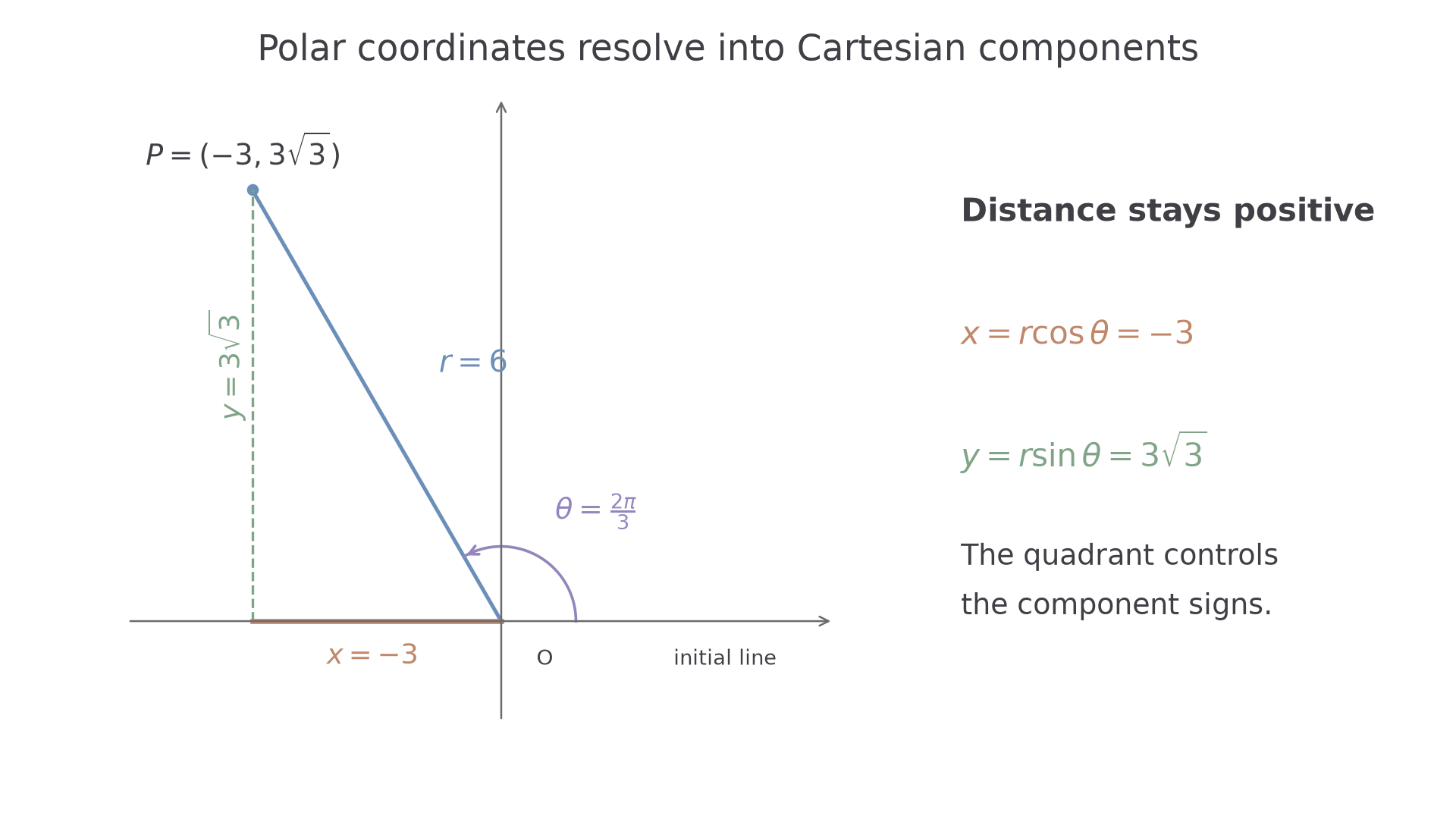
The picture uses a second-quadrant point deliberately: remains positive while its horizontal component is negative. A signed component is different from a distance.
Key idea
The radius tells you how far; the angle tells you which direction. An angle range chooses one representative of a direction, while the pole has no unique angle.
Check the coordinate order and the direction convention together.
From polar to Cartesian coordinates
Resolve the radius horizontally and vertically. The same component formulae work in every quadrant because sine and cosine already carry the correct signs.
Cartesian components of polar coordinates
For and real ,
Angles are in radians. These relations are not separately printed among the polar formulae.
Not in the formula booklet: learn it.
The first example lies in the first quadrant, where both components are positive.
Worked example 1: a first-quadrant point
Question. Convert to Cartesian coordinates.
Plan. Substitute the radius and angle into the two component formulae.
Why this step? Cosine goes with the horizontal coordinate, since the angle is measured from the horizontal initial line.
Answer. .
Check. The distance is , and both coordinates are positive.
Change only the angle from to . The point is reflected across the vertical axis, so only its horizontal sign should change.
Worked example 2: a second-quadrant point
Question. Convert to Cartesian coordinates.
Plan. Use the exact sine and cosine values in the second quadrant.
Why this step? The radius is still ; the quadrant changes the sign of the component, not the sign of the distance.
Answer. , as in the diagram.
Check. Its distance is again , and a negative horizontal coordinate with positive vertical coordinate puts it in the required quadrant.
Sketching a direction before substituting takes a moment and catches many sign slips.
Watch out
Wrong: , . At , this would place a point above the pole instead of on the initial line. Right: horizontal cosine, vertical sine.
Move the angle to the third quadrant while keeping the radius fixed.
From Cartesian to polar coordinates
Find the distance using Pythagoras, then choose the angle using both coordinates. The ratio alone cannot distinguish opposite quadrants.
Squaring and adding the component formulae gives . Dividing them gives the tangent ratio when .
Recovering radius and direction
For a non-zero point ,
Choose in the requested range and the correct quadrant. If , use the upward or downward axis direction directly.
Not in the formula booklet: learn it.
An inverse-tangent result is a starting angle, not automatically the final polar angle.
Worked example 3: choosing the second quadrant
Question. Find polar coordinates for , with and .
Plan. Calculate the radius, find a reference angle and use the coordinate signs to select the quadrant.
Why this step? A calculator may return for the inverse tangent, but that direction has positive . The given point has negative and positive .
Answer. .
Check. and , recovering both coordinates.
Change only the sign of the vertical coordinate. The point moves to the third quadrant, while its distance remains the same.
Worked example 4: choosing the third quadrant
Question. Find polar coordinates for , with and .
Plan. Use the same distance and reference angle, then select the direction with both coordinates negative.
Why this step? A positive tangent occurs in both the first and third quadrants. The coordinate signs, rather than the tangent sign alone, decide which one is needed.
Answer. .
Check. , .
If the question instead specified , the second answer would use . Polar coordinates do not impose one universal angle interval: follow the interval in the question.
Watch out
Wrong: without checking the point. Right: find a reference angle and use the signs of both and , then enforce the requested range. At , do not calculate : state and no unique direction.
The opening directions now have a concrete position: at radius , both and give .
Converting curve equations
Use , and to translate a whole equation. Keep track of restrictions when multiplying, dividing or squaring.
For example, becomes , hence because . A circle centred at the pole has a constant radius: its equation becomes simpler in polar coordinates. The opposite direction can reveal a circle hidden inside a trigonometric polar equation.
Worked example 5: a circle touching the pole
Question. Convert to Cartesian form and identify the curve.
Plan. Multiply by , substitute for and , then complete the square.
Why this step? Multiplication by creates exactly the combinations with Cartesian meanings. Dividing by instead would require a separate check at the pole.
Answer. The curve is a circle with centre and radius . Its polar points use angles with .
Check. The circle passes through and . Both occur in the polar description: at , and at .
Change only cosine to sine. This changes which Cartesian coordinate appears and turns the circle's position through a right angle.
Worked example 6: the circle moves above the pole
Question. Convert to Cartesian form and identify the curve.
Plan. Multiply by , replace by , then complete the square.
Why this step? The angle still starts at the horizontal initial line, so the sine component is . It is the curve that changes, not the coordinate convention.
Answer. A circle with centre and radius , using polar angles with .
Check. At , , giving ; at , the point is the pole.
The component relations are not printed in the formula booklet, and these particular circle conversions are not printed either. Reconstruct them rather than memorising each separate case.
Watch out
Wrong: cancel from and forget the case . Right: discuss the pole whenever a division by is used. Also, a restricted angle interval may describe only an arc of the Cartesian circle.
The next circle has the same form with a different scale.
Quick Recap
- Polar coordinates use distance and an angle from the initial line; the origin is the pole.
- Convert to Cartesian form with , .
- Recover , then choose the angle using the quadrant and the required range.
- For equations, use the component relations and ; preserve restrictions and check the pole before cancelling .
The opening angles differ by , so they give the same direction and, at equal radius, the same point.