FP2 2.1 - Reduction formulae
Derive and use reduction formulae, keeping endpoint terms, index ranges and starting values under control. Connect an integral with a simpler member of the same family instead of expanding a high power or starting the integration again.
An integral can be one member of a sequence
Can you find the exact value of without expanding the twentieth power? A reduction formula turns that intimidating integral into ten short multiplications. There is also a pleasing pattern: every odd-power integral in this family is rational, while every even-power one is a rational multiple of .
You already know
From A-level Mathematics, integration by parts is . For definite integrals, evaluate the term at both bounds. Substitution changes the differential and the limits together; trigonometric identities can expose a simpler integrand.
Define for nonnegative integer indices. Each index gives a number; the variable is integrated out. The starting values are and .
Reduction formula
A reduction formula relates an indexed integral to one or more integrals in the same family with simpler indices. Its definition includes the integrand, limits or variable, and the permitted index range.
For a definite-integral family, every linked term must use the same bounds. For indefinite integrals, the identities are understood with consistent choices of antiderivative constants.
An index step of two makes two separate chains: even indices end at , and odd indices at . An index step of one needs a single base value. The family definition tells you what must remain fixed while the index changes.
Key idea
Derive a relationship that exposes the simpler integral, then follow its index steps until you reach a known starting value.
There is no general reduction-formula table in the formula booklet. Integration by parts and the trigonometric identities used to build the formulas are printed; the family-specific relationships below must be derived or learned as stated.
Use integration by parts and retain the boundary term
Write . Differentiate the first factor and integrate the last. The remaining becomes , which creates both and . Collect the repeated integral on one side.
Sine-power reduction on a quarter period
For and integers ,
The endpoint product vanishes at these particular bounds.
Not in the formula booklet: learn it.
The derivation explains both the coefficient and the range . It also shows what changes if the upper endpoint is different.
Worked example 1: derive the quarter-period relationship
Question. Derive for the stated family and .
Plan. Integrate by parts with , , then rewrite the remaining cosine square.
Why this step? Replacing exposes exactly the powers and , so the original unknown appears in a solvable linear relationship.
Answer. Collecting terms gives , for .
Check. At , , agreeing with .
Change only the upper bound, from to . The integration-by-parts choice stays the same, but the endpoint term survives.
Worked example 2: a different endpoint changes the formula
Question. For , derive a relationship between for integers .
Plan. Repeat the same parts calculation, evaluating rather than discarding the endpoint product.
Why this step? The lower product is zero for , but the upper product is not. Changing a bound changes the recurrence, not just its base value.
Answer.
Check. At , this gives , the same result as integrating the sine-square identity directly to .
The second relationship is another derived result, not a formula-booklet entry. Its extra term is precisely the retained endpoint product.
Watch out
Wrong: reuse after changing the upper bound. Right: write the parts boundary term first and evaluate it using the actual bounds.
Change the upper endpoint once more.
Follow the index chain to the correct starting value
For the original bounds, . The reduction multiplier is less than one for , agreeing with the fact that raising a sine value between zero and one makes it smaller. The curve's area shrinks while the recurrence keeps the calculation short.
[DIAGRAM: asset_name: Sine powers and their decreasing integrals; asset_slug: 9fm0-fp292-sine-power-areas; caption: Raising the power reduces the area, and the reduction formula quantifies the change; description: A Cartesian plot from zero to pi over two shows sin squared x in blue and sin to the sixth power x in sage, with pale fills beneath the curves. The legend sits above the plotting area. Exact ticks are zero, pi over four and pi over two. A clear note gives I subscript two equals pi over four and I subscript six equals five pi over thirty-two; all labels are dark ink and no curve is hidden by a legend.]
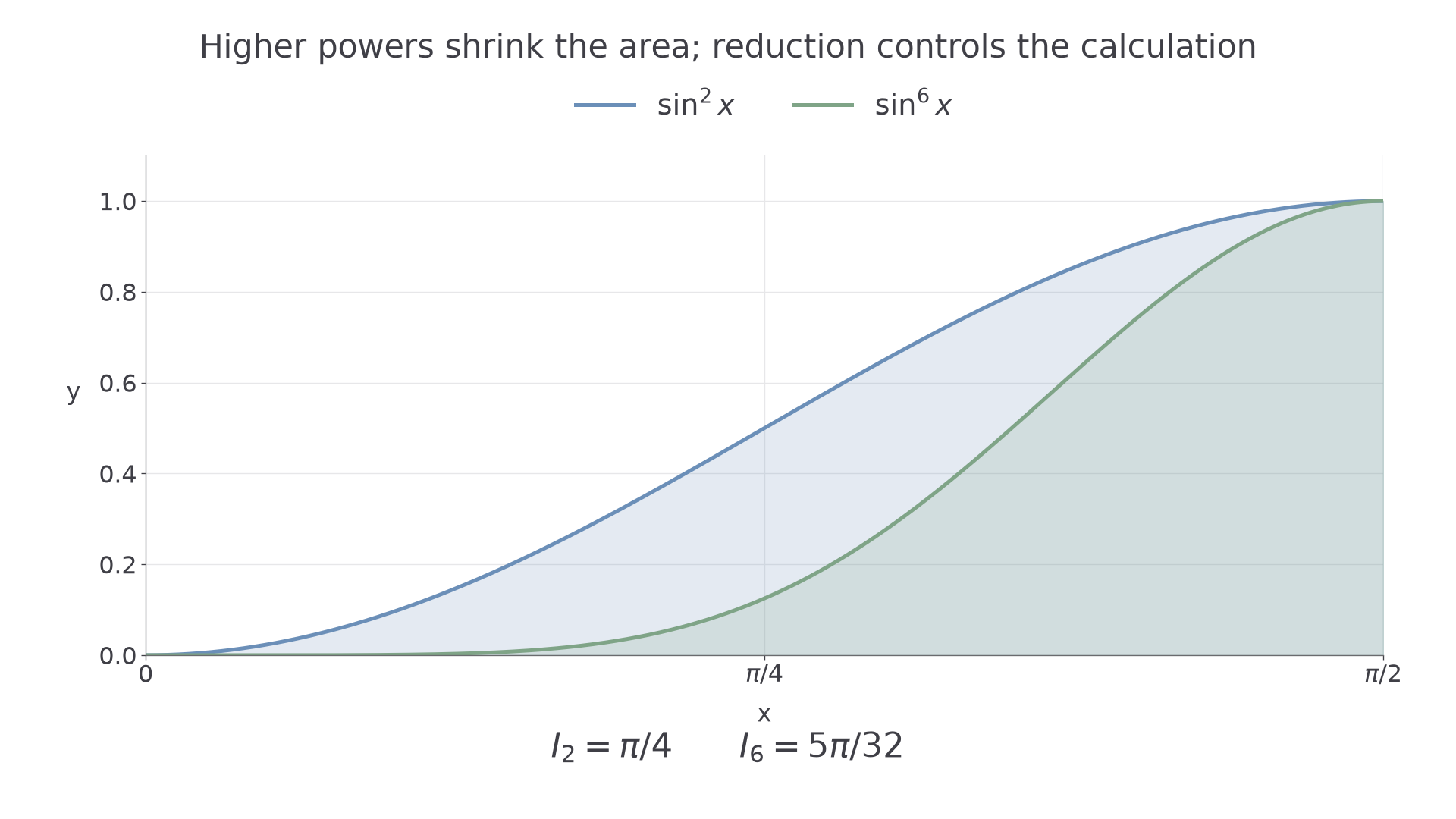
The starting values and are elementary integrals, not printed as this family's base-value table. Record the index chain before multiplying so you can see which one is required.
Worked example 3: an even chain
Question. Find the exact value of .
Plan. Reduce through to the even base .
Why this step? The index drops by two at each stage, so the factors involve , not every integer down to one.
Answer. .
Check. , as the plotted curves require.
Change only the required index from to . The parity changes the starting value.
Worked example 4: an odd chain
Question. Find exactly.
Plan. Reduce to , retaining the odd-index multipliers.
Why this step? An odd chain stops at the sine integral , not at the interval length .
Answer. .
Check. Substituting gives .
This proves the parity pattern in the opening: multiplying rational factors into gives rational odd-index values, while the even chain retains the factor from .
Watch out
Wrong: continue the recurrence at and introduce . Right: the formula was proved for ; stop at or according to parity.
Return to the even chain with the next index.
A disappearing endpoint can simplify a polynomial family
For , with fixed, integration by parts using creates a factor . Rewrite that factor as ; the two resulting integrals belong to the same family.
A polynomial-power reduction
For integers and fixed ,
The endpoint product vanishes at both ends for .
Not in the formula booklet: learn it.
The scale belongs to the definition and must stay fixed during an index reduction. We will derive the rule at two scales, rather than assume that changing a coefficient leaves the multiplier unchanged.
Worked example 5: a family ending at three
Question. For , derive a reduction formula for integers .
Plan. Take , , then express in terms of .
Why this step? The rewrite creates one lower-index integral and one copy of the original integral; both use the original bounds.
Answer. , for .
Check. , so . Directly, .
Continue this lesson.
You’re previewing NovaLearn without an account. Create a free account to read the rest.
Create free account