FM2 3.1 - Centres of mass by integration
Integration extends mass-weighted averages to a continuous body. You will choose a mass element for a wire, lamina, solid or thin shell, integrate its mass moment, and use symmetry to remove unnecessary coordinates. You will also see why the same outline can give different centres when its density or its physical construction changes.
Add small mass moments by integration
Do equal-height bands near the top of a spherical shell contain less material than bands near its equator? Their circles are smaller, but their curved widths are larger. For a uniform thin spherical shell, equal axial heights actually give equal masses. You will build the integral that explains this at the end.
You already know
For discrete masses, . A definite integral adds limiting contributions. Choose a reference coordinate before integrating, and retain the same reference when dividing mass moment by mass. The Core Pure disc method gives volume element for rotation about the x-axis.
Divide a body into small pieces. If a piece has mass near coordinate , its mass moment is approximately . Summing and refining the pieces produces the continuous moment formula.
Continuous centre of mass
For a body with positive finite total mass,
Use corresponding moment integrals for other coordinates. Choose from the actual mass distribution, not just from the outline. Symmetry of that distribution may give coordinates directly.
Not in the formula booklet: learn it.
The mass element is the modelling decision. A density is mass per unit of the appropriate geometric measure.
| Model | Density | Mass element |
|---|---|---|
| Thin wire | Linear density | |
| Thin lamina or shell | Areal density | |
| Solid | Volume density |
These density relations are not printed in the formula booklet. On a straight rod along the x-axis, ; on a curved wire its arc length must be used instead. A common constant density cancels from the centre calculation, but a position-dependent density stays inside both integrals.
Worked example 1: a rod denser at one end
Question. A thin straight rod occupies , with x measured in metres. Its linear density is , where and x denotes the numerical coordinate in metres. Find its mass and centre of mass.
Plan. Integrate the linear density for mass and x times that density for mass moment.
Why this step? Dividing by the rod's length would average a coordinate-density product incorrectly. Divide by the actual total mass.
Answer. Mass is , with centre at .
Check. The centre lies right of the midpoint , towards the denser end, and remains inside the rod. The scale factor cancels.
Change only the density gradient: replace by , retaining the same rod.
Worked example 2: a stronger density gradient
Question. The same rod has linear density . Find its mass and centre.
Plan. Recalculate both integrals using the changed density.
Why this step? The density affects the mass denominator as well as the moment numerator. Changing it in only one integral would describe two different bodies.
Answer. , .
Check. , consistent with the stronger bias towards the right end.
A zero density at an isolated endpoint is harmless if the body still has positive finite mass; a negative density over a region is not an admissible mass model.
Watch out
Wrong: cancelling a variable factor such as from inside two different integrals. Right: integrate it in both. Only common constant factors may be cancelled before integration.
Change only the density gradient again.
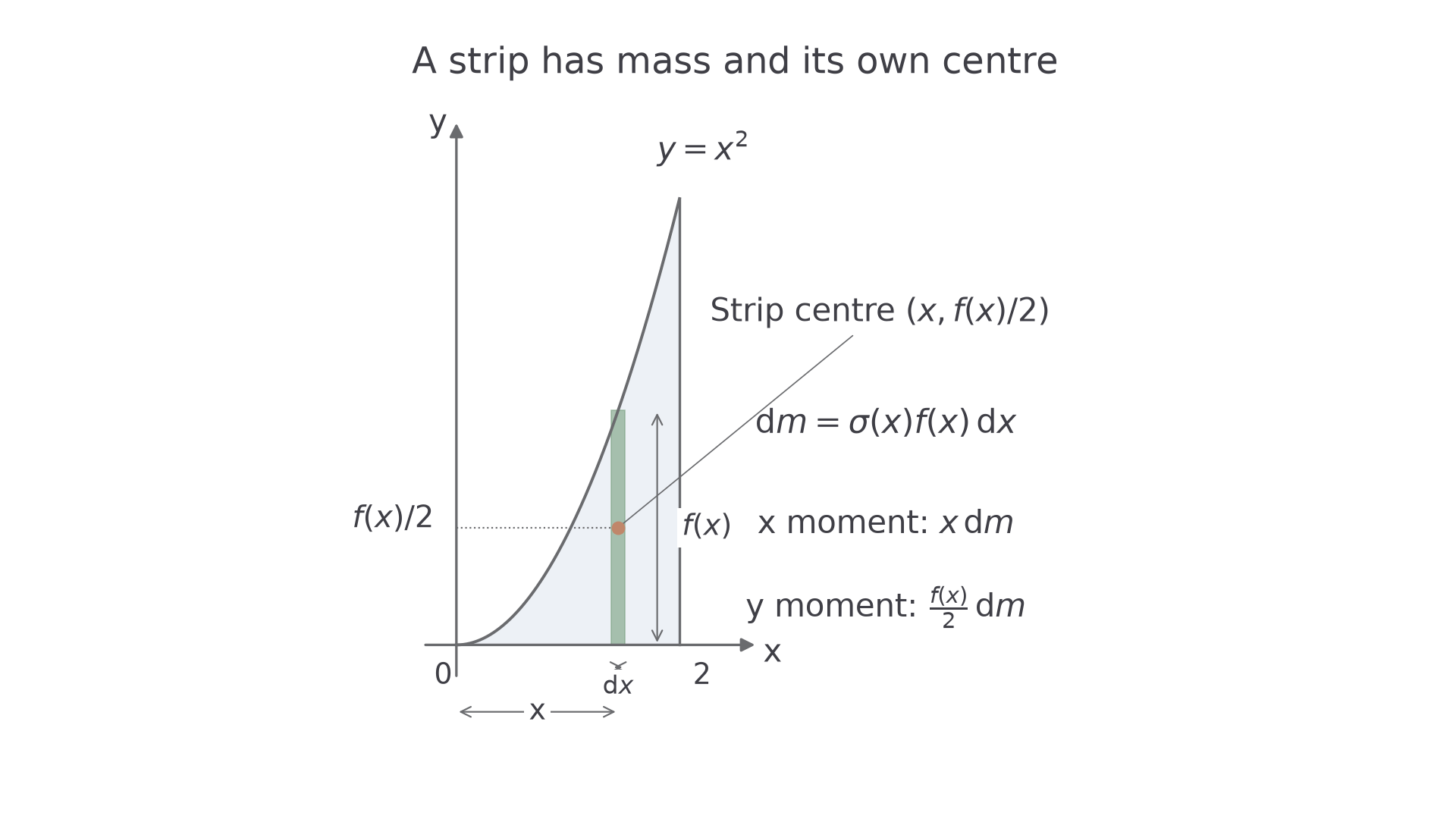
A lamina strip has both area and its own centre
For a lamina under , a vertical strip has area approximately . If its density depends on x alone, it is constant along that strip. Its centre is halfway up, at height . The x and y mass moments therefore use different factors.
Vertical strips in a lamina
For , , and areal density constant across each vertical strip,
The one-half in the y moment comes from the strip's own centre. If density varies along the strip as well, its centre is not automatically halfway up; choose elements appropriate to that density.
Not in the formula booklet: learn it.
Sketch the strip before choosing an integrand. It makes the extra x in one moment and the half-height in the other visible.
[DIAGRAM: asset_name: A vertical lamina strip and its centre; asset_slug: 9fm0-fm153-lamina-strip; caption: The strip mass is density times f(x) dx, acting halfway up when density is constant vertically; description: The region under y equals x squared from zero to two has a narrow vertical strip at x. The strip height is f(x), width dx and centre at x f(x) over two. Horizontal and vertical coordinate arms to that centre are labelled. A side annotation distinguishes the x moment x dm and y moment f(x) dm over two.]
Worked example 3: a uniform curved plate
Question. A uniform lamina occupies , , with coordinates in metres and constant areal density . Find its centre of mass.
Plan. Use vertical strips, calculating their mass, x moment and half-height y moment.
Why this step? A strip's whole height determines its area, but only half that height locates its centre. Using the top boundary as the strip centre doubles the y moment.
Answer. .
Check. Both coordinates lie within the lamina's coordinate ranges. The region is wider in vertical extent near the right, consistent with .
Change only the density to , retaining the same boundary and limits. It still stays constant along each vertical strip.
Worked example 4: density varying across the same plate
Question. The same lamina has areal density , where and x is the numerical coordinate in metres. Find its centre.
Plan. Include the extra x density factor in all three integrals.
Why this step? The boundary height and the density are different ingredients. The y moment is still half the height times strip mass; the varying density does not remove the one-half.
Answer. .
Check. Both coordinates increase towards the tall, denser right-hand part of the lamina.
Horizontal strips are equally valid when their lengths and centres are easier to express. Use the corresponding coordinate and density consistently; do not mix a vertical-strip mass with a horizontal-strip centre.
Watch out
Wrong: for these full-height strips. Right: include the factor . A moment integrand is coordinate of the element's centre multiplied by its mass.
Change only the density again.
Use circular slices for a uniform solid
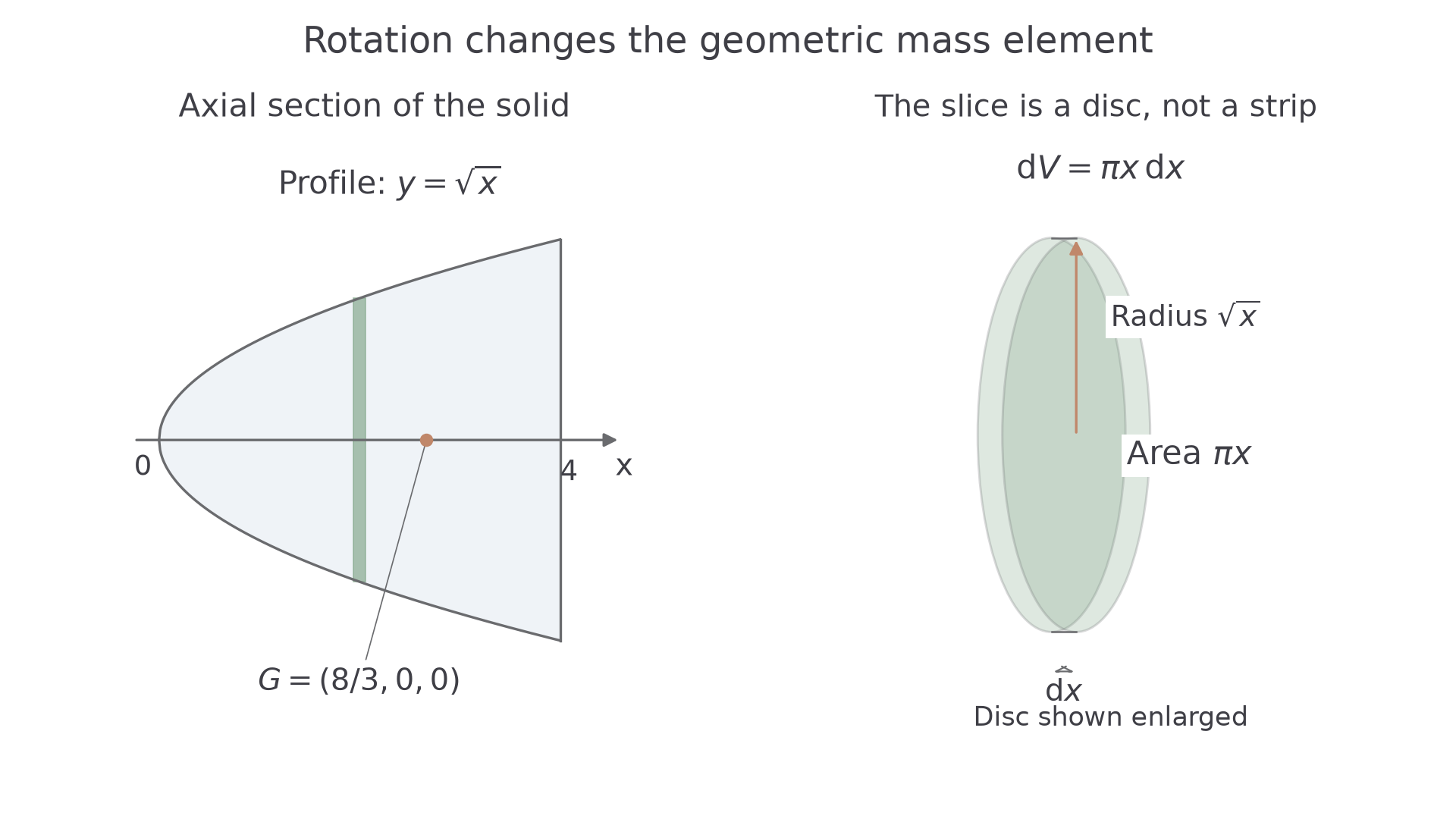
Rotate a region about the x-axis. A disc at coordinate x has volume and its centre lies on that axis at x. If density is uniform, rotational symmetry gives , leaving one coordinate to calculate.
Uniform solid of revolution
For a uniform solid formed by rotating , , about the x-axis,
A common volume density cancels. The denominator is volume, not the area under the original curve. For washers, replace by outer-radius squared minus inner-radius squared.
Not in the formula booklet: learn it.
A profile diagram is a section through the solid, not a lamina whose centroid can be reused. Rotation changes the relative masses of the slices.
[DIAGRAM: asset_name: Disc slices for a solid's mass moment; asset_slug: 9fm0-fm153-solid-slices; caption: The disc area is pi times radius squared and its moment arm is the axial coordinate; description: The generating profile y equals square root x between zero and four is shown above and below the x-axis. A thin disc at x has radius square root x and axial thickness dx; the circle's area is pi x. The axial centre eight thirds is marked, and symmetry places the other coordinates on the axis.]
Worked example 5: a uniform curved solid
Question. The region , is rotated about the x-axis to form a uniform solid. Coordinates are in metres. Find its volume and centre of mass.
Plan. Use disc volumes and multiply each by its x-coordinate for the axial moment.
Why this step? Each slice has mass proportional to its circular area , rather than its profile height .
Answer. Volume is , with centre .
Check. , towards the broader end; the other coordinates are zero by rotational mass symmetry.
Change only the upper endpoint, extending the same profile from to .
Continue this lesson.
You’re previewing NovaLearn without an account. Create a free account to read the rest.
Create free account