FP2 5.7 - Counting principles and subsets
Use set notation and the multiplication, addition and subtraction principles to count outcomes. Count subsets, and choose between direct counting and counting a complement without omitting or repeating cases.
Decide what counts as one outcome
How many positive integers below contain the digit ? Listing them sounds like a long afternoon. Counting the numbers that avoid will give the answer in one line: surprisingly, more than a quarter of the integers contain it. We will find the exact count and explain why leading zeros help rather than spoil the method.
Before counting, decide what makes two outcomes different. The numbers and differ; the sets and do not. A set has no order and no repeated elements: .
Sets and subsets
A set is a collection of distinct elements. Write when belongs to , and for the number of elements of a finite set.
means every element of belongs to . A proper subset, , is a subset with . The empty set has no elements and is a subset of every set.
For and , we have , , and . The element and the singleton set are different objects.
The universal set contains every outcome under discussion. The union contains outcomes in either set or both; the intersection contains those in both; the complement contains outcomes in that are not in . Sets are disjoint when their intersection is empty.
Key idea
A count is reliable only when the outcomes, the universal set and any restrictions are stated precisely.
These set meanings and notation are not listed as counting results in the formula booklet. They are the language used to state the principles below.
Multiply choices made in successive stages
Suppose a code consists of a letter, a second letter, then a digit. Each first choice leads to a set of second choices; each resulting pair leads to digit choices. Multiplication counts all the branches without listing them individually.
The number of available choices may change after a previous selection. “No repetition” changes a later factor; it does not change multiplication into addition.
Multiplicative principle
If each first-stage choice has second-stage choices, each resulting pair has third-stage choices, and so on, the number of outcomes is
The stated number of choices at each stage must apply to every partial outcome being counted in that product.
Not in the formula booklet: learn it.
If different first choices lead to different numbers of continuations, split into cases and count those separately. You do not need probabilistic independence: you need the correct number of choices at each stage.
Worked example 1: codes allowing repetition
Question. A code has two letters followed by one digit. Each letter is chosen from , repetition is allowed, and the digit can be to . How many codes are possible?
Plan. Count the choices for each of the three fixed positions, then multiply.
Why this step? A code records positions. and differ, while is allowed.
Answer. codes.
Check. There are ordered letter pairs, each followed by ten possible digits, giving .
Keep the character sets and positions fixed; change only the rule on repeating letters.
Worked example 2: prohibit a repeated letter
Question. How many such codes are possible when the two letters must be different?
Plan. Choose the first letter freely, then exclude it from the second position.
Why this step? Whatever the first letter is, exactly three alternatives remain. The second choice depends on the first, but its count is always three.
Answer. codes.
Check. The forbidden repeated-letter codes are , so .
The same leading-zero issue will reappear when we count integers. Here the last character may certainly be zero; a code is not a three-digit positive integer.
Watch out
Wrong: use because “zero is not a digit”. Right: zero is a digit; exclude it only when the problem's position or number restriction requires that exclusion.
Expand the letter set by one element, retaining the no-repetition rule.
Add disjoint cases and remove any double count
When every outcome lies in exactly one of several cases, add the case counts. If the cases overlap, plain addition counts their intersection twice. Subtract one copy of that overlap.
Addition with and without overlap
For finite sets ,
If are disjoint, , so their union has elements. More generally, add the counts of pairwise disjoint cases.
Not in the formula booklet: learn it.
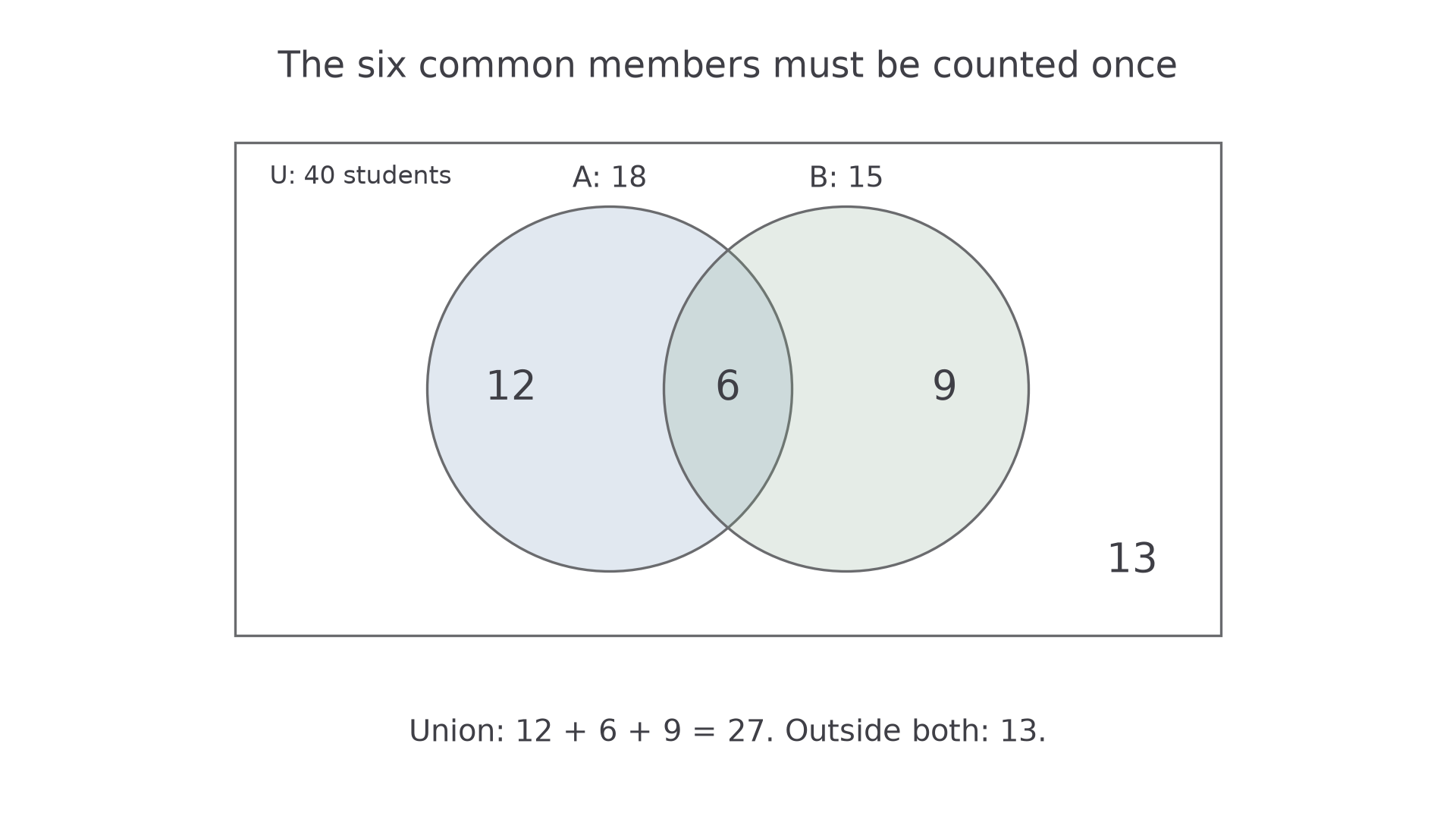
The reason is visible in a Venn diagram: an outcome in both sets is included in each separate total, so the overlap needs subtracting once. An outcome outside both is not in the union.
[DIAGRAM: asset_name: Counting a union without duplicating its overlap; asset_slug: 9fm0-fp285-set-union; caption: Add the two set totals and subtract the six outcomes counted twice; description: A rectangular universal set of 40 people contains overlapping circles A and B. The A-only region is labelled 12, the overlap 6, the B-only region 9, and the outside-both region 13. Set labels A and B are dark ink, with small notes n(A)=18 and n(B)=15. A bottom line states union 12+6+9=27 and neither 13. White background and generous margins.]
Use club memberships to make the difference concrete.
Worked example 3: mutually exclusive cases
Question. Of students, belong to club and to club . No student belongs to both. How many belong to at least one club?
Plan. The sets are disjoint, so add the two counts.
Why this step? “At least one” means the union. Disjointness guarantees nobody appears in both counts.
Answer. students.
Check. The remaining students belong to neither, so all are accounted for.
Keep both club totals and the class size fixed; change only the overlap, to six students in both clubs.
Worked example 4: overlapping cases
Question. Now . How many students belong to at least one club, and how many to neither?
Plan. Remove one copy of the overlap, then subtract the union from the universal total.
Why this step? Subtracting all six common members from each club would remove them completely. They must appear once in the union.
Answer. belong to at least one club, and to neither.
Check. The four Venn regions contain , whose sum is .
When using a direct digit count, a number such as may satisfy several position-based cases. Use disjoint cases or explicitly remove the overlap; “at least once” does not mean “exactly once”.
Watch out
Wrong: add counts of “first digit is ” and “second digit is ” as if they were disjoint. Right: account for numbers in both cases, or choose a complement that avoids the overlap entirely.
Change the overlap once more.
Continue this lesson.
You’re previewing NovaLearn without an account. Create a free account to read the rest.
Create free account