CP 6.2 - Equations of a plane
Two independent directions let you move anywhere on a flat surface. You will construct a plane through three points, convert between its vector and Cartesian descriptions, and recognise when the information describes only a line.
Two independent directions span a plane
Why do three points usually fix a flat sheet, while three points on one straight edge do not?
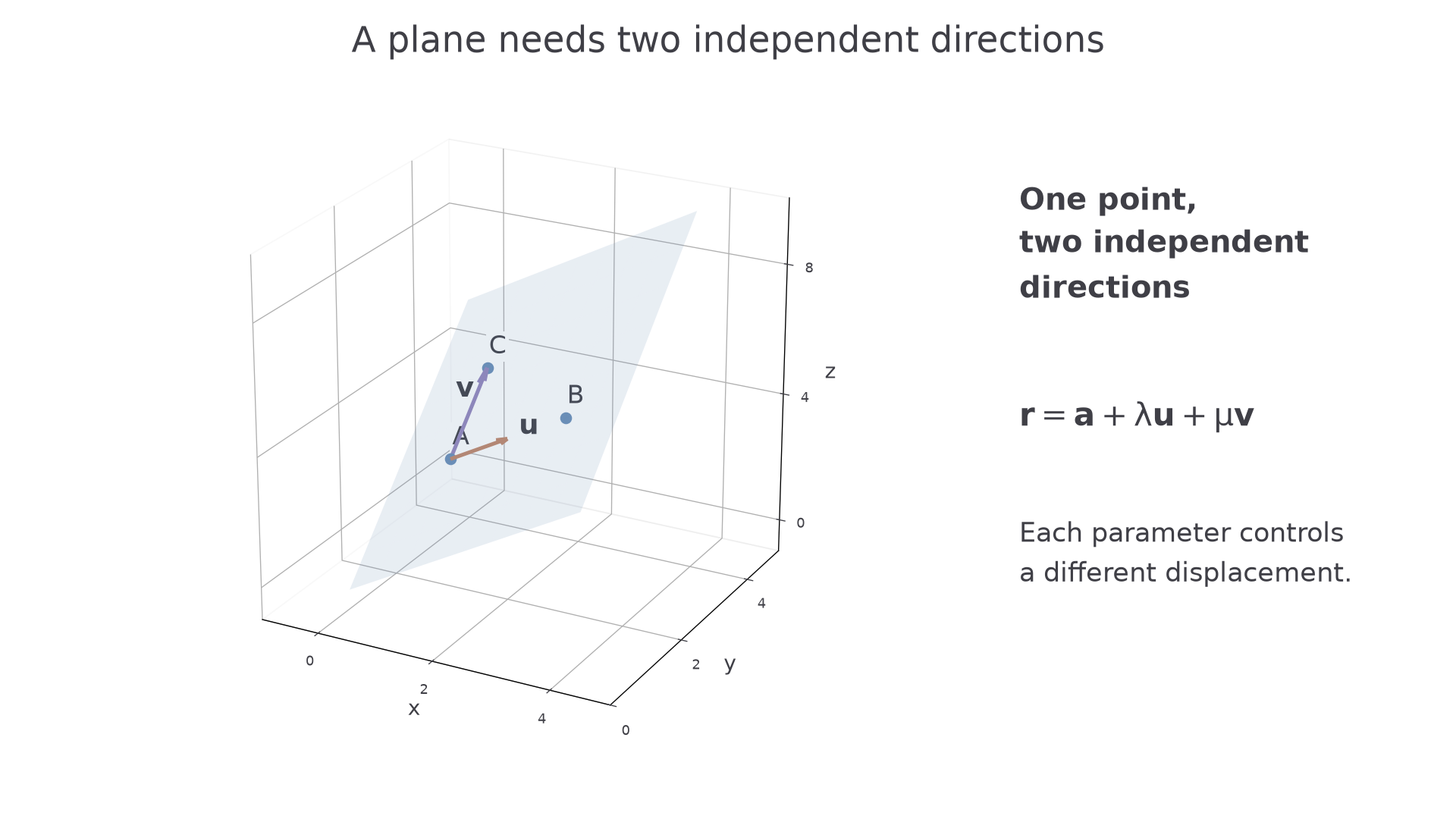
Start at . Moving by changes one horizontal coordinate and the height together; moving independently by supplies a second way across the surface. One parameter controls each movement.
You already know
A line uses one direction: . The displacement from to is . Proportional directions describe the same line direction.
The second direction must genuinely add a choice: a scalar multiple of the first cannot open out a plane.
Vector equation of a plane
Through point , parallel to two non-zero, non-parallel vectors :
Through three non-collinear points , choose , . Equivalently,
In the formula booklet.
The first form is often easier to read: a starting point plus two independent displacements.
[DIAGRAM: asset_name: Two independent directions span a plane; asset_slug: 9fm0-cp40-plane-directions; caption: Two parameters control independent displacements across the same plane; description: An exact spatial diagram shows the plane through A at (1,2,3), with directions u at (1,0,1) and v at (0,1,2). Point B is A plus twice u and point C is A plus v. Arrows from A show the two independent directions and a side panel gives r equals a plus lambda u plus mu v]
Worked example 1: a plane through three points
Question. Find a vector equation of the plane through , , .
Plan. Form two displacements from the same point and check that they are not proportional.
Why this step? The first displacement has a non-zero first component and zero second component; the second has the reverse pattern, so they cannot be parallel.
Answer. The displayed equation, for real , describes the required plane.
Check. give , respectively.
Worked example 2 changes only the height of . One of the two spanning directions changes, so the plane tilts.
Worked example 2: one moved point
Question. Keep , but let . Find a vector equation of the new plane.
Plan. Retain the first direction and recalculate the second.
Why this step? Keeping fixes their line, but changing the third point can turn the plane about that line.
Answer. .
Check. gives , while retains the original line .
This gives a small geometric surprise: two different planes can share infinitely many points, namely every point on their common line , while remaining different surfaces.
Watch out
Wrong: any three points determine one plane. Three collinear points determine a line, with infinitely many planes through it. Right: check that the two displacements are not proportional.
The next three points vary only the third height once again.
Eliminating the two parameters
A plane's Cartesian equation is one linear relation shared by all its points; eliminating both parameters reveals that relation.
The form is , where are not all zero. A zero coefficient just means that coordinate is absent from the constraint. For example, is a horizontal plane, not an incomplete equation. The Cartesian plane form is in the formula booklet.
Worked example 3: a Cartesian equation by substitution
Question. Find a Cartesian equation for .
Plan. Use to isolate the parameters, then substitute them into .
Why this step? Substitution leaves one relation with no parameter, so it applies to every point of the plane.
Answer. .
Check. The anchor gives ; substitution of the full parameter expressions also cancels both parameters.
Worked example 4 changes only the last component of the second direction, from to .
Worked example 4: the changed tilt
Question. Find a Cartesian equation for .
Plan. Keep the first two substitutions and update the height equation.
Why this step? The changed direction alters a coefficient and the constant; keeping the old right-hand side would lose the anchor point.
Answer. .
Check. gives .
You can reverse the process too. From , choose ; then , recovering the vector equation. There is no need for a new operation on vectors.
Watch out
Wrong: use different values of the same parameter in different coordinates. Right: substitute the same consistently. A candidate Cartesian equation must hold for the entire vector expression, not just one point.
The next plane changes the same coefficient once more.
What the plane equation includes
A valid plane equation describes all of a surface, even when some coordinates are fixed or some parameters look quite different.
For , any choice of gives exactly one . Thus it has two independent choices, like the two parameters. The point lies on it, while does not. Substitution is a test for membership, not a search for a special parameter.
Non-collinear spanning points
Three points are non-collinear when they do not lie on one straight line. Their two displacements from one chosen point are not scalar multiples. This is the condition needed for the three-point plane formula; repeated points or proportional directions cannot determine a unique plane.
Different equations can describe the same surface. Multiplying by gives , with exactly the same points. But changing only the right side to produces a different, parallel surface. These equivalence and membership checks follow from the linear equation and are not separate formula-booklet results.
The opening question now has a precise answer. Three non-collinear points supply two independent directions. Collinear points supply only one, leaving the sheet free to turn about their line.
Key idea
A plane needs one point and two independent directions, or one non-trivial linear Cartesian constraint. Its parametrisation and its coefficients need not be unique.
Check independence before trusting a three-point construction.
Quick Recap
- describes a plane when the two directions are non-parallel.
- Three non-collinear points provide two such displacements.
- Eliminate parameters to obtain , and reverse this by choosing two free coordinates.
- Test points by substitution; non-zero scalar multiples of a Cartesian equation describe the same plane.
Three points fix the sheet only when they are non-collinear; three points along one edge leave infinitely many possible planes.