FP2 6.1, 6.2 - Second-order recurrence relations
Solve second-order recurrence relations using auxiliary roots, complementary functions and particular solutions (FP2 6.1, 6.2). You will handle all three root types, repeated-root overlap and a population model with a one-year delay.
Two previous terms give two arbitrary constants
Can a sequence have a closed form full of square roots and trigonometric functions, yet every term be an integer? The auxiliary equation will explain how. First, two simpler roots show why a second-order rule needs two initial values.
You already know
A complementary function solves the homogeneous equation; adding a particular solution solves the full equation. Auxiliary roots also organised second-order differential equations, but recurrence solutions use powers , rather than . Initial values must use their stated indices.
A second-order linear recurrence has the form
and uses two preceding terms. For example, , with , gives . One starting value alone would leave , and hence later terms, undetermined.
For constant coefficients, try in the homogeneous equation. With a nonzero root,
so the bracket gives the auxiliary equation.
Distinct auxiliary roots
For
with constant real , , solve
Distinct roots give
Two initial values determine .
Not in the formula booklet: learn it.
If the coefficient of is not , divide through first or retain it in the auxiliary quadratic. These constant-coefficient forms do not automatically solve arbitrary changing coefficients.
Worked example 1: distinct real roots
Question. Solve , .
Plan. Factor the auxiliary quadratic, write both power terms and apply both initial conditions.
Why this step? The first equation alone fixes only a sum; the next initial term separates the two constants.
Answer. , for .
Check. It gives , and .
Change only , leaving the roots and unchanged.
Worked example 2: use both initial values again
Question. Solve the same recurrence with .
Plan. Use the same two-constant family and the changed second equation.
Why this step? Changing an initial value changes the member of the solution family, not the auxiliary equation.
Answer. .
Check. , and both supplied values agree.
A zero root needs care at the starting index. For , , simply use for , with separately. This avoids an ambiguous ; the first value no longer influences later terms.
Watch out
The line uses the differential-equation form. For recurrence roots , the correct line is .
Change only the second initial term once more.
A repeated root needs an extra factor of n
Two identical power terms would merge: . A repeated root must still provide two independent sequences.
For , substitute into . Cancelling gives
so consecutive differences of are constant. Thus .
Repeated auxiliary root
A repeated nonzero root gives
The factor keeps the second solution independent.
Not in the formula booklet: learn it.
A negative repeated root is allowed; retain with brackets. If the auxiliary equation is , the recurrence is : retain the two initial values separately, then all later terms vanish.
Worked example 3: two independent repeated-root terms
Question. Solve , .
Plan. Use the repeated-root form before applying the conditions.
Why this step? Repeating twice cannot fit two independently chosen initial values; supplies the missing freedom.
Answer. .
Check. , and .
Change only the second initial value.
Worked example 4: the same repeated root
Question. Solve the same recurrence with .
Plan. Keep the repeated-root form and replace the second condition.
Why this step? The value at eliminates the term, but the value at includes both terms and the multiplier .
Answer. .
Check. .
The same root can produce different growth rates within its family: the extra linear factor matters, even though the exponential base stays fixed.
Watch out
Writing omits the factor . The correct second condition is .
Change just the second initial value again.
Complex roots can describe an integer sequence
For conjugate roots, use their modulus and argument. The real part of a recurrence root is not the base of an exponential envelope.
Conjugate auxiliary roots
If the roots are , with , their real complementary function is
Here are real for a real-valued sequence. This follows by combining the conjugate powers using De Moivre's theorem, which is supplied; this recurrence solution form is not supplied.
Not in the formula booklet: learn it.
For roots , the modulus is and the angles are . Their powers combine into a real expression.
Worked example 5: real values from complex roots
Question. Solve , .
Plan. Write the roots in polar form, then use the two initial values in the real trigonometric form.
Why this step? At , , so the second condition is especially simple.
Answer. .
Check. It gives , agreeing with .
Change only , keeping the roots and unchanged.
Worked example 6: another real combination
Question. Solve the same recurrence with .
Plan. Keep the polar-root form and apply the new second initial value.
Why this step? The two conditions select a different sine coefficient, while the modulus and angular step stay fixed.
Answer. .
Check. , and .
The first sequence begins . Every term is an integer: its initial values and recurrence coefficients are integers. The square roots and trigonometric values in its closed form cancel exactly.
[DIAGRAM: asset_name: Integer terms from conjugate auxiliary roots; asset_slug: conjugate-root-integer-sequence; caption: A trigonometric closed form can produce integer terms at every integer index.; description: Discrete unjoined blue points for the first conjugate-root example from n0 to12 show the values1,0,minus2,minus4,minus4,0,8,16,16,0,minus32,minus64,minus64. Pale sage dashed upper and lower envelopes have heights plus and minus root2 to the power n+1. The expression and roots1 plus or minus i are labelled in ink; axes have integer indices.]
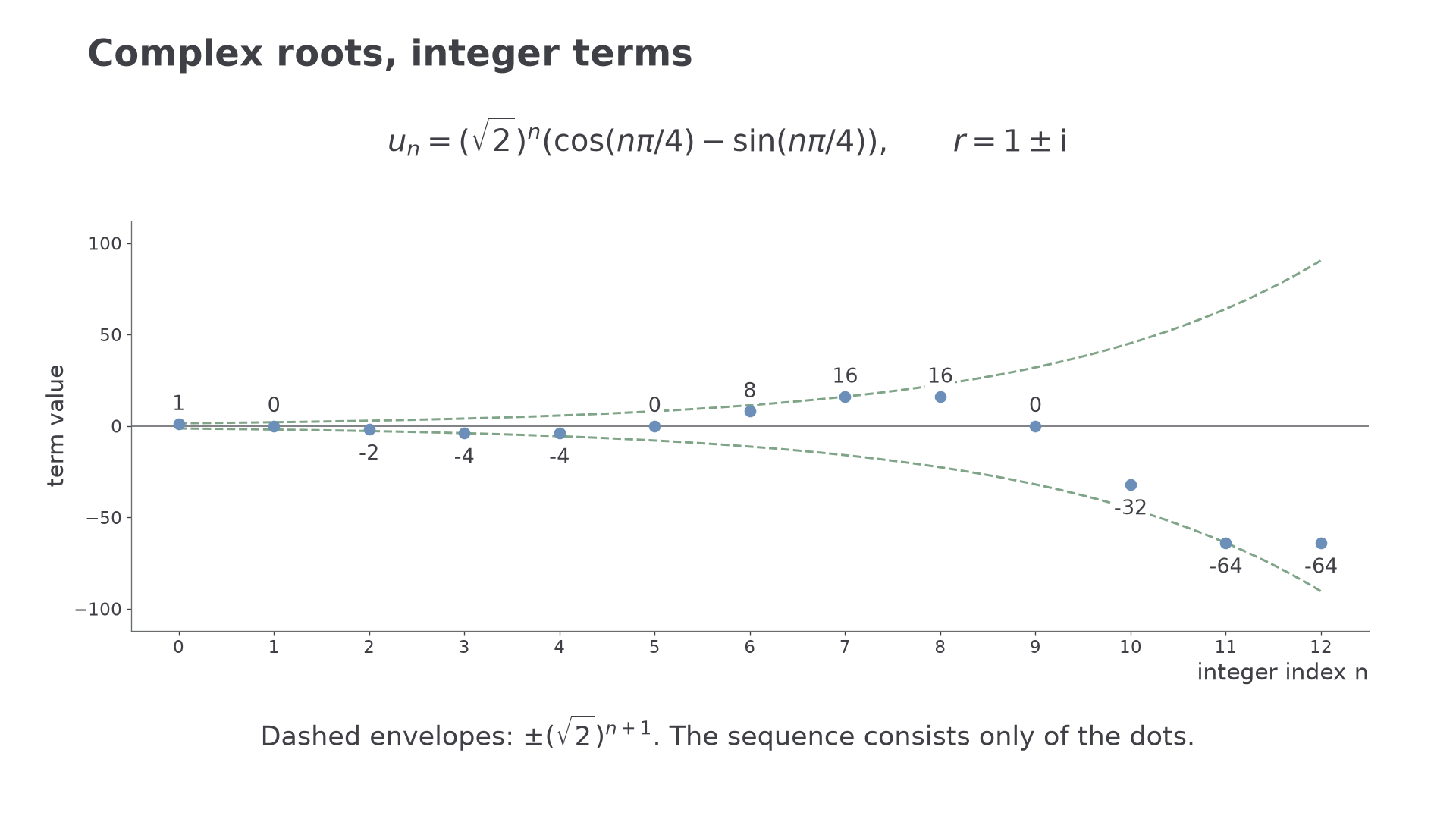
The envelope in the diagram has modulus base , rather than the root's real part .
Watch out
For roots , is the wrong solution type. Use the root modulus and argument in the recurrence form.
Change only the second initial term once more.
Continue this lesson.
You’re previewing NovaLearn without an account. Create a free account to read the rest.
Create free account