CP 2.9 - Exponential form of a complex number
An exponential can describe a turn as neatly as it describes growth. You will use the definition of to write complex numbers in exponential form, calculate with them, and recover sine and cosine from pairs of exponentials.
An exponential on the unit circle
Can an exponential equal , even though is positive for every real ?
The crucial word is “real”. An imaginary exponent has a different job. Start at on the unit circle and turn anticlockwise through radians. The point you reach has coordinates , so its complex number is . We give that number the shorter name .
You already know
A non-zero complex number can be written as , where . Multiplication multiplies moduli and adds arguments; division divides moduli and subtracts arguments.
A quarter-turn gives ; a half-turn gives . The exponential has moved round a circle, rather than along the positive real axis.
[DIAGRAM: asset_name: Imaginary exponentials on the unit circle; asset_slug: 9fm0-cp12-unit-exponentials; caption: The exponents give angles and the points stay one unit from the origin; description: A unit circle on equal-scale Argand axes has the points 1, i, minus 1 and minus i marked. The point exp(i pi over 3) at one half plus i root 3 over 2 and its conjugate exp(minus i pi over 3) are highlighted. A dashed vertical projection meets the real axis at one half. Anticlockwise and clockwise angle arcs are labelled pi over 3 and minus pi over 3. A side panel states modulus equals 1 and adding 2 pi to an angle returns to the same point]
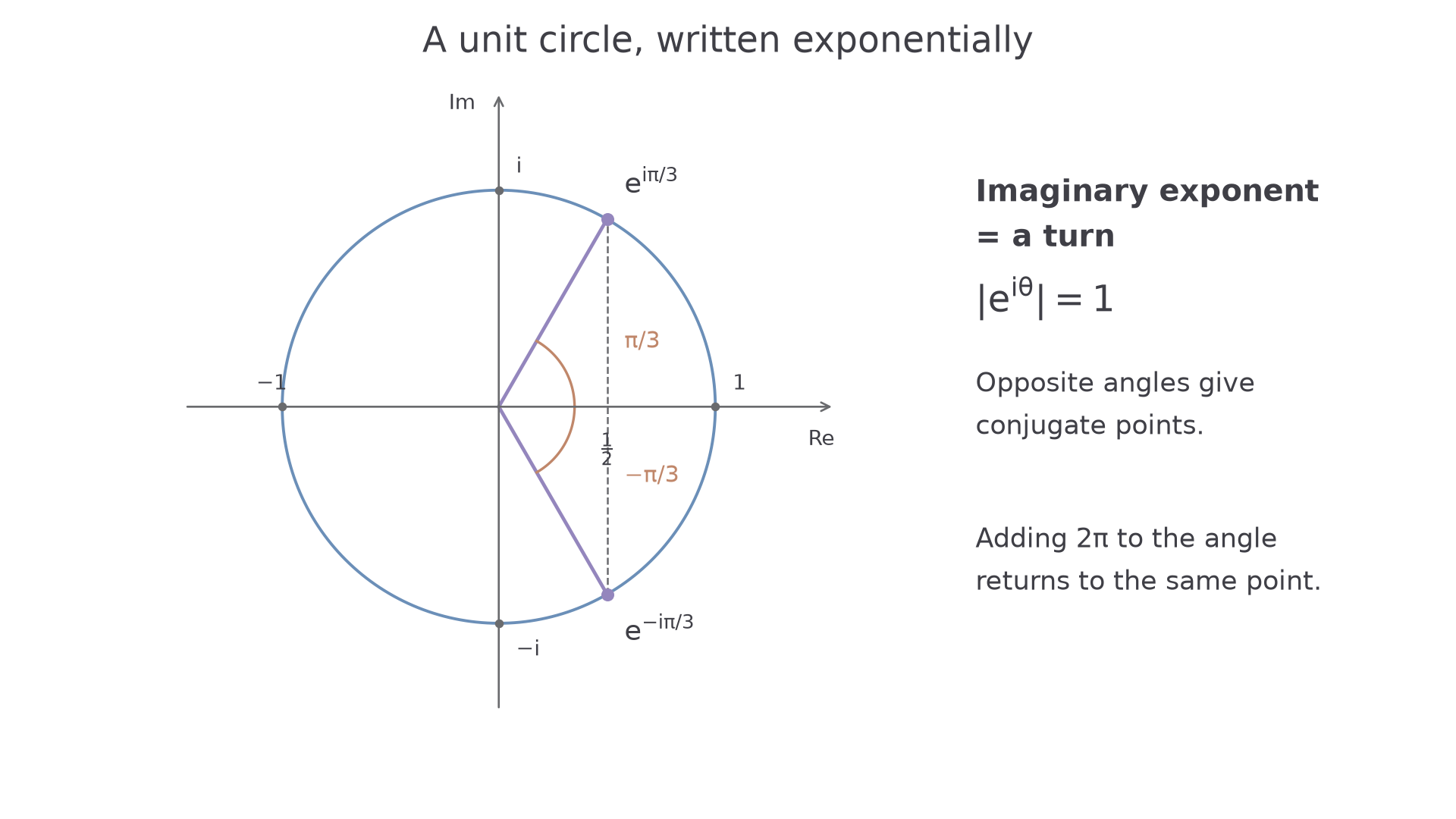
The definition uses radians. It agrees with the multiplication rule you already know, which is why exponential notation is so useful.
Imaginary exponential
For real ,
For example, . It does not mean .
The modulus is . Adding any whole number of full turns changes the angle label but leaves the number unchanged: for integer . In particular, , even though the exponent looks enormous: .
Key idea
In , the real number specifies a turn; the modulus is always .
Read the exponent as an angle before deciding where the point lies.
Converting between Cartesian and exponential form
The exponential form packages the same modulus and argument you have already been finding into a shorter expression.
For example, has modulus and argument , so it is . The coefficient supplies the distance from the origin; the exponent supplies the direction.
Exponential form
For , choose an argument and let . Then
The principal argument satisfies , unless a question requests another interval. Not in the formula booklet: learn it.
Zero has no argument and therefore no exponential form with . For any other number, locate the quadrant before using an inverse tangent.
Worked example 1: a point above the real axis
Question. Express in the form , where and .
Plan. Find the modulus, then use the second quadrant to select the argument.
Why this step? The inverse tangent of alone gives a fourth-quadrant angle, whereas the negative real part puts this point on the left.
Answer. .
Check. .
Worked example 2 changes only the sign of the imaginary part. The modulus stays fixed, but the principal argument changes sign.
Worked example 2: reflecting below the real axis
Question. Express in the form , where and .
Plan. Keep the modulus and reference angle, then measure clockwise to the third-quadrant point.
Why this step? reaches the right point, but it is outside the requested interval. Subtracting gives .
Answer. .
Check. and , giving the required Cartesian parts.
The positive modulus makes the two forms easy to compare: a sign change in a coordinate belongs in the angle, not in a negative value of .
Watch out
Wrong: . Matching the tangent is insufficient: gives two positive coordinates. Right: locate the point first, then write .
Change the distance while keeping the direction in your turn.
Products, quotients and powers in exponential form
Exponential notation makes the modulus-argument rules look like the index laws they describe.
For instance, : two successive turns combine into a quarter-turn. This follows from the established multiplication rule, so it does not require a new rule for complex multiplication.
Calculating with exponential form
For positive real , real , and integer :
The power rule is de Moivre's theorem written exponentially; its trigonometric form is in the formula booklet. The exponential calculation rules above are not printed there. Not in the formula booklet: learn it.
For a principal argument, reduce the final angle after calculating. Reducing it earlier is also valid, but usually creates extra work.
Worked example 3: a product with a large argument
Question. Given and , express in Cartesian form.
Plan. Multiply moduli, add arguments, then use exact trigonometric values.
Why this step? Reducing to identifies the principal argument without changing the number.
Answer. .
Check. Directly, and , so ; its modulus is .
Worked example 4 changes the operation from multiplication to division, using the same two numbers. Subtract the denominator's argument from the numerator's.
Worked example 4: a quotient in exact form
Question. For the same and , find in Cartesian form, showing your working.
Plan. Divide the moduli and subtract the arguments in the order of the quotient.
Why this step? Division reverses the turn contributed by ; adding the angles would calculate a product instead.
Answer. .
Check. Multiplying by gives , as required.
A power repeats a product: . The coefficient is cubed while the angle is tripled.
Watch out
Wrong: . The modulus is raised to the power too. Right: .
In an exact-form question, a decimal Cartesian approximation is not a substitute for the requested surds. Show the exponential calculation before evaluating the trigonometric functions.
Recovering cosine and sine from exponentials
Pairing opposite turns separates the real and imaginary parts of an exponential.
Replacing by in the definition gives
because cosine is even and sine is odd. Add the two definitions and the imaginary terms cancel; subtract them and the real terms cancel.
Cosine and sine as exponentials
For real :
Also . The reciprocal equals the conjugate here because the modulus is . Not in the formula booklet: learn it.
The same identities work for any real angle in place of . If , then for integer . This is the exponential version of the reciprocal pairing used in multiple-angle work.
Worked example 5: a sum of opposite turns
Question. Given , show that .
Plan. Write both powers as exponentials and apply the definition at angles and .
Why this step? The negative power is a reciprocal, hence an opposite angle. It is not a minus sign in front of .
Answer. , as required.
Check. At , and ; both sides equal .
Worked example 6 changes only the plus sign to a minus sign. Now the real parts cancel instead.
Worked example 6: a difference of opposite turns
Question. Given , show that .
Plan. Expand the same two exponentials, taking care to subtract the whole second bracket.
Why this step? Subtracting the negative imaginary part produces another positive ; the imaginary unit remains in the answer.
Answer. , as required.
Check. At , the left side is , matching .
These identities extract real-valued sine and cosine from complex expressions. They also settle the opening question: gives , or .
Watch out
Wrong: . The numerator is , so divide by . Without that imaginary unit, the expression is generally imaginary rather than real.
The next check changes the power from to . Use the same opposite-angle cancellation and show the missing factor explicitly.
Quick Recap
- describes a point on the unit circle.
- For , records its positive modulus and an argument; angles differing by give the same number.
- Multiply moduli and add arguments; divide moduli and subtract arguments; raise the modulus and multiply the argument for a power.
- Adding opposite exponentials gives ; subtracting them gives .
An exponential can equal : the imaginary exponent describes the half-turn from to .