FP1 1.2, 1.3 - Identities and equations with t-formulae
Use the t-formulae to prove trigonometric identities (FP1 1.2) and convert equations into algebra (FP1 1.3). You will preserve domain restrictions through cancellation, recover angles in their stated ranges and check the half-angle cases that no finite parameter represents.
Proving identities without changing their domain
How can correct algebra in produce only one angle when has two solutions on ? The algebra can describe every finite perfectly and still omit . Before solving, practise the related habit of keeping track of exclusions when simplifying identities.
A rational expression can look simpler after cancellation, while retaining the original expression's forbidden inputs. For example, requires , even though the final expression itself is defined at .
You already know
With , , and where each is defined. The substitution omits odd multiples of ; recover finite-parameter angles with .
Reciprocal functions follow by taking the appropriate reciprocals or ratios. Their denominator restrictions still come from the original trigonometric functions.
Reciprocal functions in terms of t
For finite ,
and
A quotient may impose further restrictions if its denominator must be non-zero.
Not in the formula booklet: learn it.
For a proof, start from one side, substitute, factorise and reach the other side. State that the identity holds where both sides are defined. A cancellation proves equality on that common domain; it does not give the original expression a value at a forbidden point.
Worked example 1: a reciprocal-function identity
Question. Using the t-formulae, prove that
where both sides are defined.
Plan. Express the two reciprocal functions in , combine the numerator and factorise before cancelling.
Why this step? The numerator is a perfect square, while the denominator is a difference of squares; the common factor is visible only after factorisation.
Answer. Replacing by gives the required right-hand side. The original left side requires and ; for finite , these exclude .
Check. At , the left side is . Substituting into gives the same value.
Change only the sign of the constant in the numerator. The other linear factor now cancels, reversing the final ratio.
Worked example 2: changing one numerator sign
Question. Using the t-formulae, prove that
where both sides are defined.
Plan. Use the same substitution, but factorise the numerator as .
Why this step? A changed sign in the numerator changes which factor remains; cancelling terms before factorising would not be valid.
Answer. Substitution back gives the printed identity, on its common domain. The original restrictions are again and .
Check. At , the left side is , the reciprocal of the previous example's value.
For instance, at the simplified answer in the first example is zero, but the original left side has and is undefined. Its missing input remains missing.
Watch out
Wrong: “The factor cancelled, so its zero is now allowed.” Right: cancellation preserves an identity only on the original domain. An undefined trigonometric quotient is not repaired by simplifying it.
Apply the same factorisation habit to a new quotient.
A linear sine-cosine equation becomes a quadratic
An equation becomes a quadratic in , so an unfamiliar combination can be solved without choosing a phase-shift angle first.
Substitute both t-formulae and multiply by , which is always positive for finite real :
Solving this polynomial finds every finite-parameter solution, after which you must recover angles and check omitted odd multiples of .
The algebraic equation in t
For finite ,
If , the quadratic term vanishes; do not divide by that coefficient. The original angles satisfy the trigonometric equation exactly when .
Not in the formula booklet: learn it.
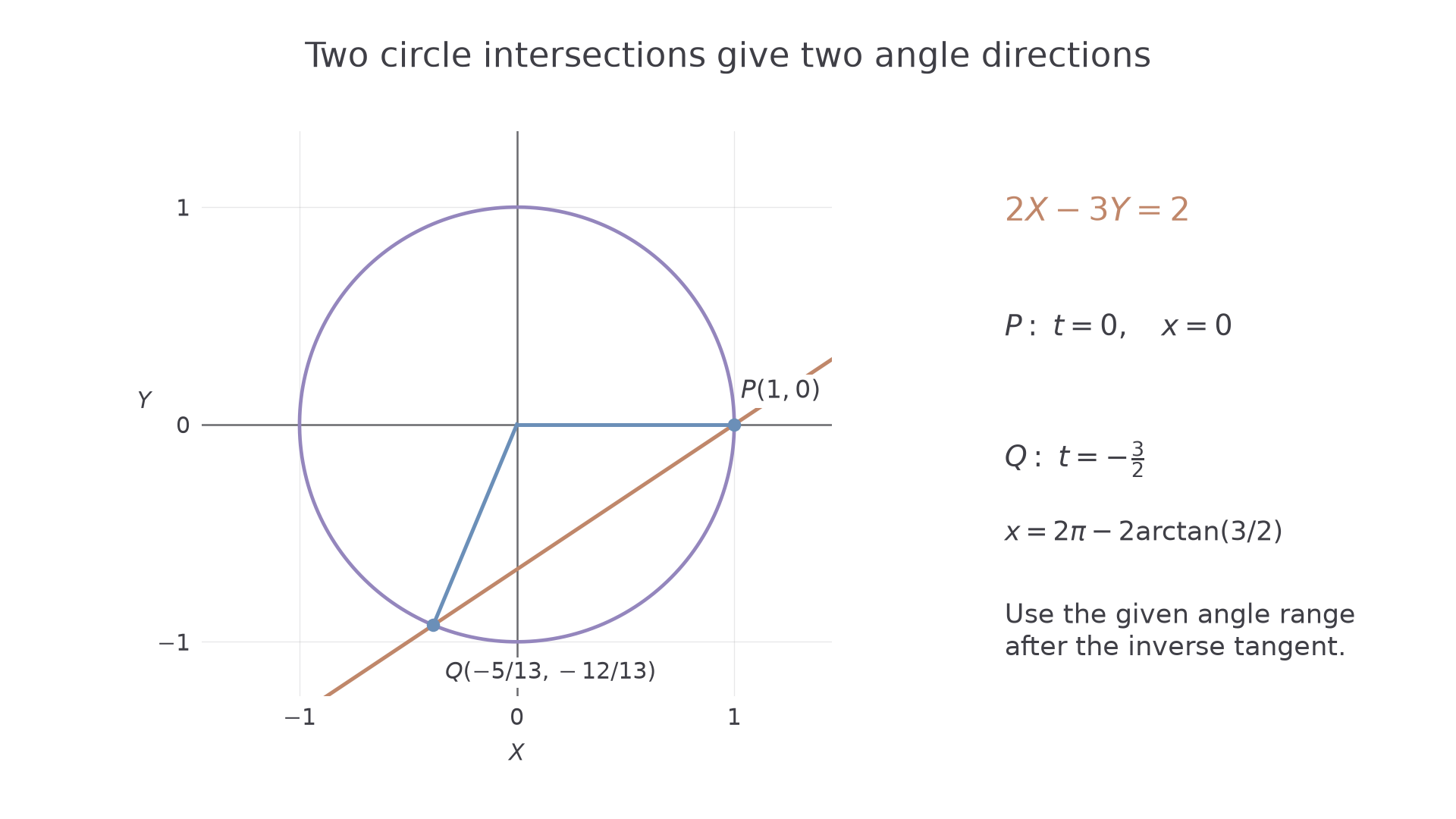
There is a geometric reason a quadratic appears. Set and . The equation is a straight line cutting the unit circle. Its discriminant is : for , a line misses the circle, touches it once or crosses it twice according as is greater than, equal to or less than . Count directions per turn, restoring the omitted point when needed.
[DIAGRAM: asset_name: A sine-cosine equation as a line meeting the unit circle; asset_slug: 9fm0-fp1-t-equation-circle; caption: The two circle intersections represent the two directions solving the equation; description: Equal-scale X and Y axes show the unit circle and the line 2X minus 3Y equals 2. Its two intersections are marked at (1,0) and (minus 5 over 13,minus 12 over 13). Blue radii connect the origin to both points. A side note identifies t equals zero and t equals minus three halves, with the negative parameter's angle recovered by adding a full turn.]
Continue this lesson.
You’re previewing NovaLearn without an account. Create a free account to read the rest.
Create free account