CP 2.11 - Roots of unity in geometric problems
Roots of unity give you a ready-made regular polygon, which you can turn, enlarge and move using complex arithmetic. You will use this structure to find lengths and areas, describe transformed polygons, and recover missing vertices from geometric information.
Roots of unity as a geometric template
A regular hexagon has opposite vertices and . Can you find the other four vertices without measuring six angles?
Begin with a simpler hexagon. The sixth roots of have modulus and arguments . They form a regular hexagon centred at , with as one vertex. The harder hexagon is a moved and enlarged version of this template.
You already know
The roots of , for , have equal moduli and argument step . Multiplying by enlarges distances by and rotates directions through ; adding moves every point by the same displacement.
“Unity” simply means . Choose the first anticlockwise root after , and call it . Repeated multiplication by walks once round the vertices.
Roots of unity
The roots of unity for the power are the solutions of . Writing , they are
For example, the fourth roots of unity are . The next power repeats the starting point.
The formula booklet supplies the general list, so your task is to recognise which geometry it describes.
Roots of unity
For a positive integer ,
For , the points are the vertices of a regular -gon on the unit circle. In the formula booklet.
There is a neat consequence: for every , the roots of unity add to zero. To see it, let . Multiplying by just moves every term one place round the circle:
As , forces . Geometrically, the position vectors balance exactly about the centre. This sum is not in the formula booklet; derive it using the rotation when needed.
Key idea
Roots of unity supply equally spaced directions; multiplication and addition turn that one template into any regular polygon with the same number of vertices.
The closing gap matters just as much as all the other gaps when deciding whether a set is the complete polygon.
Lengths and areas from the central angles
The difference between two complex numbers represents the displacement joining their points, so its modulus gives the distance between them.
For vertices on a circle of radius , separated by a smaller central angle , the two radii form an isosceles triangle. Bisecting it gives a right-angled triangle with hypotenuse , angle and opposite side half the chord. The triangle's area follows from the two radii and their included angle.
[DIAGRAM: asset_name: A pentagon chord and a diagonal; asset_slug: 9fm0-cp14-pentagon-chords; caption: A side spans one root step and a diagonal spans two; description: Two equal-scale Argand diagrams show the same regular pentagon centred at the origin with radius 3 and a vertex at 3. The left highlights the chord from vertex 0 to vertex 1, two radii and central angle 2 pi over 5. The right highlights the chord from vertex 0 to vertex 2, two radii and central angle 4 pi over 5. Vertices are labelled 0 to 4, highlighted chord lengths are labelled 6 sin pi over 5 and 6 sin 2 pi over 5, and each shaded triangle has its area labelled]
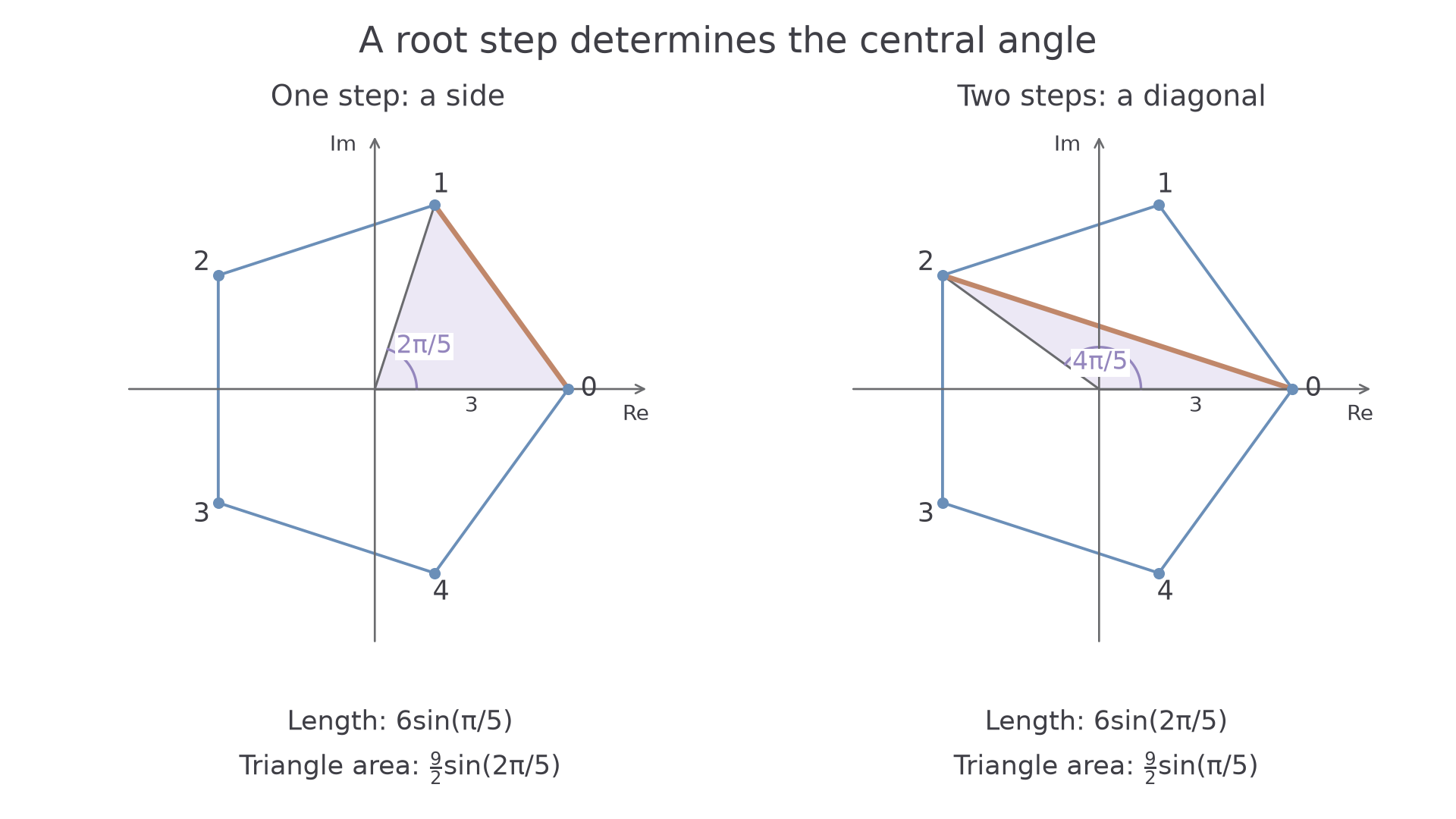
This picture works after a rotation or translation too: neither changes the angle between the radii or the distances involved.
Chord lengths and triangular areas
For two vertices on a circle of radius , with smaller central angle :
For a regular -gon, , use for neighbours. Its total area is , by adding the central triangles. These specialised results are not printed in the booklet; its triangle-area formula gives the second result. Not in the formula booklet: learn it.
Use the smaller central angle for a triangle area: taking a reflex angle would give a negative sine, whereas an ordinary area is non-negative.
Worked example 1: a side of a root pentagon
Question. The five points , for , have centre . Find the exact length and the area of triangle .
Plan. Read the radius and the one-step central angle, then use the isosceles triangle.
Why this step? The chord formula uses half the central angle; the area formula uses the full included angle.
Answer. The side length is and the triangle area is . These are exact values.
Check. The length is approximately , less than the diameter , and the area is approximately , less than .
Worked example 2 changes only the second vertex, from to . The diagonal spans two root steps rather than one.
Worked example 2: a diagonal of the same pentagon
Question. For the same five points, find and the area of triangle , giving exact answers.
Plan. Keep , double the central angle and use the same two formulae.
Why this step? The angle is already the smaller angle between these radii, so no reflex-angle correction is needed.
Answer. The diagonal length is and the triangle area is .
Check. The diagonal is approximately , longer than the side but shorter than . Its triangle area is approximately : a longer chord need not give a larger central triangle.
The whole pentagon consists of five one-step triangles, so its area is . Do not use the two-step triangles for this sum: those triangles overlap.
Watch out
Wrong: the side length is . This uses the whole central angle. Right: a neighbouring chord is ; splitting the isosceles triangle halves the angle.
Change only the radius from to in the next pentagon. Lengths scale by , while areas scale by .
Turning, enlarging and moving the polygon
A complex expression can transform all the vertices at once, provided the rotation and enlargement happen relative to the correct centre.
Start with unit roots . Multiplying by changes the radius to and turns the first vertex towards . Adding then moves the centre from to . This order gives .
A regular polygon with centre c
For integer , let , let , and let be complex. Then
are the vertices of a regular -gon with centre and radius . Equivalently, the vertices solve
Not in the formula booklet: learn it.
The inverse expression moves the centre back to zero and undoes the enlargement and rotation. The resulting numbers are roots of unity, which is the bridge between an equation and its geometry.
Worked example 3: a turned square at the origin
Question. The vertices of a square satisfy . Find all four vertices in Cartesian form, and state the centre and radius.
Plan. Set the fraction equal to each fourth root of unity, then multiply by .
Why this step? Solving for the normalised quantity first turns a compound equation into four simple multiplications.
Answer. The vertices are , , and . The centre is and the radius is .
Check. The four coordinate pairs form an axis-parallel square of side , and every vertex is distance from the centre.
Worked example 4 changes only the centre, from to . The four displacements from the centre remain exactly those found above.
Worked example 4: the same square at a new centre
Question. Determine the roots of in Cartesian form. State their geometric arrangement.
Plan. Use the same four roots of unity and add the new centre after multiplying.
Why this step? Add the centre after rotating the displacements. Multiplying itself by would rotate about the origin and move the centre too.
Answer. The roots are , , and , forming a square of radius , centred at .
Check. The midpoint of opposite vertices is ; adjacent vertices are still units apart.
The roots-of-unity sum gives a useful second check: . Thus the mean of the vertex coordinates is the centre. This follows from the earlier sum, and is not a separate formula supplied in the booklet.
Watch out
Wrong: the next vertex after is always . That turns the centre as well. For centre , the correct next vertex is : subtract, turn, then add back.
The next square changes only the centre again, so you can keep the four displacement calculations.
Recovering missing vertices from a diameter
For a regular polygon with an even number of sides, opposite vertices give you both the centre and one displacement from it.
If those vertices are and , the centre is their midpoint . Set . Then , , and all the vertices are . These midpoint and displacement relations are not in the formula booklet; use ordinary coordinate reasoning to obtain them.
Worked example 5: a horizontal diameter
Question. The points and are opposite vertices of a regular hexagon. Determine its other four vertices in Cartesian form.
Plan. Find the midpoint and first radius displacement, then multiply that displacement by the four non-real sixth roots of unity.
The given points use and . For the others,
Why this step? Once one vertex is known relative to the centre, the sixth roots of unity supply all the remaining directions; no independent angles have to be found.
Answer. The other four vertices are , , and .
Check. Each has distance from . The opposite pairs and both have midpoint .
Worked example 6 changes the diameter displacement from to , while keeping the centre fixed. Now the complex multiplication must carry the turn as well as the scale.
Worked example 6: a sloping diameter
Question. The points and are opposite vertices of a regular hexagon. Determine the other four vertices in exact Cartesian form.
Plan. Find and from the diameter, then expand for .
For the first missing vertex,
Using the other three unit roots gives
Why this step? The complex factor already fixes the hexagon's orientation. Multiplying it by unit roots advances in equal turns about , even when the diameter slopes.
Answer. The other vertices are , , and .
Check. Each displacement has modulus . Also and , so both pairs have the required midpoint.
The diagram keeps the centre visible so that you can check both the translation and the angular order of the roots.
[DIAGRAM: asset_name: A hexagon recovered from a sloping diameter; asset_slug: 9fm0-cp14-sloping-hexagon; caption: Rotate the radius displacement about c, then add c back; description: An equal-scale Argand diagram shows a regular hexagon centred at c equals 1 plus i, with radius 2 root 2. Opposite given vertices are z0 equals 3 minus i and z3 equals minus 1 plus 3i. The other vertices z1, z2, z4 and z5 are labelled, with a side panel giving the rule zk equals 1 plus i plus (2 minus 2i) exp(k pi i over 3). A dashed diameter joins the given points, the first radius displacement is labelled 2 minus 2i, and a central angle from z0 towards z1 is labelled pi over 3]
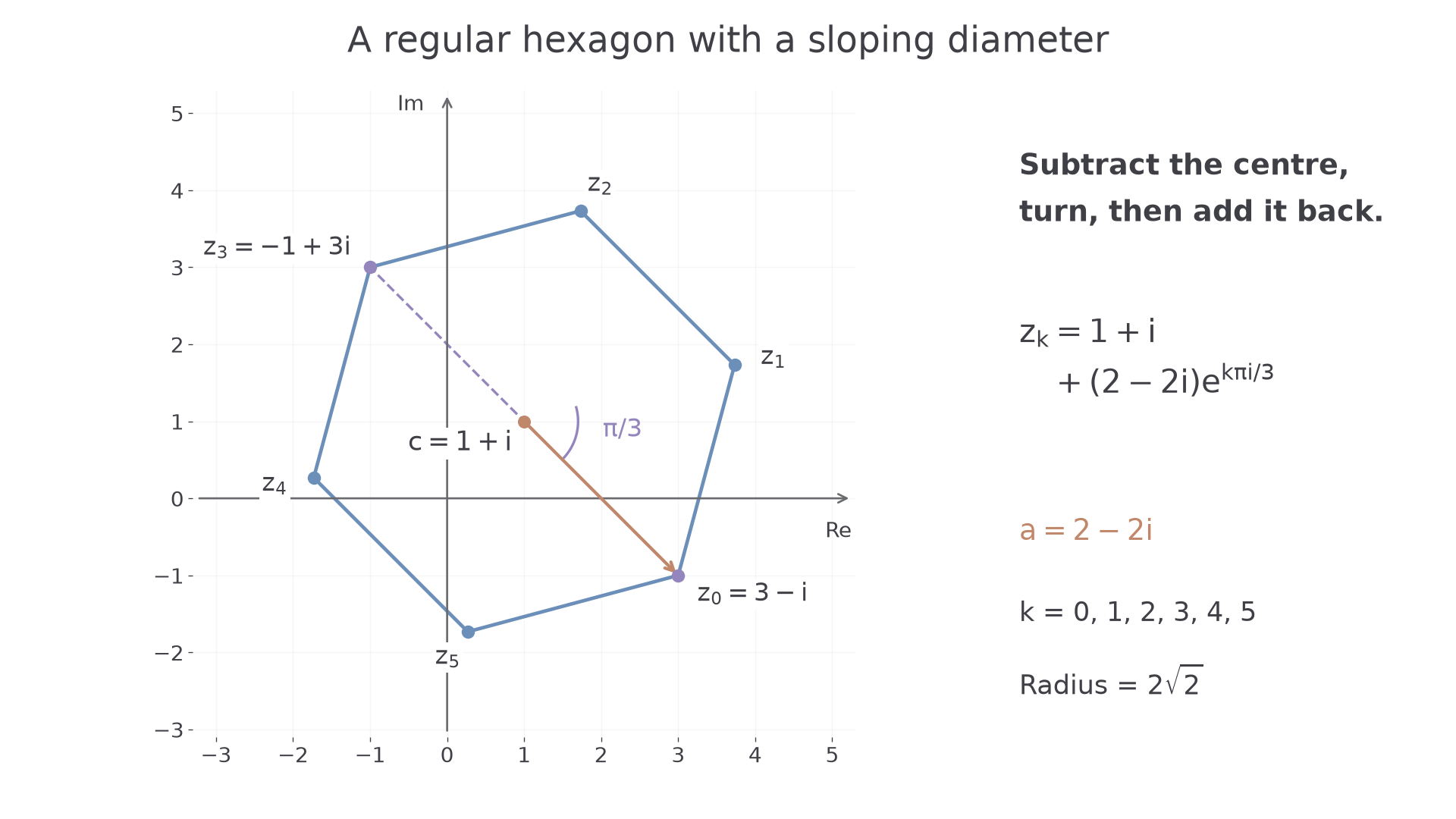
If a problem instead supplies , with , set that entire expression equal to a root of unity, then rearrange . This is the same normalisation as before, with .
Watch out
Wrong: the centre is any point equidistant from the two given opposite vertices. Infinitely many points meet that condition. Right: opposite vertices are ends of a diameter, so the centre is their midpoint.
The opening hexagon is now complete. A shift of its centre changes every vertex by the same amount, which gives you a short final check.
Quick Recap
- The solutions of are , where and .
- A chord with smaller central angle has length ; its central triangle has area .
- The vertices form a regular polygon with centre and radius .
- Opposite vertices reveal the centre through their midpoint; rotate the displacement from that centre to find the others.
For the opening hexagon, and ; multiplying by the sixth roots of unity produces all four missing vertices without measuring a single angle.