CP 8.1 - The functions sinh, cosh and tanh
Build three new functions from exponentials, understand their domains, ranges and graphs, and use their identities to solve exact equations (CP 8.1). Their names resemble trigonometric functions, but their behaviour comes from exponentials rather than repeated motion round a circle.
Three functions made from exponentials
Can an equation such as have three real solutions even though the exponential function is one-to-one? It can: the new functions combine exponentials in different ways. You will find all three solutions at the end.
Take . Then and . Their half-sum is ; their half-difference is . These two combinations are the starting point.
You already know
From A-level Mathematics, for every real , , and reverses the exponential function. In particular, requires .
The names hyperbolic sine, hyperbolic cosine and hyperbolic tangent are abbreviated as follows. Read as one function, not as a product of letters.
Hyperbolic functions
For real ,
For example, , and . These are exponential definitions; does not mean with a new spelling.
Not in the formula booklet: learn it.
The denominator of is never zero: is the half-sum of two positive numbers. Thus all three functions are defined for every real input.
Worked example 1: exact values at a logarithm
Question. Find the exact values of , and .
Plan. Evaluate the exponential and its reciprocal, then use the half-difference, half-sum and quotient.
Why this step? Evaluating the exponentials first keeps every quantity exact and makes the reciprocal easy to see.
Answer. , and .
Check. ; you will soon see why this relationship always holds.
Change only the sign of the input. The two exponentials exchange places, so their difference reverses sign but their sum does not.
Worked example 2: changing the input's sign
Question. Find , and exactly.
Plan. Exchange the exponential values and use the same definitions.
Why this step? The sign of the input swaps the terms in the numerator of ; it does not put a minus sign in front of their sum.
Answer. The values are , and , respectively.
Check. The definitions give , , and consequently .
These symmetries will give two of the graphs rotational symmetry about the origin and the other reflection symmetry in the vertical axis.
Watch out
Wrong: . That is . The minus sign distinguishes the functions and controls the signs in their identities.
Use a different logarithmic input without rounding.
Graphs, domains and ranges
The exponential definitions determine the shapes of the graphs, including their symmetry, turning points and asymptotes.
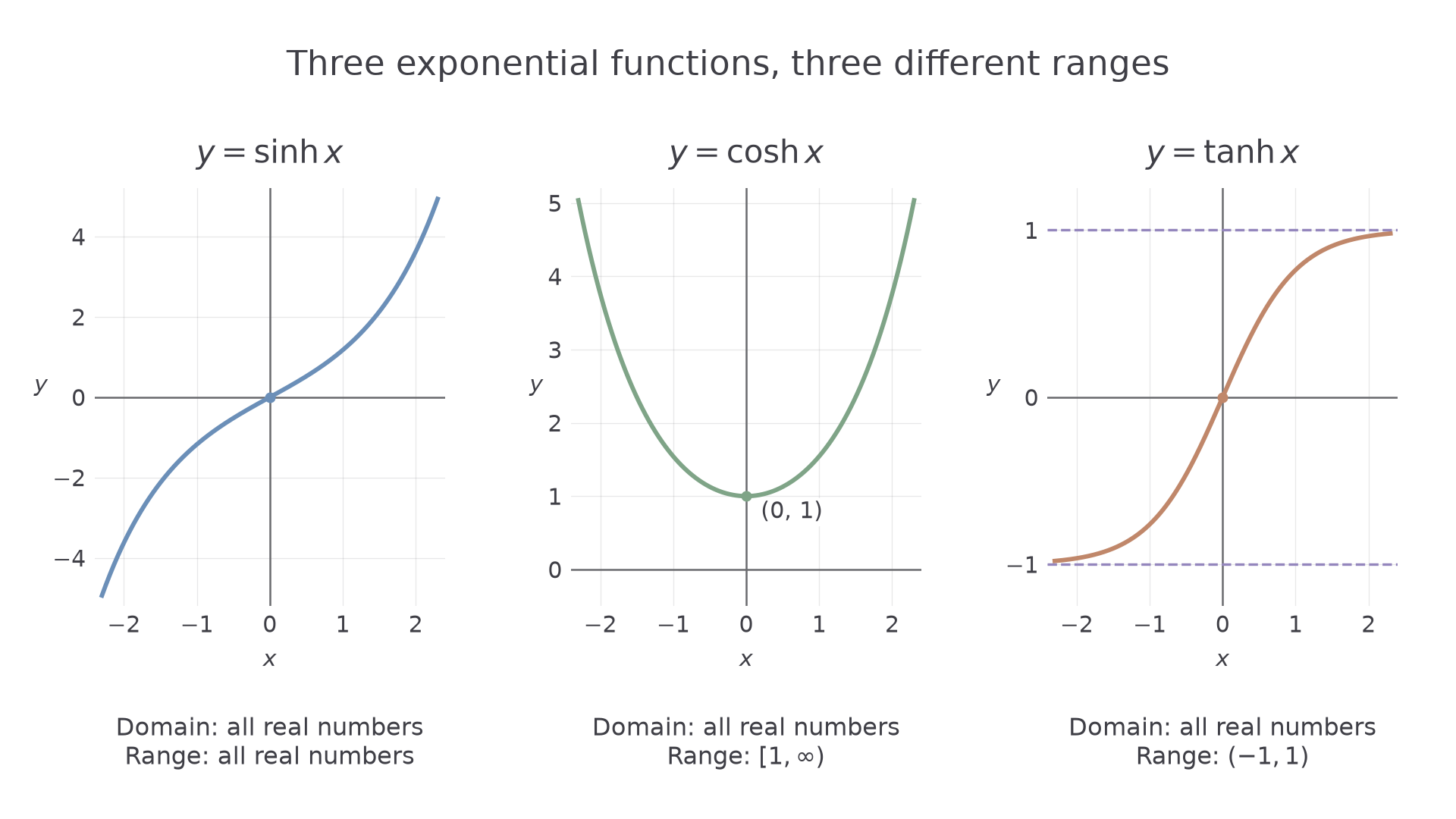
For , increasing increases and decreases . Subtracting the latter makes both changes increase the result. Thus is strictly increasing, passes through the origin, and takes every real value: it grows without bound to the right and becomes arbitrarily negative to the left.
For , the symmetry is even. Its smallest value is , because
Equality holds only at . The function decreases towards on the left and increases away from it on the right. It never crosses either axis except for its vertical intercept .
For , divide the defining numerator and denominator by :
As increases, the last fraction decreases, so increases. It approaches as tends to infinity and as tends to negative infinity, but reaches neither at a finite input.
[DIAGRAM: asset_name: The three hyperbolic graphs; asset_slug: 9fm0-hyperbolic-graphs; caption: All three domains are real, but their ranges and symmetries differ; description: Three separate labelled Cartesian panels show sinh x increasing through the origin with odd symmetry, cosh x with even symmetry and minimum (0,1), and tanh x increasing through the origin between dashed horizontal asymptotes y equals minus 1 and y equals 1. Equal positive and negative horizontal extents are used, and each panel states its range.]
Domains and ranges of the hyperbolic functions
Each function has domain . Their ranges are
For example, has one real solution, while has none. The equation has no real solution; an asymptote is not an attained value.
None of these graphs is periodic. Despite the familiar-looking names, copying the oscillating shapes of sine and cosine would give the wrong functions entirely. Their definitions and graph features are not supplied in the formula booklet; learn them.
Key idea
and are one-to-one on the real line; takes the same value at opposite inputs and has minimum value .
Use those ranges and symmetries to count solutions before calculating any.
Identities from the definitions
Hyperbolic identities can be proved by substituting the exponential definitions and collecting terms; their signs are part of the mathematics, not a detail to borrow from trigonometry.
For the fundamental identity,
The cross-terms survive with a plus sign after the subtraction. It follows that , since never vanishes. The reciprocal is written , so this is also .
Continue this lesson.
You’re previewing NovaLearn without an account. Create a free account to read the rest.
Create free account