CP 2.7 - Regions in the Argand diagram
Interpret complex inequalities as regions of an Argand diagram: inside or outside circles, nearer to one point than another, and between two argument rays. You will combine conditions using intersections and decide exactly which boundaries belong to the region (CP 2.7).
Inside and outside a circle
What region is described by all three conditions , and ? Each condition is short; together they cut out a precise piece of a circle. By the end you will know which piece and whether each edge belongs to it.
Start with a single distance condition. The circle is the boundary between points less than three units from and points more than three units away. Replacing equality by an inequality chooses a side of that boundary.
You already know
The locus is a circle, is a perpendicular bisector for , and is a ray excluding . A point satisfies two conditions together only if it belongs to both sets.
Use the direction of the inequality to decide between the interior and exterior. Use whether equality is allowed to decide about the circle itself.
Distance inequalities
For fixed and ,
The boundary is the circle with centre and radius . An included boundary may be drawn solid; an excluded boundary may be drawn dashed, with the inclusion stated clearly.
Not in the formula booklet: learn it.
A centre is always inside its own positive-radius circle because its distance from itself is zero. It makes a useful test point when you are unsure which way to shade. If the radius is zero, check the inequality directly: for example, gives only , while gives no points.
[DIAGRAM: asset_name: Interior and exterior distance regions; asset_slug: 9fm0-regions-circle; caption: The inequality selects the side of the circle and whether its boundary belongs; description: Two equal-scale Argand diagrams have centre (1,2) and radius 3. The left shades the closed disc for modulus of z minus (1 plus 2i) at most 3, with a solid circle. The right shades the exterior for modulus greater than 3, leaving the disc white and using a dashed circle. Each centre and radius is labelled.]
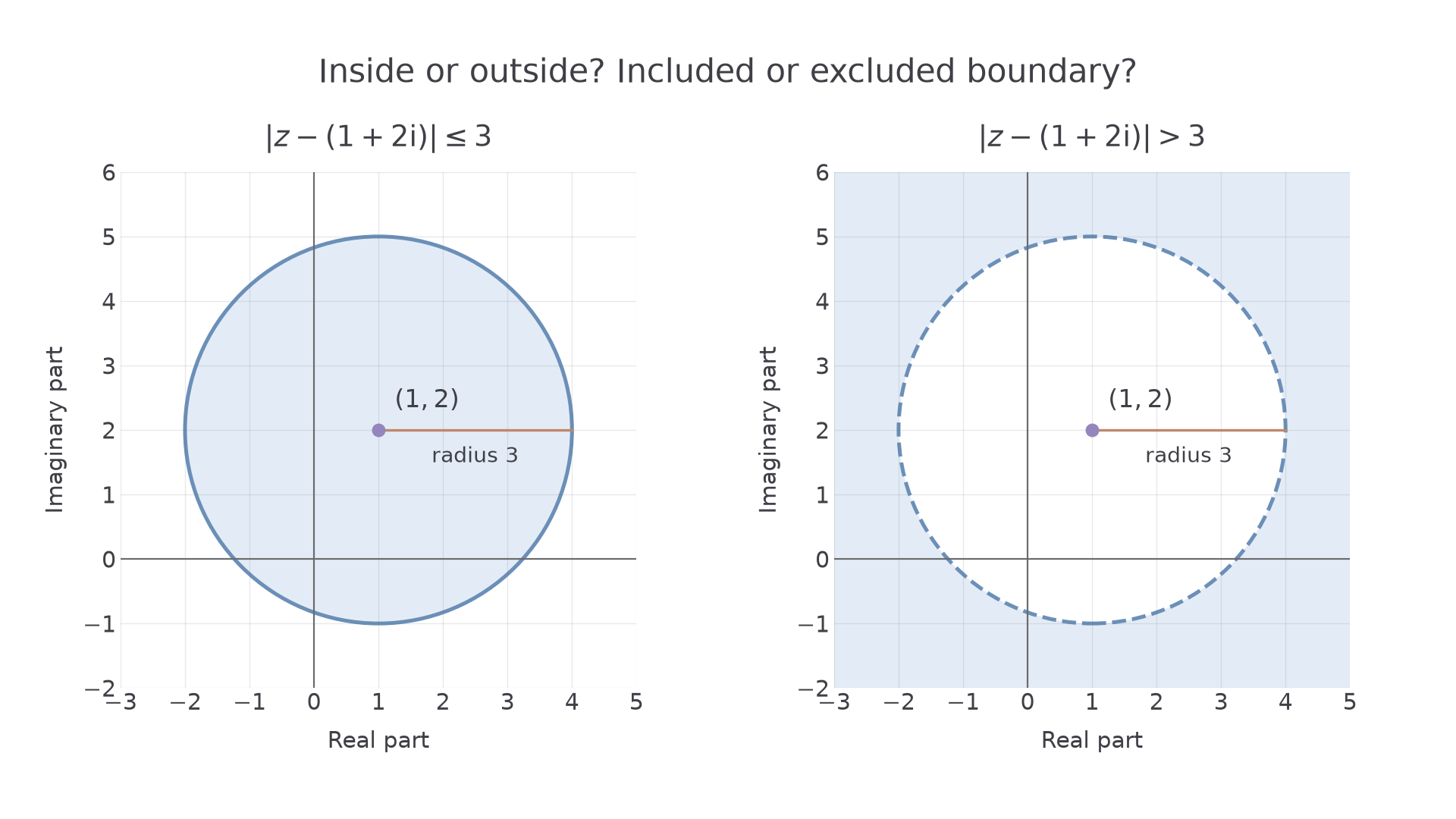
Worked example 1: a closed disc
Question. Describe the region and express it as a Cartesian inequality.
Plan. Identify the boundary circle, then keep its interior and the boundary because the inequality allows equality.
Why this step? Squaring preserves the inequality because a modulus and the radius are both non-negative.
Answer. The closed disc with centre and radius , including its circumference, given by .
Check. The centre gives ; the point gives . Both are included.
Change only the comparison from “at most” to “greater than”. The same circle is now an excluded boundary around an exterior region.
Worked example 2: an open exterior
Question. Describe in geometric and Cartesian terms.
Plan. Use the same centre and radius, then select distances strictly greater than the radius.
Why this step? A strict inequality leaves the equal-distance circle out; it does not change the centre or radius.
Answer. The exterior of the circle with centre and radius , excluding the circumference. Its inequality is .
Check. has distance , so it is included. The centre and are excluded.
A shaded drawing is useful only when you know whether it includes its edge.
Watch out
Wrong: shading only the circumference for . Equality gives the circumference; “less than” adds every interior point. The complete region is a filled disc, with its boundary included.
Change the centre and decide about the strict boundary in this check.
Closer to one fixed point
An inequality comparing two moduli selects one half-plane on a side of the perpendicular bisector of the two fixed points.
For , keep points at least as close to as to . The point itself certainly qualifies when : its two distances are zero and . Thus the correct side contains . This single test point is often quicker than expanding everything, although the expansion gives an exact Cartesian inequality.
A half-plane from two distances
For distinct , the region
is the half-plane on the side of the perpendicular bisector of , including the bisector. A strict inequality excludes the bisector. Reversing the inequality selects the other side.
Not in the formula booklet: learn it.
Both sides are non-negative, so squaring preserves the comparison. As with the equality locus, the terms cancel. A region defined by distances can therefore have a perfectly straight edge.
[DIAGRAM: asset_name: The half-plane nearer to A; asset_slug: 9fm0-regions-halfplane; caption: Shade the side containing A when the distance to A is at most the distance to B; description: Equal-scale Argand axes show A at (1,1), B at (5,3) and the solid perpendicular bisector 2x plus y equals 8. The side 2x plus y at most 8 is shaded pale sage and contains A. The other side, containing B, is white. The midpoint (3,2) is marked.]
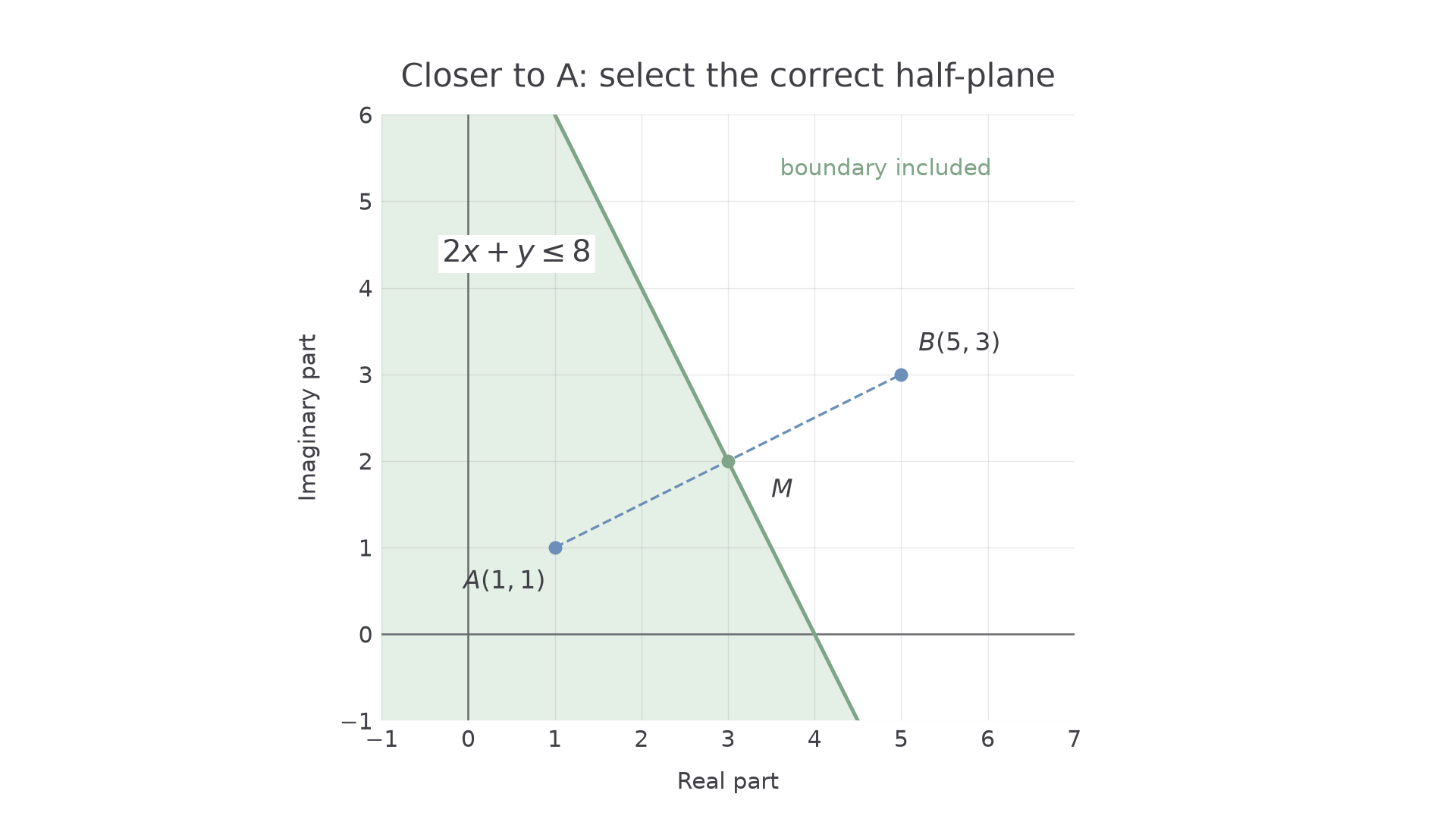
Worked example 3: selecting the nearer side
Question. Find a Cartesian inequality for , and describe the region.
Plan. Square both distances, simplify to a linear inequality, and use the first fixed point to check its side.
Why this step? Dividing by a positive number keeps the inequality direction. The cancellation itself does not reverse it either.
Answer. The closed half-plane , on the side of the perpendicular bisector, including that line.
Check. At , . At , , so is excluded.
Now change only the direction of the comparison. The two sides exchange roles; the equal-distance boundary still belongs.
Worked example 4: reversing the comparison
Question. Describe and give its Cartesian inequality.
Plan. Reverse the previous distance comparison and check the side containing the second fixed point.
Why this step? Being farther from than from means being nearer to , so the selected side must contain .
Answer. The closed half-plane , containing and its perpendicular-bisector boundary.
Check. At , the right-hand distance is zero and the left-hand distance is , so the inequality is true.
The order of the distances tells you which fixed point to test; it does not tell you to shade “left” or “right” without a diagram.
Watch out
Wrong: shading the line joining the fixed points or a strip between them. The boundary is their perpendicular bisector, and the region fills one whole side. State or shade that side; a bisector alone is incomplete.
This horizontal pair makes the exact boundary especially easy to find.
Between two argument rays
An interval of arguments selects all the directions between two rays from the same fixed point, with no restriction on their positive lengths.
For , start both rays at : one horizontal to the right, the other at angle . Keep points whose direction lies between them, rather than the whole half-plane above the horizontal line. The angle is measured at , not at the origin.
An argument region
For fixed and ,
selects directions strictly between and in the principal range. The two boundary rays are excluded. Replacing an endpoint comparison by includes that ray, but is always excluded because its argument is undefined.
Not in the formula booklet: learn it.
The boundary-ray rule above assumes . If the lower bound is exactly , changing to adds no points: is never a principal argument. The negative real ray from has principal direction , so it belongs only when the upper bound allows .
The interval must be read in increasing principal-angle order. A surprising example is : its width is , so it covers three quarters of a turn. It is the large region through the positive real direction, not the small wedge at the left. At the principal endpoint, , so includes the negative real ray and none of the lower-left directions.
[DIAGRAM: asset_name: An argument interval measured from a translated point; asset_slug: 9fm0-regions-sector; caption: Argument inequalities select directions from the translated starting point, which remains excluded; description: Equal-scale Argand axes show an open vertex A at (1,1), with dashed rays at angles minus pi over 3 and pi over 3 to the positive real direction. The infinite wedge between them is shaded pale blue within the frame. A dashed horizontal guide from A shows the reference direction, and the label gives minus pi over 3 less than arg(z minus a) less than pi over 3.]
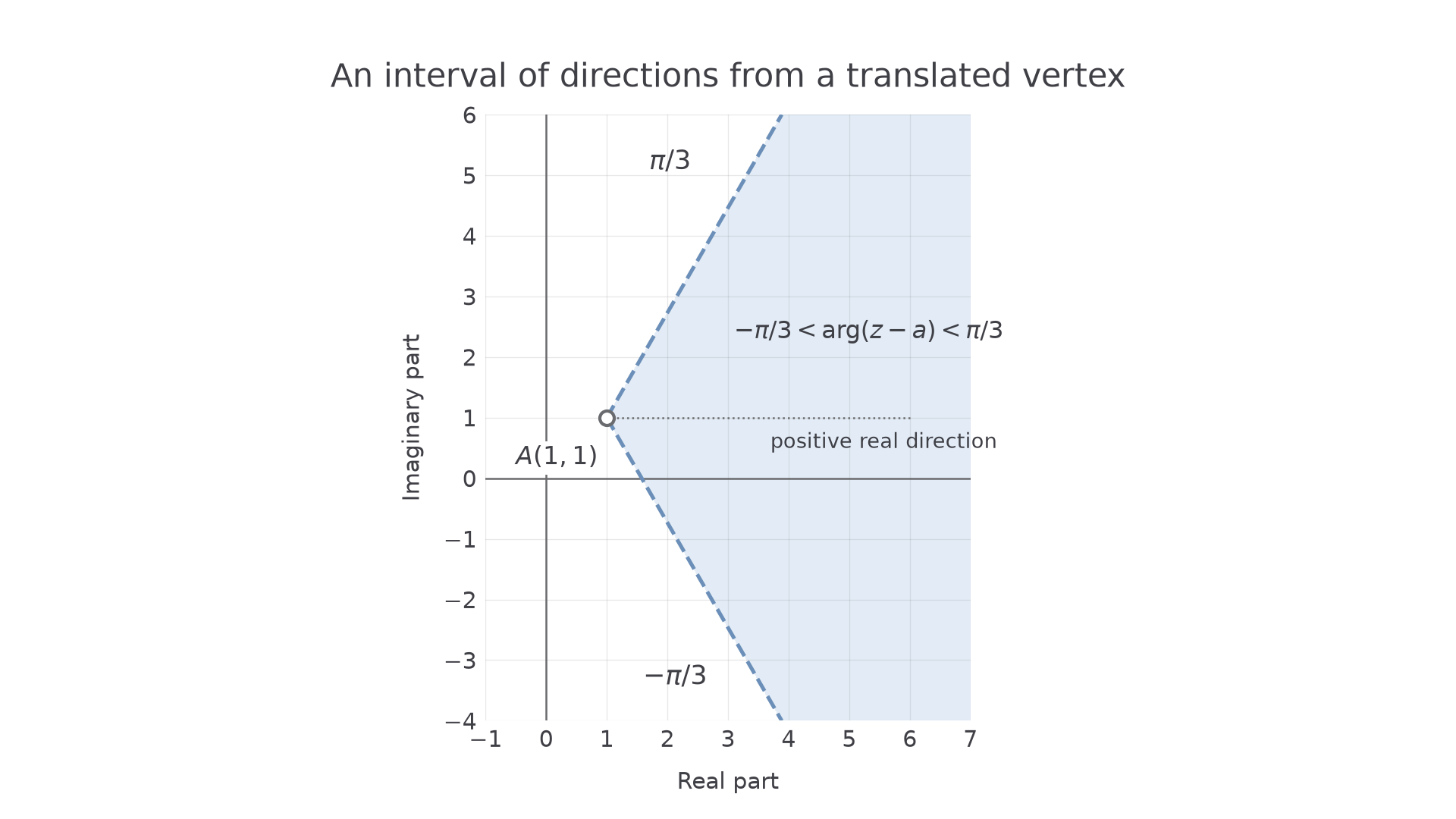
Worked example 5: a wedge above the reference line
Question. Describe , and give equivalent Cartesian inequalities.
Plan. Locate the vertex and the two ray gradients, then restrict to points right of the vertex.
Why this step? The condition explicitly records that these rays face right. A supporting line by itself does not record a ray's direction.
Answer. The open wedge from between angles zero and , with and . Both rays and the vertex are excluded.
Check. At , the displacement is , whose argument lies strictly between the bounds. At , its argument is zero, so that point is excluded.
Change only the lower angular bound, from zero to . Directions below the reference line are now included too.
Worked example 6: a wedge across the reference line
Question. Give Cartesian inequalities and a geometric description for .
Plan. Keep the right-facing restriction and use the two gradients .
Why this step? A negative lower argument allows clockwise directions, so the lower boundary lies below the horizontal guide through the vertex.
Answer. The open wedge centred on the positive real direction from , between angles and . Both rays and the vertex are excluded.
Check. At , the displacement is the positive real number , with argument zero, so it is now included. At the vertex, both strict bounds would become , which is false.
An included ray and an included vertex are different decisions: allowing an endpoint angle never gives an argument to zero.
Watch out
Wrong: including because both angular comparisons use . The expression is undefined there. Even a closed angular interval excludes its vertex.
Use this distinction when describing a wedge with one included ray.
Combining conditions by intersection
Several conditions joined by “and” keep only their common overlap, and a boundary point belongs only if every condition allows it.
The set symbol means intersection, so is the set of points in both regions. Draw the boundaries first, select each side with a test point, then shade only the overlap. A sketch should preserve sensible angles and relative distances; a shallow line in place of a steep argument ray can suggest the wrong overlap.
Intersection of regions
The intersection of two or more regions contains exactly the points satisfying every defining condition. For example, being inside a circle and above a line keeps the part of the disc above that line. A point excluded by any one condition is excluded from the intersection.
Work through the opening three conditions individually. They define a disc, a half-plane and an angular region; no single condition replaces either of the other two.
[DIAGRAM: asset_name: The intersection of a disc, a half-plane and an angular region; asset_slug: 9fm0-regions-intersection; caption: Keep only the first-quadrant points in the disc on the selected side of x equals 2; description: Equal-scale Argand axes show the circle x squared plus y squared equals 16, the line x equals 2 and the positive coordinate rays. The region inside the circle with 0 less than x at most 2 and y greater than 0 is shaded sage. Its circular arc and vertical edge are solid where included, while positive axis boundaries are dashed and excluded. The point (2,2root 3) is marked as the included meeting of the line and circle; the origin is open.]
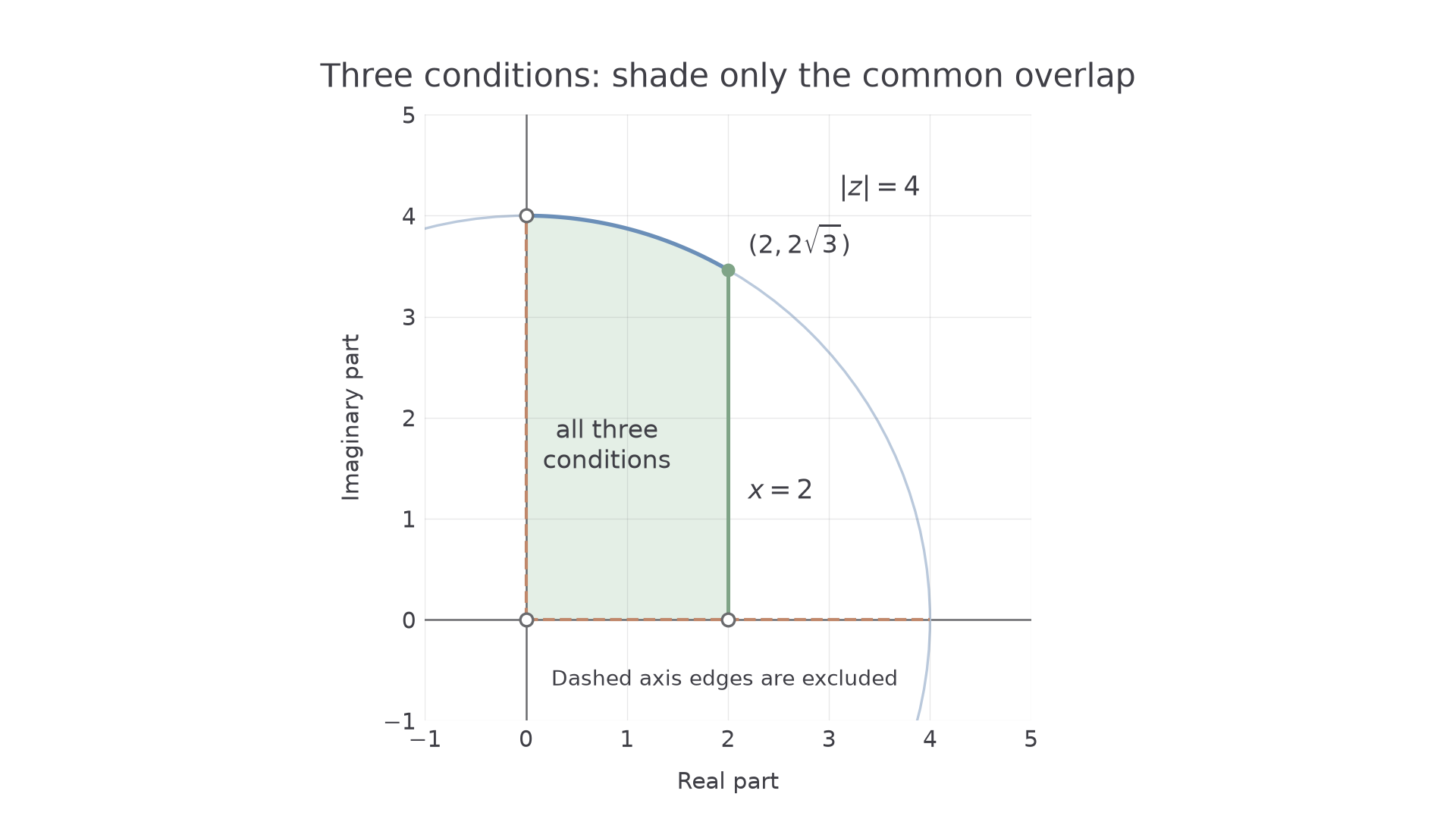
Worked example 7: the opening intersection
Question. Describe the set of points satisfying
and state which boundaries are included.
Plan. Convert the distance conditions to Cartesian inequalities, use the angle interval for the quadrant, then intersect them.
Why this step? The region must be on the origin's side of the bisector , since the origin is nearer to itself than to . The separate angle condition then excludes the origin and both axes.
Answer. The region , , . The portions of the circle and the line satisfying these conditions are included; the coordinate-axis edges are excluded.
Check. satisfies all three conditions. At , the point is inside the disc and in the first quadrant, but it is nearer to than to zero, so it is excluded.
Now change only the nearer-point comparison. The disc and angular region stay fixed, but the other side of the bisector is kept.
Worked example 8: keeping the other overlap
Question. Describe the region
and find the point where its vertical boundary meets its circular boundary above the real axis.
Plan. Reverse the half-plane inequality, retain the quadrant, then substitute the vertical boundary into the circle.
Why this step? The angle interval keeps the upper half-plane, so the negative square root is not an allowed boundary intersection.
Answer. Keep the part of the disc with and . The line and circle meet at . Their relevant edges are included; the real-axis edge is excluded.
Check. The meeting point has modulus , equal distances to zero and , and argument , strictly inside the angular interval.
Test a proposed boundary point against every condition, including the argument's domain.
Watch out
Wrong: “ belongs to the intersection because it satisfies both distance inequalities.” The argument condition must hold too, and is undefined. The correct decision is to exclude , even when both modulus comparisons allow it.
A final point check is often more reliable than trying to remember which direction every inequality should face.
Exam tip
For a shaded-region question, give a clearly shaded overlap, with labelled axes and enough boundary information to locate it. Drawing all the correct boundaries but leaving every side unselected does not identify the region.
Use all three conditions, including the argument's domain, in this last check.
Quick Recap
- A modulus inequality selects the interior or exterior of a circle; equality decides whether the circumference belongs.
- A comparison of two distances selects one side of a perpendicular bisector. Test a fixed point to choose the side.
- An argument interval selects directions from its vertex. Check each ray's inclusion separately, and always exclude the vertex.
- “And”, or , means keep only the common overlap. Every defining condition must hold.
The opening region is , , : inside the circle, on the nearer-to-zero side of , and strictly between the positive coordinate rays.