CP 3.8 - How three planes intersect
Each linear equation in three variables describes a plane, so solving three equations means finding points that lie on three planes at once. You will distinguish a unique intersection, a common line, and inconsistent arrangements, including a prism, then use algebra to justify the geometry.
A solution is a common point
Can three planes meet in pairs without sharing a single point? Two intersecting planes give a whole line of possibilities, so it feels as though adding a third ought to leave at least one. A prism will show why that intuition fails.
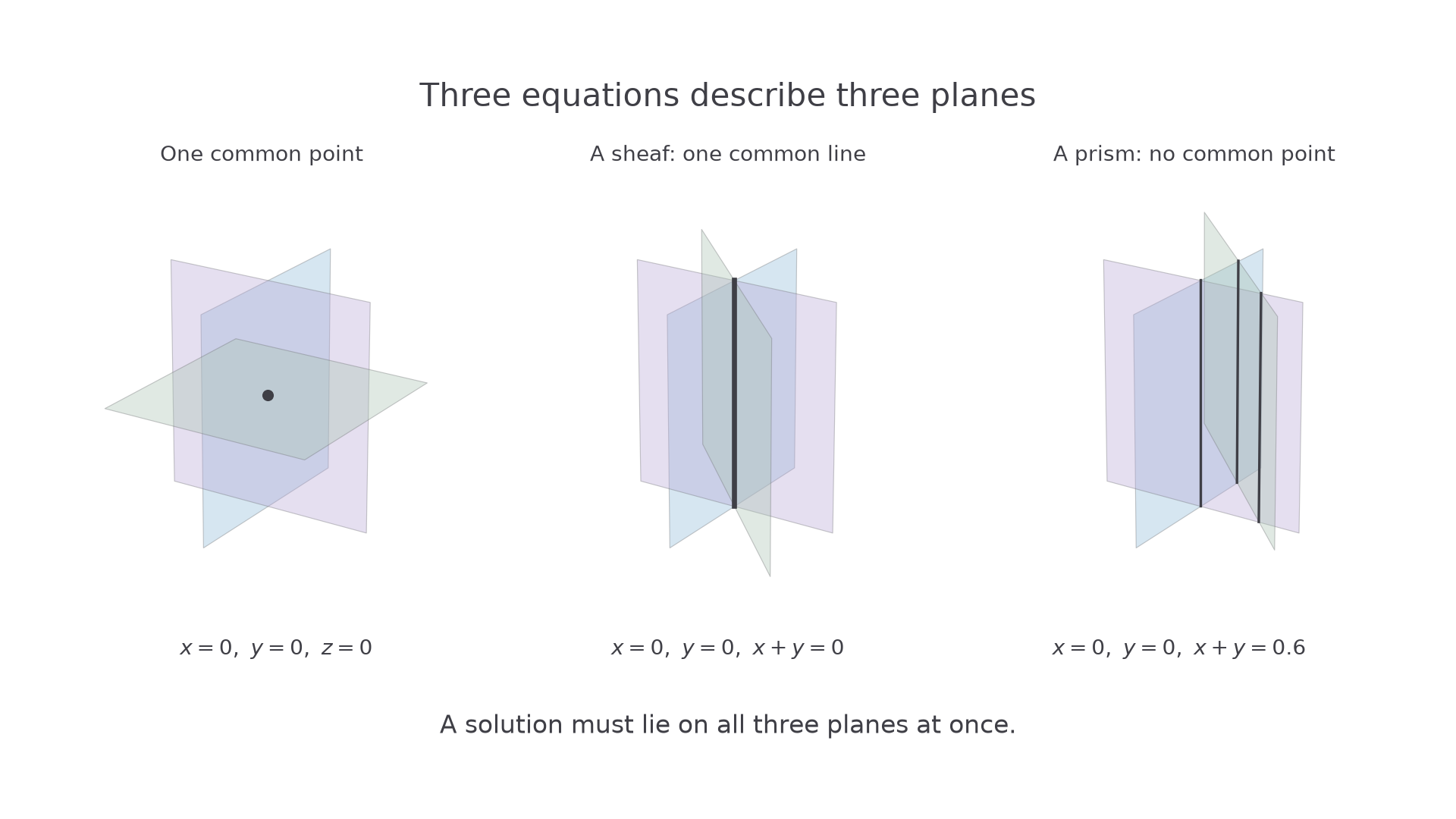
Start with the familiar system , , . Its solution is the one point lying on all three planes. A point on just two planes is not a solution of the whole system.
You already know
For , a non-zero determinant gives a unique solution . A zero determinant means the inverse method is unavailable; it does not decide whether the equations are consistent.
A plane has equation , where at least one of is non-zero. For instance, is the coordinate plane containing the - and -axes. Two distinct planes are either parallel, with no common point, or meet along a straight line. Three planes must therefore be considered together, not just pair by pair.
[DIAGRAM: asset_name: Three ways three planes can meet; asset_slug: 9fm0-cp38-plane-configurations; caption: A point, a common line, or three separate parallel intersection lines; description: Three perspective panels show x=0, y=0, z=0 meeting at the origin; x=0, y=0, x+y=0 sharing the z-axis as a sheaf; and x=0, y=0, x+y=0.6 forming the sides of a triangular prism, with three distinct parallel pairwise intersection lines. Each plane has a consistent blue, lavender or sage colour.]
Consistent and inconsistent systems
A system is consistent if at least one point satisfies every equation, and inconsistent if no point does. Three planes may have one common point, a common line, or a whole common plane if all three coincide. An inconsistent system has no common point even if every pair intersects.
For a three by three coefficient matrix, gives exactly one common point. When , a consistent system has infinitely many solutions; an inconsistent system has none. These classification results are not in the formula booklet: learn them.
The word “infinitely” has a precise geometrical meaning here. A line or a plane contains infinitely many points, so dependent equations can leave one or two variables free. They do not produce exactly two or three isolated solutions.
Key idea
The determinant separates “one solution” from “not one solution”. If it is zero, the constants still decide between infinitely many solutions and no solution.
Here is the tempting inference that the rest of the lesson will replace with a better one.
Three planes sharing a line
Three distinct planes that share one common line form a sheaf. Every point on that line satisfies all three equations, so there are infinitely many solutions.
Sheaf of planes
A sheaf is an arrangement of planes passing through the same line. For three distinct planes, each pair has that same intersection line. For example, , and form a sheaf along the -axis. Three planes with three different intersection lines do not form a sheaf.
Algebraically, one equation follows from the other two, including its right-hand side. Adding entire equations is legitimate: every point satisfying both originals must satisfy their sum. The third plane then adds no further restriction to their common line.
Worked example 1: the third equation is a sum
Question. Describe the intersection of
and give all common points.
Plan. Test whether the third equation follows from the first two, then solve the two independent equations with one variable free.
Put , where is any real number. Then .
Why this step? Two independent equations leave one degree of freedom. Introducing describes the entire line rather than selecting one point from it.
Answer. The three distinct planes form a sheaf, with common line
Check. Substitution gives , , and , for every real .
Worked example 2 changes only the third plane. It is now a different linear combination of the same two equations, so the common line stays fixed.
Worked example 2: a weighted sum
Question. Describe the common intersection of
Plan. Compare the third equation with twice the first plus the second, then use the known intersection of the first two.
The first two equations still give and .
Why compare entire equations? Matching only the variable coefficients would miss a possible contradiction in the constant.
Answer. The planes form a sheaf with common line , .
Check. On this line, , for every .
There is a distinction between “a common line” and “all planes coincide”. For example, , and all describe one plane: their common points fill a plane, rather than just a line. If two planes coincide and the third cuts them, the common set is a line, but there are only two distinct planes.
Watch out
Wrong: “The determinant is zero, so the planes form a sheaf.” Right: show that the equations are consistent and that the common set is a line. A zero determinant also occurs for a prism, parallel planes and coincident planes.
Try the same weighted-sum test with new constants.
Prisms and other inconsistent arrangements
A contradiction after valid elimination means the planes have no common point. To describe the geometry fully, look at whether the planes themselves are parallel or whether only their pairwise intersection lines are parallel.
Prism arrangement
Three distinct, pairwise non-parallel planes form a prism when their pairwise intersections are three distinct parallel lines. Every pair meets, but there is no point common to all three planes. A cross-section perpendicular to the three lines gives a triangle.
In the diagram's prism, and intersect on the -axis. The third plane, , never reaches that line. Its intersections with the first two planes are parallel to the -axis, but displaced from it.
Worked example 3: a contradiction gives a prism
Question. Describe the arrangement of
Plan. Compare the sum of the first two equations with the third, then identify the pairwise intersections.
These conditions contradict one another. No point can satisfy all three equations.
Why look beyond the contradiction? It establishes inconsistency, but “prism” also requires the planes to meet pairwise along different parallel lines. Here those lines are
| Pair | Intersection line |
|---|---|
| First and second | |
| First and third | |
| Second and third |
In each line, increasing by an amount decreases by the same amount, with fixed. The directions agree, but the lines are distinct.
Answer. The planes form a prism and the system has no solution.
Check. The first line gives for every , so none of its points lies in the third plane.
Worked example 4 changes the third plane's relationship to the first: they are now parallel. The algebra is still contradictory, but the geometric description changes.
Worked example 4: two distinct parallel planes
Question. Describe the arrangement of
Plan. Divide the third equation by and compare it with the first.
Why rescale? Proportional coefficients describe parallel or coincident planes. Rescaling exposes whether the constants agree as well.
Answer. The first and third planes are distinct and parallel. The second cuts both of them. There is no common point, so the system is inconsistent.
Check. Every point of the first plane gives , never , in the third equation.
Three mutually parallel distinct planes are also inconsistent. Two coincident planes and a third parallel distinct plane are inconsistent too. The determinant is zero in all these cases, but a drawing of a prism would describe them incorrectly.
Watch out
Wrong: “The planes are parallel” when the system forms a prism. Right: for a prism, the planes meet in pairs and their three intersection lines are parallel. For distinct parallel planes, the planes themselves do not meet.
That answers the opening question: pairwise intersections need not include a common point. Check the alternative source of inconsistency below.
Finding parameters for a common line
A parameter question often has two jobs: make the coefficient rows dependent, then make the constants consistent with that dependence. The determinant handles the first job; substituting or comparing whole equations handles the second.
Use these two fixed planes:
Their coefficients are not proportional, so they meet along a line. A third plane forms a sheaf with them exactly when it contains that line and is distinct from both fixed planes.
Worked example 5: determinant then consistency
Question. The planes , and form a sheaf. Determine and .
Plan. Set the coefficient determinant to zero, then compare the third equation with the sum of the first two.
For a sheaf, , hence . Adding the first two equations now gives
so the third plane contains the common line exactly when .
Why this second step? Setting the determinant to zero matches the coefficients, but it does not match the constants.
Answer. , .
Check. The third equation is exactly the sum of two non-parallel planes' equations and is distinct from both, so all three share their intersection line.
Worked example 6 changes only the coefficient of in the third plane. A sum is no longer the correct combination.
Worked example 6: a different linear combination
Question. The planes , and form a sheaf. Determine and .
Plan. Find the singular coefficient case, then identify which combination of the first two equations produces the third.
Thus . Three times the first equation minus the second gives
Why this combination? Its -coefficient is and its -coefficient is , exactly as required.
Answer. , .
Check. The point satisfies both fixed equations and gives ; the whole-equation combination proves the result for their entire common line.
Coefficient dependence and consistency remain two separate checks.
Watch out
Wrong: in the first parameter family, gives a sheaf for every . It only makes the coefficient determinant zero. The first two equations also require , so the correct sheaf conditions are ; a different contradicts that common-line condition.
For the first parameter family, gives a unique point, gives a sheaf, and gives a prism. Notice how changing only a constant can turn infinitely many solutions into none, without changing the determinant at all.
Exam tip
If told that planes form a sheaf, use , then explicitly impose consistency. Finding the coefficient parameter alone leaves the constants parameter undetermined.
The following question changes that same coefficient once more. Compare the whole equations, including their constants.
Quick Recap
- A simultaneous solution is a point common to all three planes.
- A non-zero coefficient determinant gives one common point; a zero determinant needs a consistency check.
- A sheaf has a common line. Coincident planes can instead give an entire common plane.
- A prism has three distinct parallel intersection lines and no common point; distinct parallel planes also give no solution.
- In parameter questions, match the coefficients and the constants of the same linear combination.
Yes, three planes can meet in pairs without sharing a point: that is exactly what happens in a prism arrangement.