FP1 2.2 - Limits using series expansions
Evaluate limits by expanding far enough to reveal the first terms that survive cancellation. You will compare orders of vanishing, handle products of expansions and shift the expansion variable when the limit is taken at a non-zero point.
The first surviving term controls the limit
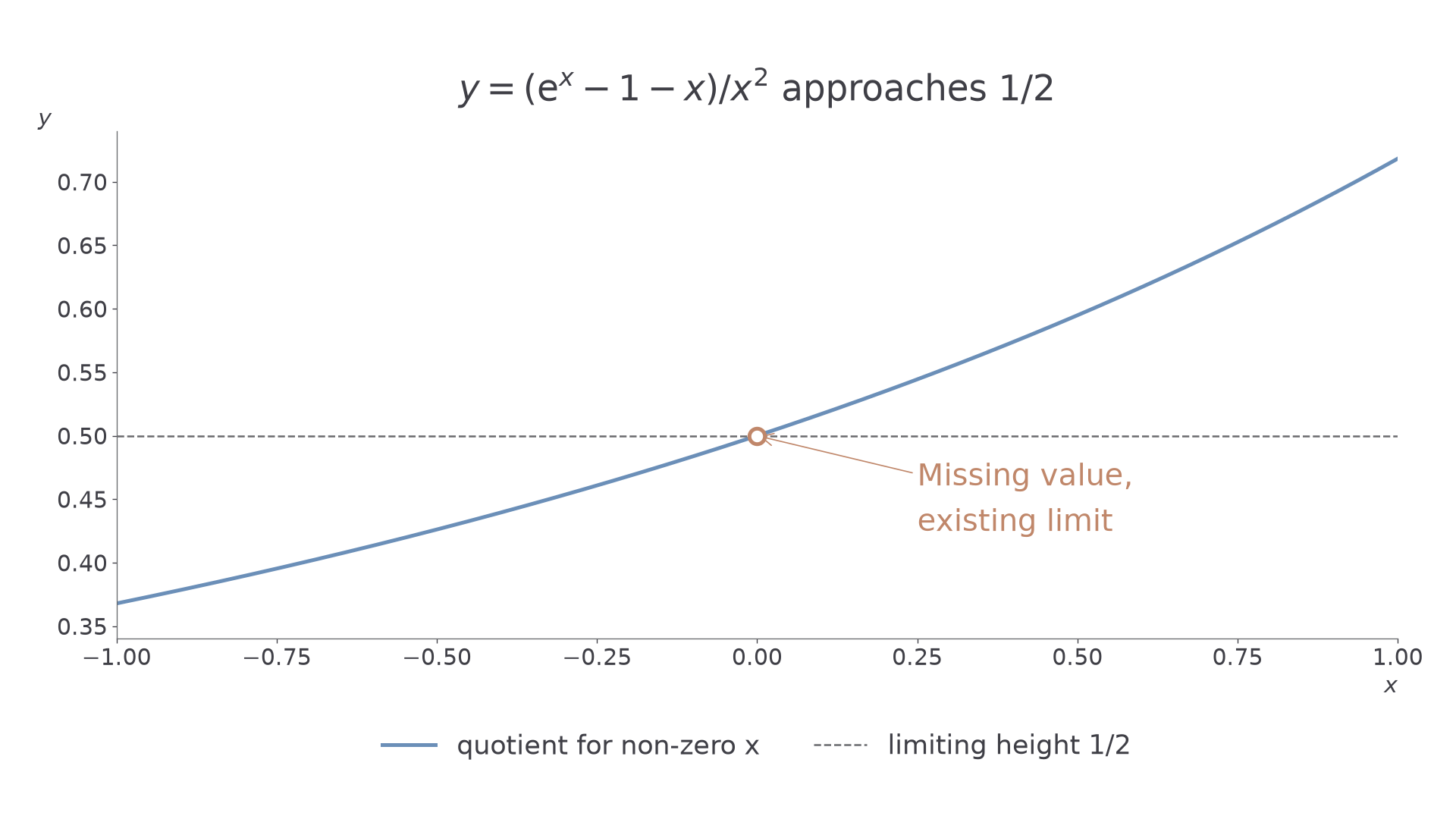
What does approach as ? Substitution gives , which is not an answer. The exponential series reveals what the cancellation has hidden:
The limit is , even though the original quotient is undefined at zero. A limit describes nearby values; it need not equal a value at the point itself.
You already know
Use the standard Maclaurin series, or a Taylor series about the point being approached. Keep enough terms to reach the first one left after subtraction. Standard sine, cosine, exponential, logarithm, binomial and arctangent expansions are in the formula booklet, with their validity conditions.
If a numerator and denominator both vanish, their speeds of vanishing matter. For example, , while . The notation means , with ; it describes the leading behaviour, not an exact equality.
Comparing the first non-zero terms
If, as ,
where and , then
Equal powers give limit ; a higher numerator power gives zero. With a lower numerator power, check one-sided signs before claiming an infinite or two-sided limit.
Not in the formula booklet: learn it.
Every omitted higher power must still tend to zero after the required division. Expanding only through a term that later cancels tells you too little; an omitted leading contribution cannot be recovered by guessing.
[DIAGRAM: asset_name: A quotient with a removable hole; asset_slug: 9fm0-fp164-removable-limit; caption: The quotient approaches one half although it is undefined at zero; description: The graph of (e to the x minus 1 minus x) divided by x squared is drawn on either side of zero, with an open clay circle at (0,one half) and a dashed horizontal line y equals one half. A label identifies the missing value and the two-sided limiting height.]
Key idea
Cancel algebraic terms before taking the limit, and identify the first non-zero power in both numerator and denominator.
This check isolates the comparison of powers.
Expanding beyond a cancelled leading term
When a linear term is subtracted from an odd function, the cubic term often becomes decisive. Write the cubic coefficient explicitly before cancelling; the first-order small-angle approximation alone will not determine these limits.
Worked example 1: the cubic term of sine
Question. Find , using a series expansion.
Plan. Expand sine through its cubic term, cancel the linear terms and divide by .
Why this step? The outer minus changes the sign of every term. The numerator begins with , not .
Answer. The limit is .
Check. The difference is positive for small positive , consistent with a positive leading coefficient.
Change only the function from sine to arctangent. The linear terms still cancel, but the cubic coefficient changes.
Worked example 2: the cubic term of arctangent
Question. Find , using series.
Plan. Use the printed arctangent expansion locally around zero.
Why this step? Arctangent has ordinary odd denominators, not factorials. Importing the sine coefficient would give the wrong limit.
Answer. The limit is .
Check. At small positive , , so the numerator and denominator have the same sign.
These particular limits are not printed in the booklet. The standard expansions are supplied, and their neighbourhoods of validity contain every sufficiently small positive and negative input used here.
Watch out
Wrong: substitute , obtain zero and conclude that the first limit is zero. The approximation removed the very term being measured. Right: retain the cubic term before dividing by .
Change the argument scale and remember that it is cubed in the decisive term.
Products and powers of vanishing expressions
For a product or a power, first find the leading term of each factor. If a factor begins at order , its square begins at order . You may not need every coefficient of the full product.
Continue this lesson.
You’re previewing NovaLearn without an account. Create a free account to read the rest.
Create free account