FM2 1.1 - Angular speed and horizontal circles
A particle can have constant speed and still accelerate: its direction keeps changing. You will connect angular speed to speed along a circle, find the inward acceleration, and use actual forces to produce it. You will also find the speed limits imposed by a string or by friction.
One turn links time, angle and distance
Two riders sit at different distances from the centre of the same rotating platform. Do they have the same speed and acceleration? They complete each turn together, but the outside rider travels farther. The answer depends on distinguishing a rate of turning from a rate of travelling.
You already know
Newton's second law uses the resultant force: in a chosen direction. Resolve forces into perpendicular components. On a rough surface, friction satisfies , with equality at limiting friction. These A-level Mathematics mechanics skills remain the starting point.
If a point from the centre makes one turn in , it travels , giving speed . Its angle changes by radians, giving angular speed .
Angular speed and period
Angular speed, , is the rate at which the angle about the circle's centre changes, measured in radians per second. For uniform circular motion it is constant. The period, , is the time for one revolution. Constant angular speed is not the same as constant velocity: the velocity's direction changes.
An arc subtending angle radians has length . For fixed radius, dividing small arc lengths by their travel times gives the speed relation.
Speed along a circle
For circular motion of fixed radius ,
Here . The booklet writes this as transverse velocity ; use its magnitude when quoting speed.
In the formula booklet.
A complete turn is radians, irrespective of radius. This gives the time conversion you need alongside that booklet result.
Period and revolutions per minute
For uniform motion with positive angular speed,
If the rate is revolutions per minute,
Use seconds and radians before substituting into .
Not in the formula booklet: learn it.
Keep the conversion visible: writing down the number of revolutions per second prevents a factor of from disappearing.
Worked example 1: from revolutions per minute
Question. A particle moves uniformly in a horizontal circle of radius , making revolutions per minute. Find its angular speed, period and speed.
Plan. Convert the rotation rate to radians per second, then use one full turn and the radius.
Why this step? The is a count of turns per minute, not an angular speed in radians per second.
Answer. , , and .
Check. Circumference divided by period gives .
Change only the rotation rate, doubling it to revolutions per minute.
Worked example 2: twice the turning rate
Question. The particle follows the same circle at revolutions per minute. Find its angular speed, period and speed.
Plan. Repeat the conversion with the new rate, retaining the radius.
Why this step? Doubling the turns per second doubles the distance travelled each second, while halving the time per turn.
Answer. , , and .
Check. In one second the particle travels its full circumference, .
Both calculations use the same circle. On one rigid platform, points at different radii instead share and , while their speeds are proportional to radius.
Watch out
Wrong: when the rate is revolutions per minute. Right: . Also use the radius of the particle's path, not its diameter.
Change only the rate once more.
Constant speed still needs inward acceleration
Velocity is tangent to the circle. Two equal-length velocity arrows at nearby points have different directions, so their difference is not zero. As the time interval shrinks, that difference points towards the centre.
[DIAGRAM: asset_name: Tangential velocity and inward acceleration; asset_slug: 9fm0-fm147-velocity-acceleration; caption: Velocity points along the tangent while the change in velocity points inward; description: A plan view shows a particle at the right of a circle, its upward tangential velocity, and its leftward inward acceleration. A second panel shows two equal velocity arrows separated by a small angle, with their difference pointing approximately towards the circle centre. The limiting expression is acceleration equals v omega equals v squared over r.]
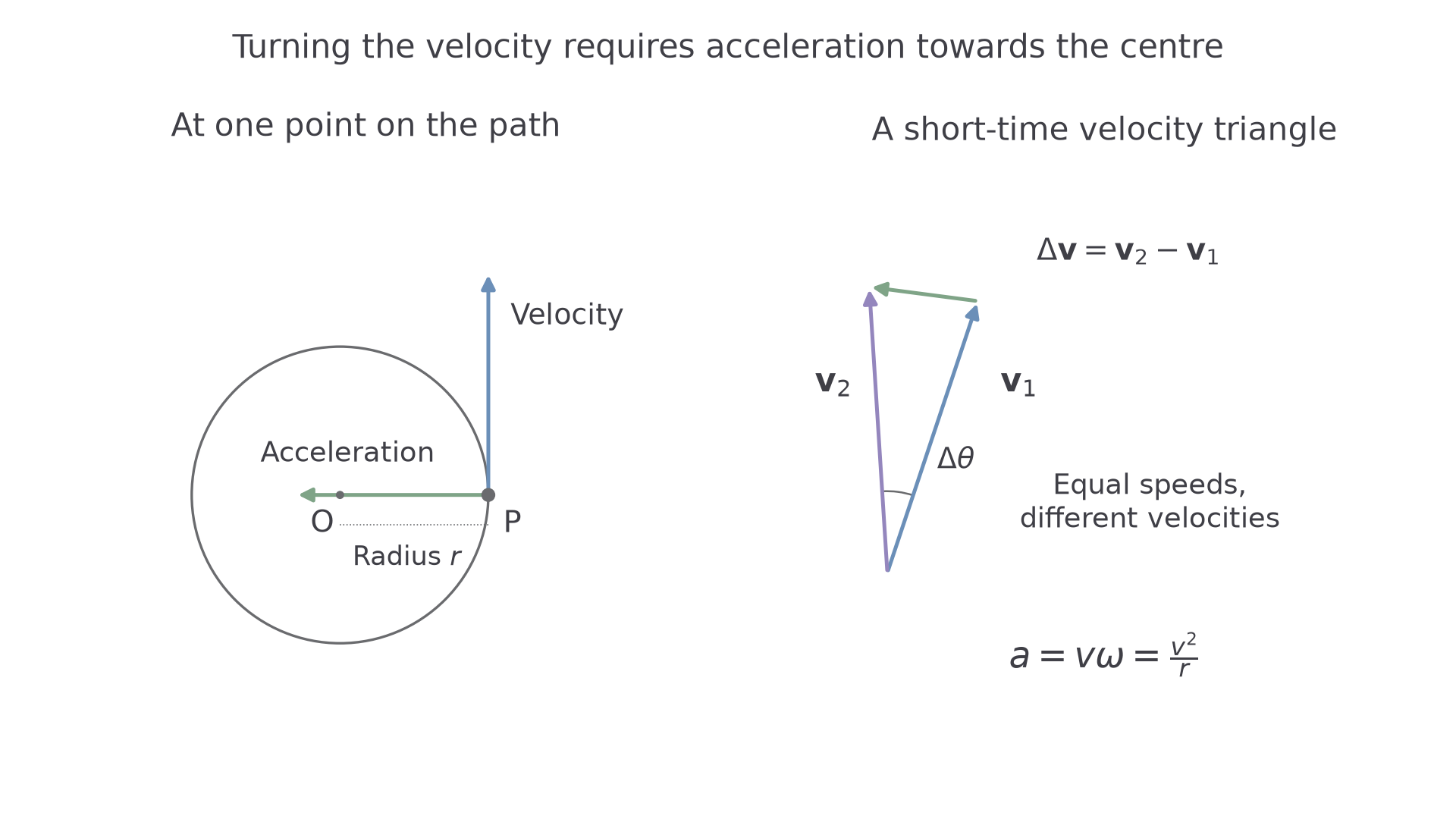
For a short time , the velocity turns through . The velocity triangle gives . Hence
using radians. With , this gives both required forms of the acceleration.
Radial acceleration
For uniform circular motion of radius , the acceleration has magnitude
and points towards the centre. There is no tangential acceleration when the speed is constant. The booklet gives the radial component as , taking outwards as positive; the positive quantities above are inward magnitudes.
In the formula booklet.
Choose the form that uses the given data. A smaller radius needs more acceleration at the same speed, but a larger radius needs more acceleration at the same angular speed. The words “same speed” matter.
Worked example 3: a tight turn at a fixed speed
Question. A particle moves uniformly at in a circle of radius . Find the magnitude and direction of its acceleration.
Plan. Use , since the speed and radius are given.
Why this step? Constant speed removes acceleration along the tangent; it does not remove the acceleration needed to turn the velocity.
Answer. The acceleration is , towards the centre.
Check. The other form gives .
Change only the radius, doubling it while holding the speed fixed.
Worked example 4: a wider turn at the same speed
Question. A particle moves uniformly at in a circle of radius . Find its acceleration.
Plan. Keep the same squared speed and use the new radius.
Why this step? The direction changes more slowly on the wider path when the distance travelled per second is unchanged.
Answer. The acceleration is , towards the centre.
Check. Doubling the radius at fixed halves ; also .
Return to the opening platform. Its riders have the same , so doubling radius doubles both and . This differs from the fixed-speed comparison in the examples. If their masses are equal, the outer rider also needs twice the inward resultant force.
Watch out
Wrong: because the speed is constant. Right: tangential acceleration is zero, but the changing direction requires radial acceleration . Do not add gravity to this horizontal acceleration: the vertical forces balance.
Keep the speed fixed for another radius change.
Continue this lesson.
You’re previewing NovaLearn without an account. Create a free account to read the rest.
Create free account