FM2 4.2 - Oscillations on strings and springs
Elastic oscillations begin with a force law and a carefully chosen equilibrium. You will derive the elastic results needed here, prove SHM for horizontal and vertical systems, combine two restoring forces, and use physical energy contributions. You will also identify when a string becomes slack and the motion must switch away from SHM.
Build the elastic force and energy locally
Does a particle on a vertical elastic string always execute SHM, however far down it is released? No. A sufficiently large release makes the string go slack on the upward journey. During that interval the particle moves under gravity alone. The distinction between a string and a spring changes the motion, not just the drawing.
You already know
Use Newton's law along a fixed signed axis. For displacement x from equilibrium, SHM requires , and release from rest at gives . From A-level Mathematics, kinetic energy is , gravity changes potential energy by , and work is a force–distance integral.
Let l be an elastic object's natural, unstretched length and L its current length. Its extension is . An ideal light object has negligible mass and follows Hooke's law over the stated range. Its modulus of elasticity is measured in newtons; its stiffness is measured in .
A string can pull but cannot push. For , its tension is , towards the other end. At natural length tension is zero; if the endpoints are closer than l, it is slack with zero tension. An ideal axial spring can also be compressed: its force acts to restore natural length on either side.
To stretch from natural length to extension e, the force grows linearly. The stored energy is the work against it:
The same squared-deformation result applies to a compressed spring. A slack string instead has zero elastic energy; do not square a negative endpoint-length difference for it.
Hooke's law and elastic energy
For a taut ideal light elastic string, or an ideal spring extended by ,
Here l is natural length, not current length. For an axial spring, signed deformation may be negative and the force on its free endpoint is restoring; its stored energy remains . For a slack string, use .
Not in the formula booklet: learn it.
The energy is the triangular force–extension area, rather than final force multiplied by the entire extension. This supplies the elastic law and energy needed for every system in this lesson.
Worked example 1: force and stored energy from an extension
Question. A light elastic string has natural length and modulus . Find its tension and stored energy when stretched to length .
Plan. Calculate extension from natural length, then stiffness, force and energy.
Why this step? Modulus and stiffness are different quantities. Dividing modulus by natural length gives the force per metre of extension.
Answer. , .
Check. The triangular area is , agreeing with the integral.
Change only the stretched length to .
Worked example 2: a larger extension
Question. For the same string at length , find tension and stored energy.
Plan. Retain stiffness and update the deformation in both force and energy.
Why this step? Force is proportional to extension, while stored energy is proportional to its square.
Answer. , .
Check. Increasing extension by factor multiplies tension by but energy by , taking to .
The same endpoint length below natural length would represent compression for a spring and slackness for a string. State which physical object the force law describes.
Watch out
Wrong: use the whole stretched length as e, or assign negative tension to a slack string. Right: subtract natural length, check the state, and use elastic energy only for actual deformation supported by the model.
Change only the stretched length once more.
A horizontal spring restores towards natural length
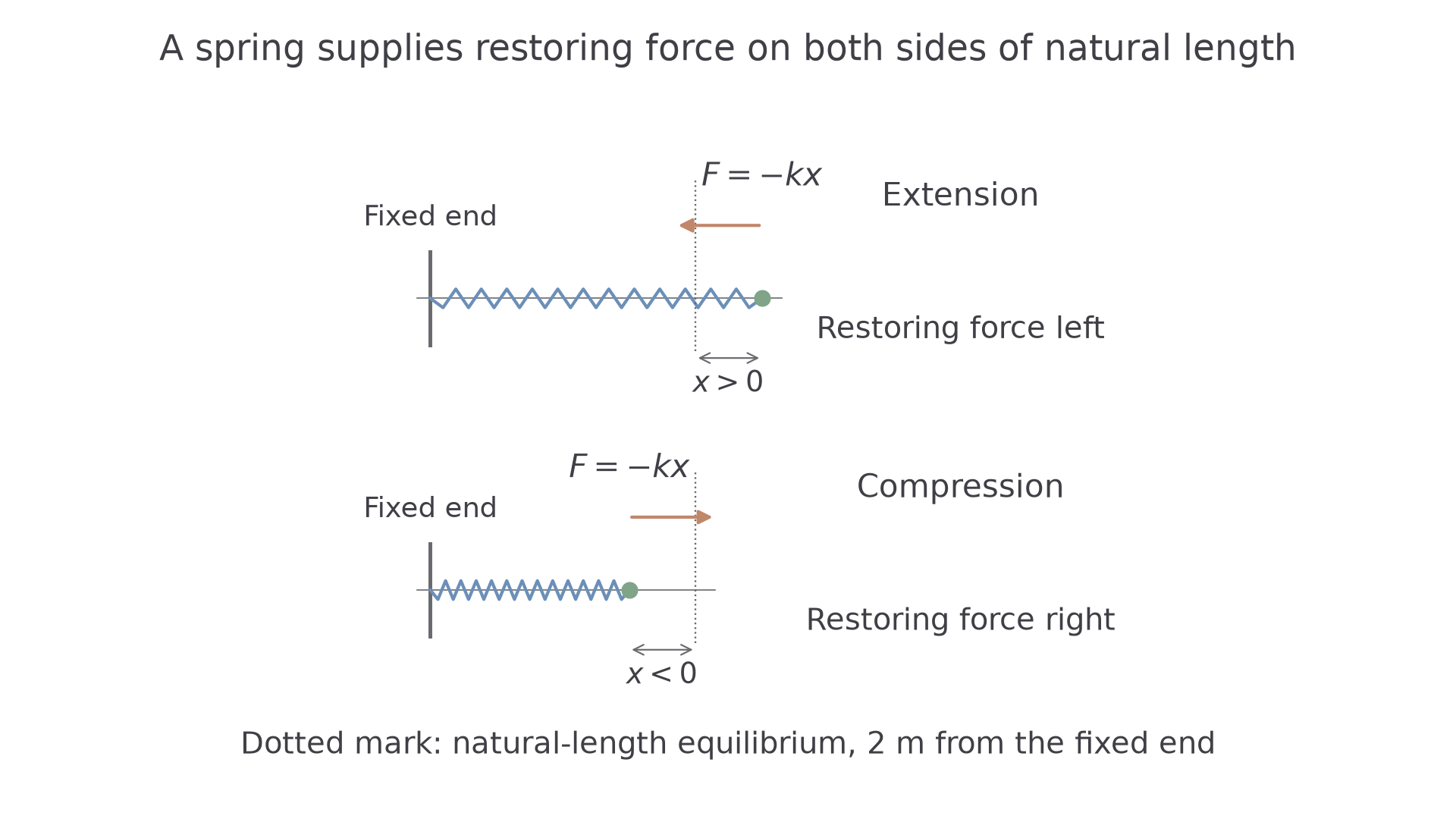
Attach one end of a light axial spring to a fixed point and its other end to a particle on a smooth horizontal guide. Weight and normal reaction cancel vertically. Let x be signed displacement of the particle from the spring's natural-length position, positive away from the fixed end. The spring force is , including when x is negative and the spring is compressed.
Horizontal ideal spring
For constant mass m and stiffness k,
For release from rest at , , maximum speed is , and total energy is . Assume a straight axial spring, no friction, a valid Hooke's-law range and positive physical spring length throughout.
Not in the formula booklet: learn it.
Unlike a single horizontal string pulling towards one fixed point, this spring provides a restoring force on both sides of natural length. A string could not supply the compressive part of the same oscillation.
[DIAGRAM: asset_name: Extension and compression in a horizontal spring; asset_slug: 9fm0-fm160-horizontal-spring; caption: The spring force changes direction across the natural-length equilibrium; description: Two exact horizontal diagrams show the same spring and particle at positive and negative displacement from the natural-length mark two metres from the fixed end. At positive displacement the restoring force points left, and at negative displacement it points right. The common equilibrium and signed x displacement are marked, with the guide smooth and motion along its axis.]
Worked example 3: a horizontal spring released from rest
Question. A mass- particle is attached to a light spring of natural length and modulus , on a smooth horizontal guide. It is released from rest at extension . Prove SHM and find displacement from equilibrium, period, maximum speed and total energy.
Plan. Find stiffness, apply the restoring-force equation and use the release conditions.
Thus . Since and ,
Why this step? The coordinate is measured from natural length, where the horizontal resultant is zero. The minus sign is supplied by the restoring force, not inserted merely to obtain a sine solution.
Answer. SHM with , period , maximum speed , total energy .
Check. Minimum spring length is , and at equilibrium .
Change only the release extension from to .
Worked example 4: larger motion with the same period
Question. The same system is released from rest at extension . Find the displacement function, period, maximum speed and energy.
Plan. Retain , changing only the amplitude set by the release.
Why this step? Amplitude changes the motion's size and energy, while stiffness and mass still set its angular frequency.
Answer. , period , maximum speed , total energy .
Check. Doubling amplitude doubles maximum speed and quadruples energy. The minimum length is still positive.
An ideal vertical spring will also oscillate about its own equilibrium, shifted by weight. A vertical string needs the additional check that it never requires a pushing force.
Watch out
Wrong: replace the spring by a string without checking compression, or use when natural length is not one metre. Right: use and verify that the physical model supplies the restoring force throughout the cycle.
Change only the release extension again.
Measure vertical displacement from the stretched equilibrium
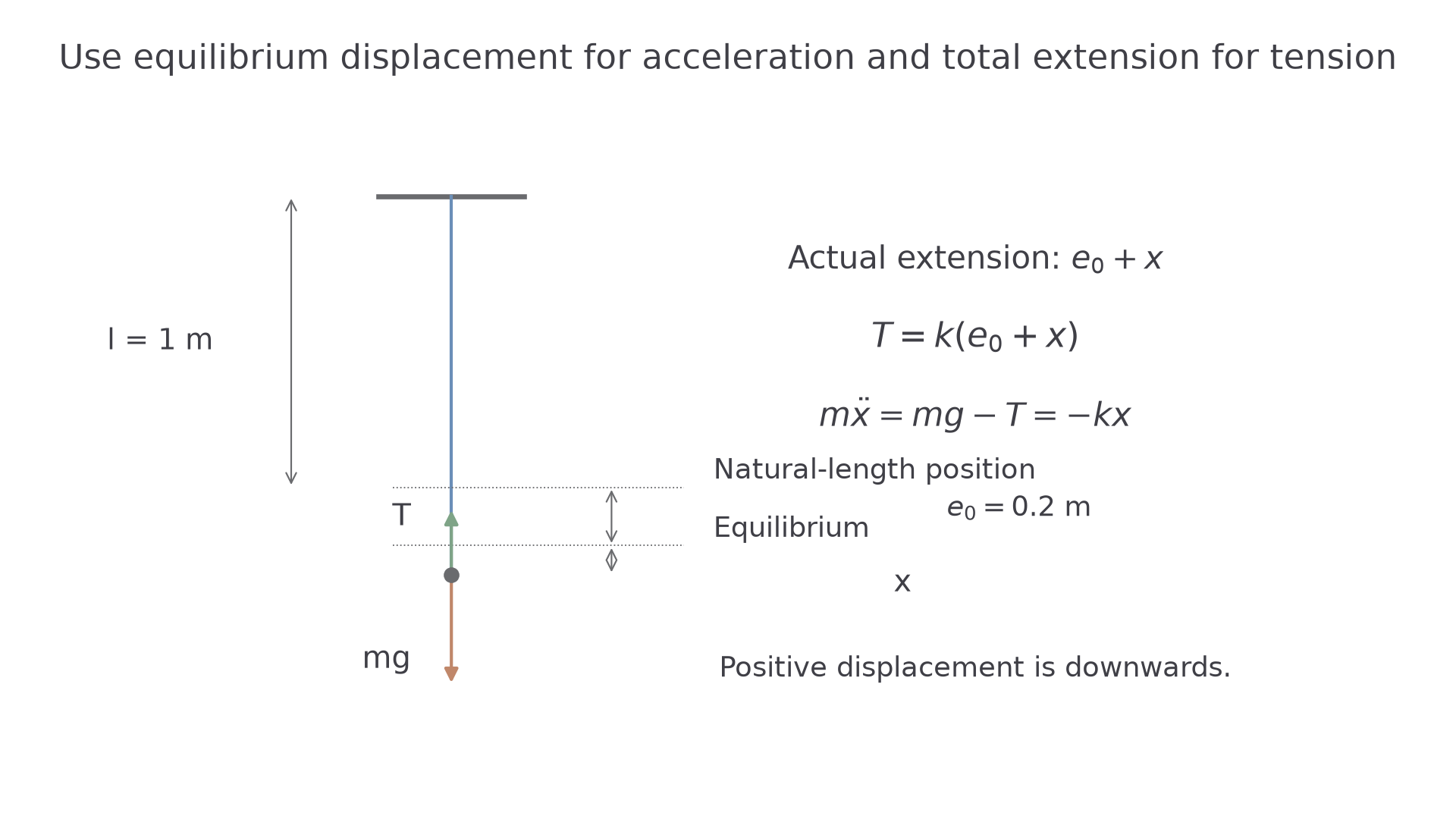
Hang a particle from a fixed point by a vertical elastic string. At equilibrium its extension satisfies . Let x be displacement downward from this equilibrium, so the actual string extension is . While the string is taut,
The constant weight cancels the equilibrium tension, leaving a restoring force proportional to displacement from equilibrium. This is the constant-force shift seen in the preceding lesson.
Vertical elastic oscillation and its domain
For a vertical ideal elastic system while its elastic force law remains valid,
For a string, require . A full SHM cycle of amplitude a has positive tension throughout if . At , tension is zero at the upper turning point only, with no slack interval. If , the string becomes slack before that SHM turning point and a new motion equation is required. A spring may also compress within its stated ideal range.
Not in the formula booklet: learn it.
Keep three lengths separate: natural length l, equilibrium extension , and displacement x from equilibrium. The current separation from the fixed point is , not x.
[DIAGRAM: asset_name: Natural position, equilibrium and instantaneous extension; asset_slug: 9fm0-fm160-vertical-reference; caption: The elastic force uses e0 plus x, while the restoring acceleration uses x from equilibrium; description: A vertical fixed support has a natural-length mark one metre below it and an equilibrium mark a further0.2metres below. An instantaneous particle lies x below equilibrium, with downward weight and upward tension. Separate dimension arrows show natural length l, equilibrium extension e0 and signed displacement x. The actual elastic extension e0 plus x is identified.]
Worked example 5: a vertical string that stays stretched
Question. A particle of mass hangs from a light elastic string of natural length and modulus . It is released from rest below equilibrium. Take . Prove SHM, find x as a function of time and its period, and check the string's state throughout.
Plan. Find the equilibrium extension, use downward displacement from that point, and test the smallest extension in the cycle.
Hence , and release from rest gives
Why this step? Weight is balanced only by the equilibrium part of the tension. The remaining change in tension supplies the restoring acceleration.
Answer. SHM with , period . Minimum extension is , so the string stays taut.
Check. Initially x is positive and acceleration is negative, starting the upward return. Maximum speed is .
Change only the release displacement from to below equilibrium.
Worked example 6: approach the tautness boundary
Question. The same particle and string are released from rest below equilibrium. Find x, period and maximum speed, and check whether the string stays stretched.
Plan. Retain equilibrium and angular frequency, using the new amplitude and minimum extension.
Why this step? The displacement amplitude must be compared with equilibrium extension, not with the natural length.
Answer. , period , maximum speed ; the string stays stretched.
Check. At the upper extreme x is , but the actual extension is still positive. Negative displacement does not itself mean a slack string.
The equality case is worth separating from both neighbouring cases. Zero tension at a single upper turning instant does not create a finite slack phase: gravity immediately starts the particle moving down into extension again.
Watch out
Wrong: use with x measured from vertical equilibrium, or say every negative x means slackness. Right: tension is , and compare its smallest extension with zero before using one SHM cycle globally.
Change only the release displacement to the boundary value.
Two taut strings contribute to the restoring gradient
Put two fixed points A and B apart on a smooth horizontal guide. A mass- particle P lies between them, attached by two light strings, each of natural length . Their moduli are on the A side and on the B side, giving stiffnesses and .
Let q be distance AP, positive towards B. Both strings are stretched when . Their tensions are
Equilibrium requires , hence . If , then
so . Both stiffnesses add to the restoring gradient: moving right increases the leftward tension and decreases the rightward tension. These equations are derived, not printed in the booklet.
The full SHM cycle is valid with both strings stretched only if its amplitude is less than both equilibrium extensions, and . Thus require for strictly positive tension throughout this model.
Continue this lesson.
You’re previewing NovaLearn without an account. Create a free account to read the rest.
Create free account