FM1 4.2 - Successive direct impacts
A sequence of impacts is a sequence of short problems, each with its own immediate before-and-after velocities. You will handle a direct impact with a fixed wall, carry velocities into later sphere collisions, and decide whether two spheres meet again. You will also combine constant-speed travel between impacts with restitution at each event.
A fixed wall reverses the velocity
Can a wall reverse a particle's momentum without removing any kinetic energy? Yes: a perfectly elastic direct rebound changes the velocity's sign while preserving its speed. That combination makes the impulse large even though the kinetic energy loss is zero.
You already know
Use signed velocities in . Restitution compares separation with approach, and . Kinetic energy depends on the square of speed, so reversing velocity need not change kinetic energy.
For a direct impact, motion is perpendicular to the smooth fixed wall. The wall's velocity is zero, so the relative approach speed is the particle's incoming speed and the separation speed is its rebound speed. Do not conserve the particle's momentum: the wall supplies an external impulse.
Direct impact with a smooth fixed wall
Take the positive direction towards the wall, with incoming velocity , outgoing signed velocity and wall coefficient . Then
For mass , the impulse on the particle is
Its magnitude is , directed away from the wall. The kinetic energy lost is
At there is no rebound speed; at the speed is unchanged. These formulae concern this direct impact only.
Not in the formula booklet: learn it.
Use momentum change for impulse and energy difference for loss. They measure different effects of the same collision.
Worked example 1: rebound with a speed loss
Question. A particle moves at directly towards a smooth fixed wall. The coefficient of restitution is . Find its rebound velocity, the magnitude and direction of its impulse, and the kinetic energy lost.
Plan. Take towards the wall as positive; find the signed rebound velocity before calculating momentum and energy changes.
Why this step? The velocity reverses, so the momentum change involves . Energy uses the squares, so its calculation does not retain that sign reversal.
Answer. The particle rebounds at away from the wall. Its impulse has magnitude , directed away from the wall, and its kinetic energy loss is .
Check. The rebound speed is half the incoming speed, so final kinetic energy is a quarter of its initial value: from .
Change only the coefficient to , making the impact perfectly elastic.
Worked example 2: a larger impulse with no energy loss
Question. A particle approaches the same smooth fixed wall directly at . The coefficient of restitution is now . Find the rebound velocity, the impulse magnitude and direction, and the kinetic energy lost.
Plan. Reverse the velocity without changing its magnitude, then calculate both changes separately.
Why this step? Momentum is a vector and reverses; kinetic energy is a scalar and remains the same. Zero kinetic energy loss does not imply zero impulse.
Answer. The rebound speed is away from the wall, the impulse magnitude is away from the wall, and the energy loss is .
Check. Momentum changes from to , a change of . Kinetic energy is both before and after.
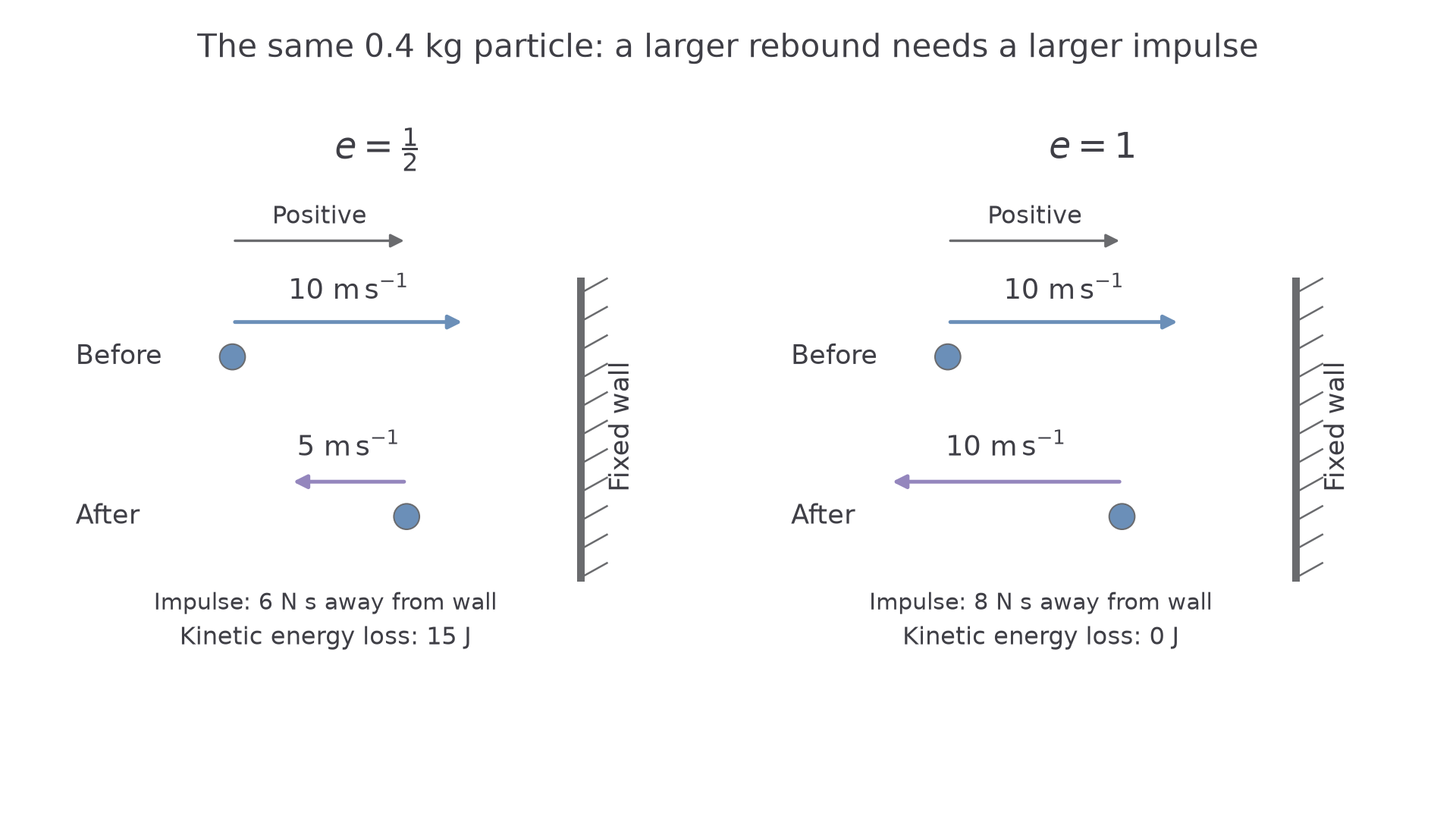
The opening puzzle is therefore resolved. The larger rebound in the second example gives a larger momentum change while losing less energy.
[DIAGRAM: asset_name: Wall impulse and kinetic energy loss are different; asset_slug: 9fm0-fm143-wall-impulses; caption: A perfectly elastic rebound can give a larger impulse while losing no kinetic energy; description: Two direct-wall-impact panels use a mass of 0.4 kilograms and incoming speed ten metres per second towards a fixed wall. The first has coefficient one half and rebound speed five away, impulse six newton seconds away, and energy loss fifteen joules. The second has coefficient one and rebound speed ten away, impulse eight newton seconds away, and zero energy loss. Before and after arrows show reversal clearly.]
Watch out
Wrong: using the positive rebound speed in while incoming motion is positive. Right: use the negative rebound velocity. Also, the particle's momentum is not conserved when a fixed wall supplies its impulse.
Change only the wall coefficient to a value between the two examples.
Update the velocities after each collision
For a chain of impacts, take the events one at a time. Immediately after one collision becomes immediately before the next for a sphere involved in both. A sphere not involved retains its velocity while moving freely on the smooth horizontal surface.
Model the small spheres as particles. Collisions are instantaneous and separated events; between them the horizontal velocities are constant. Draw the order of the particles and retain one positive direction throughout.
Worked example 3: two successive sphere impacts
Question. Three spheres lie in that order on a smooth horizontal surface, with positive gaps between them. Their masses are respectively. moves right at , while are initially at rest. The coefficient of restitution is for each pair that collides. Find all three velocities immediately after 's first collision with .
Plan. Solve the - impact first, then use 's new velocity in the - impact.
For the first collision, with right positive,
Now moves away from and towards the stationary , so - is the next impact. Denote their new velocities by :
Why this step? The velocity belonged to before the first impact. The second impact uses 's current , with still at rest.
Answer. Immediately after -, moves right at , is at rest, and moves right at .
Check. Total momentum is now , equal to the initial total. 's velocity was unchanged by the second impact.
Change only the - coefficient to . The first collision is unchanged.
Worked example 4: a different coefficient for the second pair
Question. The same three spheres have masses , with initially moving right at and at rest. The - coefficient is , but the - coefficient is . Find all three velocities immediately after -.
Plan. Retain the first-impact results and replace only the second restitution equation.
Why this step? A restitution coefficient belongs to a stated pair. There is no reason to reuse the first pair's coefficient for a different pair.
Answer. moves right at , left at , and right at .
Check. Total momentum is . For the second collision alone, separation speed is , equal to approach speed, as required.
A short state table prevents old velocities from slipping into new equations.
| Stage in Worked example 4 | |||
|---|---|---|---|
| Before - | |||
| After - | |||
| After - |
All entries are signed velocities in , with right positive.
Watch out
Do not restart every impact from the original velocities, and do not assume a third sphere is at rest unless the question says so. Update only the participants in each collision; carry every other velocity forward unchanged.
Change only the second pair's coefficient again. You may use the already established first-impact velocities.
A rebound can bring two spheres together again
After a wall impact, reset the rebounding velocity's sign before considering the next meeting. Prove that the particles approach each other using their positions and directions relative to the wall; comparing speed magnitudes alone can be misleading.
For timing questions below, model the spheres as particles and ignore their radii. Take the first sphere-sphere impact as time at coordinate , with the wall at . Right, towards the wall, remains positive.
Continue this lesson.
You’re previewing NovaLearn without an account. Create a free account to read the rest.
Create free account