D2 5.3, 5.4 - Dominance and graphical mixed strategies
You will reduce games by dominance, draw expected-pay-off lines, and find and check optimal mixed strategies for either player.
Reduce a game by dominance
Can making a deliberately random choice give a stronger guarantee than always choosing your safest row? In some games it can. The useful randomness has carefully chosen probabilities, and the opponent must not know your current random outcome.
You already know
Every entry is A's pay-off: row player A wants it large, column player B wants it small. The row maximin and column minimax give pure play-safe bounds; equality identifies a stable solution.
Before drawing anything, look for options that cannot improve a player's result against any opponent response.
Dominance
A row dominates another row if every entry is at least as large and at least one is larger. A column dominates another column if every entry is at most as large and at least one is smaller.
Delete the dominated option, not the dominating option. Repeat comparisons in the reduced matrix. Identical options may also be reduced to one representative.
The opposite inequality directions express the players' opposite aims. A dominance reduction preserves the game value and at least one optimal strategy; it need not preserve every possible optimal strategy when equalities occur. Use direct row or column comparisons here.
Worked example 1: reduce rows and columns
Question. Reduce the following pay-off matrix for A by dominance, justifying each deletion.
| A / B | X | Y | Z | W |
|---|---|---|---|---|
| R | ||||
| S | ||||
| T |
Plan. Compare all entries in a proposed pair, respecting each player's aim.
Column X dominates W because
Delete W. In the remaining matrix, R dominates T because
Delete T, leaving
Why compare the rows again after deleting W? In the original matrix, T's W entry exceeds R's , so R did not originally dominate T.
Answer. Remove W, then T; the displayed two-row matrix remains.
Check. No remaining row dominates the other. The remaining columns each trade a smaller entry in one row for a larger entry in the other, so none dominates another.
Change only TX from to . That one comparison changes what can be removed.
Worked example 2: stop when comparisons cross
Question. Reduce the changed matrix by dominance.
Plan. Repeat each proposed inequality instead of reusing a deletion from the previous game.
X still dominates W, since
After deleting W, the matrix is
R now has a smaller X entry than T but larger Y and Z entries. S also trades advantages with both rows. Comparing each column pair gives inequalities in opposite directions in different rows.
Why keep all three rows? A row cannot be removed merely because it loses most of its comparisons; every comparison must support the dominance claim.
Answer. Delete W only; no further direct row or column dominance occurs.
Check. T alone has the largest X entry, S alone has the largest Y and Z entries, and R's Y and Z entries exceed T's. These observations rule out every row deletion; the column comparisons similarly cross.
A complete dominance explanation names the dominating option and displays or states all the relevant inequalities.
Watch out
Wrong: delete the row with the smallest total, or reverse column dominance because the matrix belongs to B. Right: compare corresponding entries; larger favours A's rows, smaller favours B's columns.
An equality need not prevent a valid deletion.
Maximise the lower envelope for the row player
A mixed strategy assigns probabilities to pure options. A player randomises afresh without revealing the current choice. The expected pay-off is a long-run average, not the result guaranteed on every individual play. A predictable alternating pattern does not give the same protection.
For A's two rows R and S, let be the probability of R, so S has probability .
A's graphical problem
For column , A's expected pay-off is
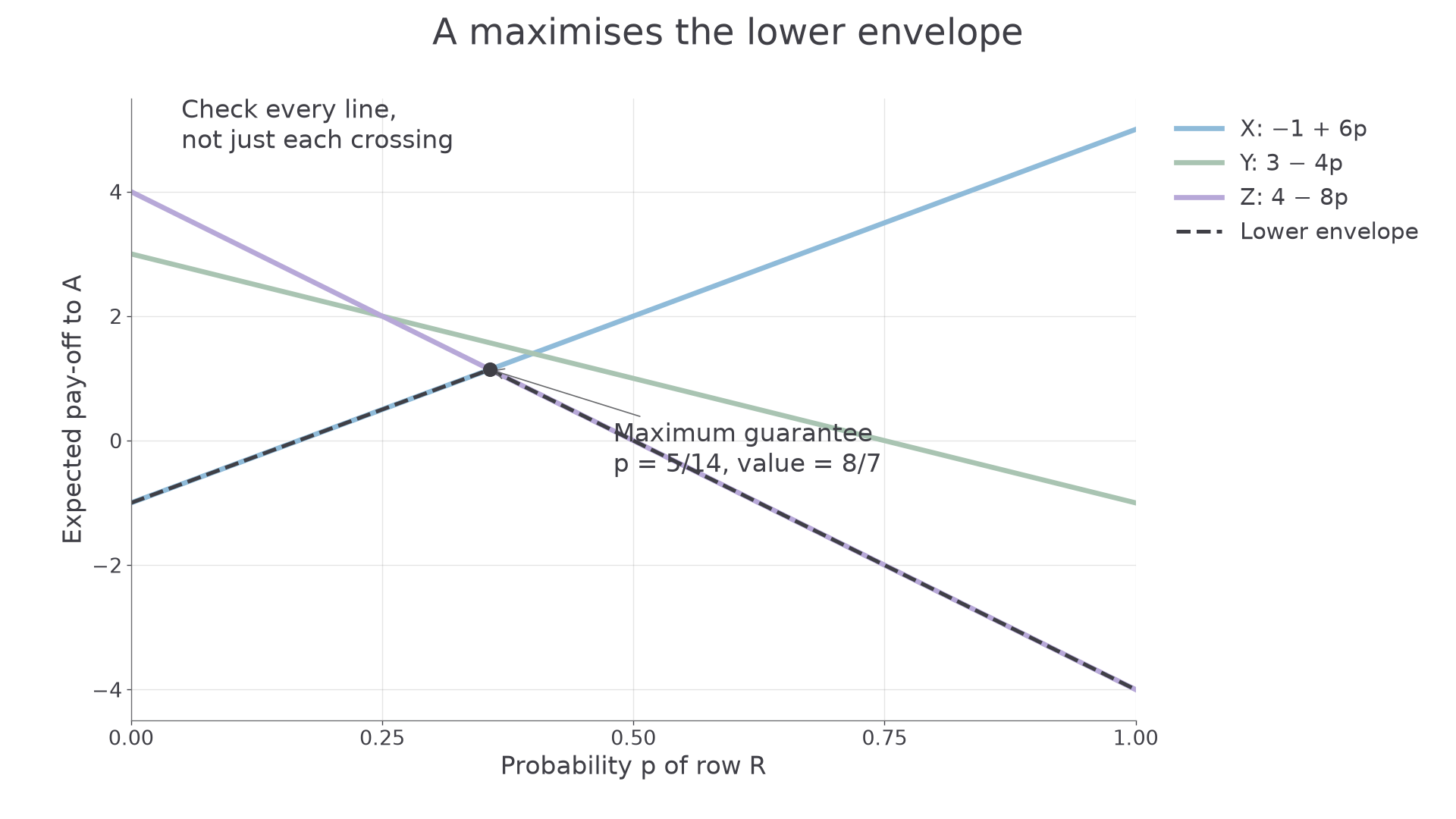
B can choose the least of these values. Draw every line and maximise their lower envelope:
Check relevant intersections and both endpoints. This method applies to games with .
Not in the formula booklet: learn it.
The lower envelope is the lowest line at each probability. An intersection above another line does not determine A's guarantee.
Worked example 3: choose the useful intersection
Question. Find A's optimal mixed strategy and guaranteed expected pay-off for the reduced matrix in worked example 1.
Plan. Plot each column's expectation, identify the lower envelope, and solve its highest corner exactly.
The pairwise intersections are
At , X gives , so the apparent YZ height is unavailable. At , Z gives , below the XY intersection. The lower envelope follows X up to , then Z downwards.
Why choose XZ rather than the highest intersection? B selects the lowest expectation, so A must maximise that actual lower boundary.
Answer. A uses R with probability , S with probability , guaranteeing
Check. The three expectations at this probability are ; both endpoints have smaller lower-envelope values, and .
The graph makes the distinction between a line intersection and an attainable guarantee visible.
[DIAGRAM: asset_name: A maximises the lower envelope; asset_slug: 9fm0-d2-190-row-envelope; caption: The highest point of A's lower envelope is the XZ intersection, below the unused Y line.; description: Lines X equals minus1 plus6p, Y equals3 minus4p and Z equals4 minus8p on probability interval0 to1; the lower envelope rises along X then falls along Z, with maximum at p5/14 and value8/7.]
For the paired example, add just one available column, W, with entries . None of the original pay-offs changes.
Worked example 4: include a fourth response
Question. Find A's optimal strategy for
Plan. Add W's line and check whether it changes the lower envelope.
The original lines remain, while
For , X forms the old lower envelope and
For , Z forms it and
W is therefore above that envelope throughout the interval.
Why retain the new line in the reasoning? An additional opponent response can lower the guarantee; checking it is what justifies keeping the old optimum.
Answer. The optimum remains R with probability , S with probability , and value .
Check. At the optimum W gives , exceeding . W is not directly dominated by any one original column: its entries trade advantages with each.
With only one available column, A's expectation is one line: its maximum occurs at an endpoint, or everywhere if the line is horizontal. Pure optimal choices are allowed; do not force an interior crossing.
Watch out
Wrong: maximise one chosen line or any pairwise crossing. Right: draw every response on , trace the lower envelope and maximise it. Label axes, lines, intercepts and the optimum clearly.
Now alter a pay-off rather than add a response.
Continue this lesson.
You’re previewing NovaLearn without an account. Create a free account to read the rest.
Create free account