FM1 2.1 - Power and driving force
Power tells you how quickly a force transfers energy. You will connect power to driving force and speed, then combine that relationship with Newton's second law on level and inclined roads. You will also find steady speeds when resistance changes with speed and explain the limits of a constant-power model.
Power measures how quickly work is done
Does an engine working at constant power exert a constant driving force? An engine can deliver the same number of joules every second while its vehicle's speed changes. The force needed to deliver that energy need not stay the same. First separate the amount of work from the rate at which it is done.
You already know
Work transfers energy. For a constant force along its displacement, ; raising a mass through vertical height increases gravitational potential energy by . Resultant work changes kinetic energy, .
Two motors can do the same work while one finishes sooner. The faster completion needs greater mean power, not more work on the load.
Power
Power is the rate of doing work, or the rate of energy transfer. Its SI unit is the watt, , with . Also, . Mean power refers to an interval; instantaneous power refers to one instant. A force measured in newtons is not a power.
Use the work done by the particular engine or force whose power is requested. Its work need not equal the resultant work of all forces.
Mean and instantaneous power
If work is done in time ,
At an instant,
For constant power, , and mean and instantaneous power agree. If power varies, a mean over an interval need not equal its value at either endpoint.
Not in the formula booklet: learn it.
Begin with a lift moving steadily. The load's kinetic energy is unchanged, so the lifting force's work supplies its gravitational potential energy gain.
Worked example 1: the same work over ten seconds
Question. A motor raises a load of mass steadily through a vertical distance of in . Air resistance is negligible. Find the motor's mean power delivered to the load.
Plan. Find the work needed for the height gain, then divide by the time.
Why this step? The requested power is the motor's output to the load. Gravity does opposite work, so the resultant work is zero even though the motor transfers energy.
Answer. The mean power delivered is , or .
Check. each second for supplies . The load's unchanged speed does not imply zero motor power.
Change only the duration: the same load makes the same rise in half the time.
Worked example 2: the same work in half the time
Question. A motor raises a load of mass steadily through vertically in . Air resistance is negligible. Find the motor's mean power delivered to the load.
Plan. Keep the same height-gain work and divide it by the shorter time.
Why this step? Power compares work with time. Halving the time doubles the rate of energy transfer, although the total work stays the same.
Answer. The mean power delivered is , to three significant figures.
Check. Before rounding, , exactly twice the previous power.
The same distinction appears in engine questions: kilowatts describe an energy transfer rate, while kilojoules describe an amount of energy.
Watch out
Wrong: . The units would be joule seconds. Right: , in joules per second. Also, convert to before combining power with forces in newtons and speeds in .
Keep the rise and duration from Worked example 2 and change only the load.
Power links driving force to speed
A driving force transfers more energy per second when its point of application moves faster. For a force along a straight-line displacement, . Divide by and use to obtain .
Power of a force
For driving force of magnitude acting in the direction of motion at speed ,
With power in watts, force in newtons and speed in , the units are consistent. At speed ,
More generally, for a force at angle to the velocity, ; it is negative when the force removes energy from the motion.
Not in the formula booklet: learn it.
On a level road at constant speed, the engine's driving force balances resistance. The resultant force is zero, but the engine still does positive work against that resistance.
Worked example 3: steady motion and a speed conversion
Question. A car travels steadily along a straight horizontal road at . Resistance is a constant force of magnitude . Find the engine's driving power, in kilowatts.
Plan. Convert speed to SI units, balance the forces, then use .
Why this step? In , is the engine's driving force, not the zero resultant force.
Answer. The driving power is .
Check. Each second the car travels , so the driving force does of work. Resistance removes the same amount; kinetic energy remains constant.
Change only the steady speed to . The model still assigns the same resistance, so the driving force is unchanged and the power rises.
Worked example 4: constant force needs greater power at greater speed
Question. A car travels steadily along a straight horizontal road at . Resistance is a constant force of magnitude . Find the engine's driving power, in kilowatts.
Plan. Convert the new speed and multiply it by the same balanced driving force.
Why this step? Constant force and constant power are different conditions. At fixed driving force, power is proportional to speed; at fixed power, driving force is inversely proportional to speed.
Answer. The driving power is .
Check. The speed rises by a factor of , and so does the required power: .
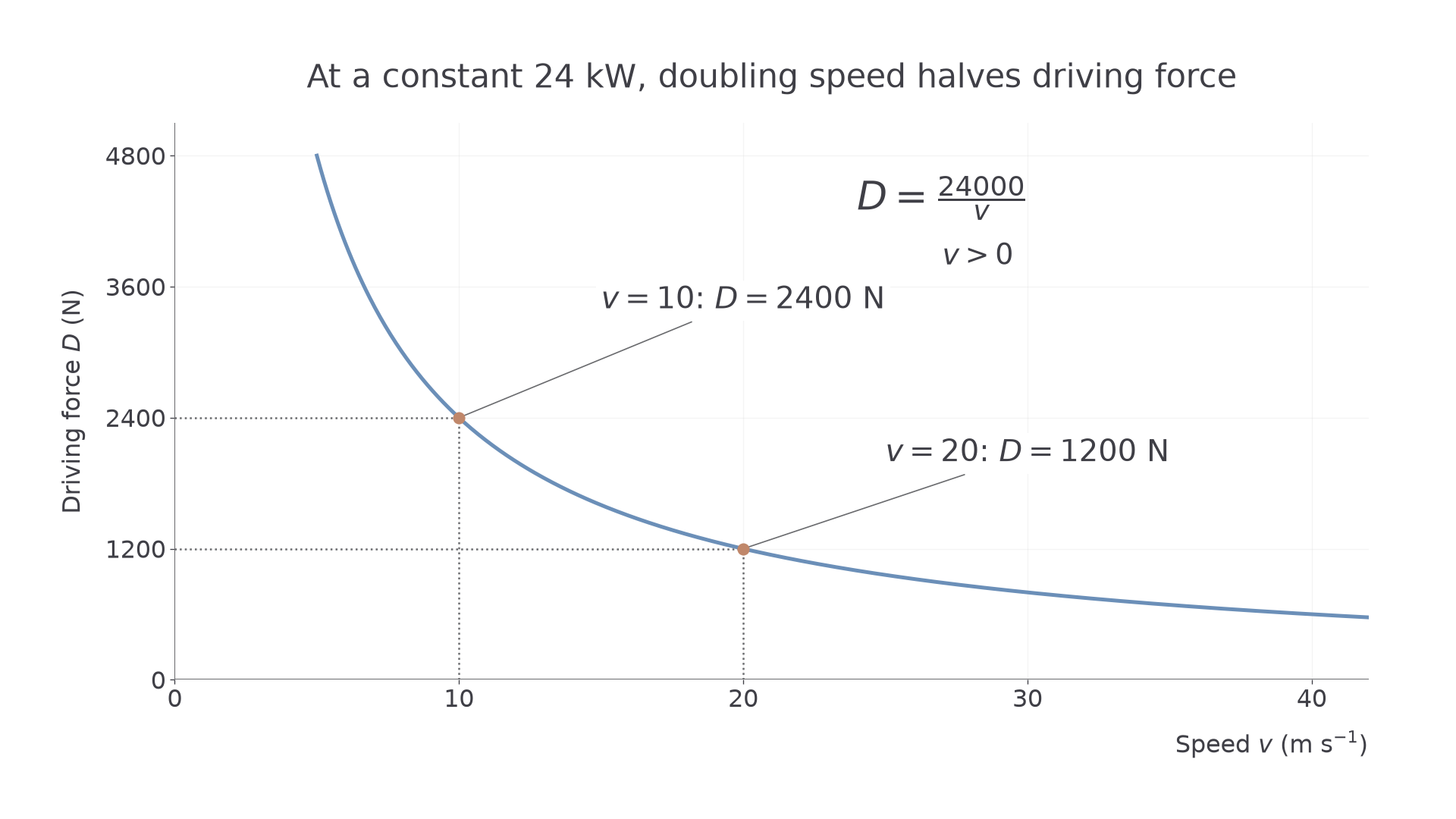
This answers the opening question. An engine at constant power supplies less driving force at a greater speed. For example, at , it supplies at , but at .
[DIAGRAM: asset_name: Driving force decreases as speed rises at constant power; asset_slug: 9fm0-fm139-constant-power; caption: At constant power, doubling speed halves the driving force; description: A force-speed graph shows D equals 24000 divided by v for positive speed. Labelled points are speed ten metres per second with driving force 2400 newtons and speed twenty with driving force 1200 newtons. Dotted guides connect both points to the axes, and the fixed power of 24 kilowatts is stated in the title.]
Watch out
Wrong: watts in Worked example 4. The speed is in , so the units do not match. Right: . Give the final answer in the unit requested.
Keep that steady speed and change only the resistance.
Combining power with the equation of motion
An accelerating vehicle needs driving force both to overcome opposing forces and to produce a resultant. Write that force equation in full before simplifying. This keeps the engine's driving force separate from the resultant force.
A powered vehicle on an incline
For a vehicle of mass , driving power , speed , and non-gravitational resistance , take the positive direction along its motion. On an incline of angle ,
These assume the driving force acts along the motion and no other force has a component along the road. On a level road set .
Not in the formula booklet: learn it.
Resistance opposes motion in both cases. The sign of the weight component changes because the positive direction changes from uphill to downhill.
Continue this lesson.
You’re previewing NovaLearn without an account. Create a free account to read the rest.
Create free account