FP1 4.2 - Foci, directrices and eccentricity
Describe a conic using the ratio of distances from a focus and a directrix. You will connect eccentricity with the Cartesian parameters, find foci and directrices, and use shared geometric information to determine unknown conics.
One distance ratio creates three kinds of conic
An ellipse has equation . A hyperbola has the same foci and the reciprocal eccentricity. Can you find its two parameters without starting with simultaneous equations? The foci provide the useful shortcut; we will find .
You already know
Recognise the standard Cartesian and parametric conics from FP1 4.1. The distance between two points uses the square root of the sum of squared coordinate differences. A distance to a line is perpendicular: to it is , and to it is .
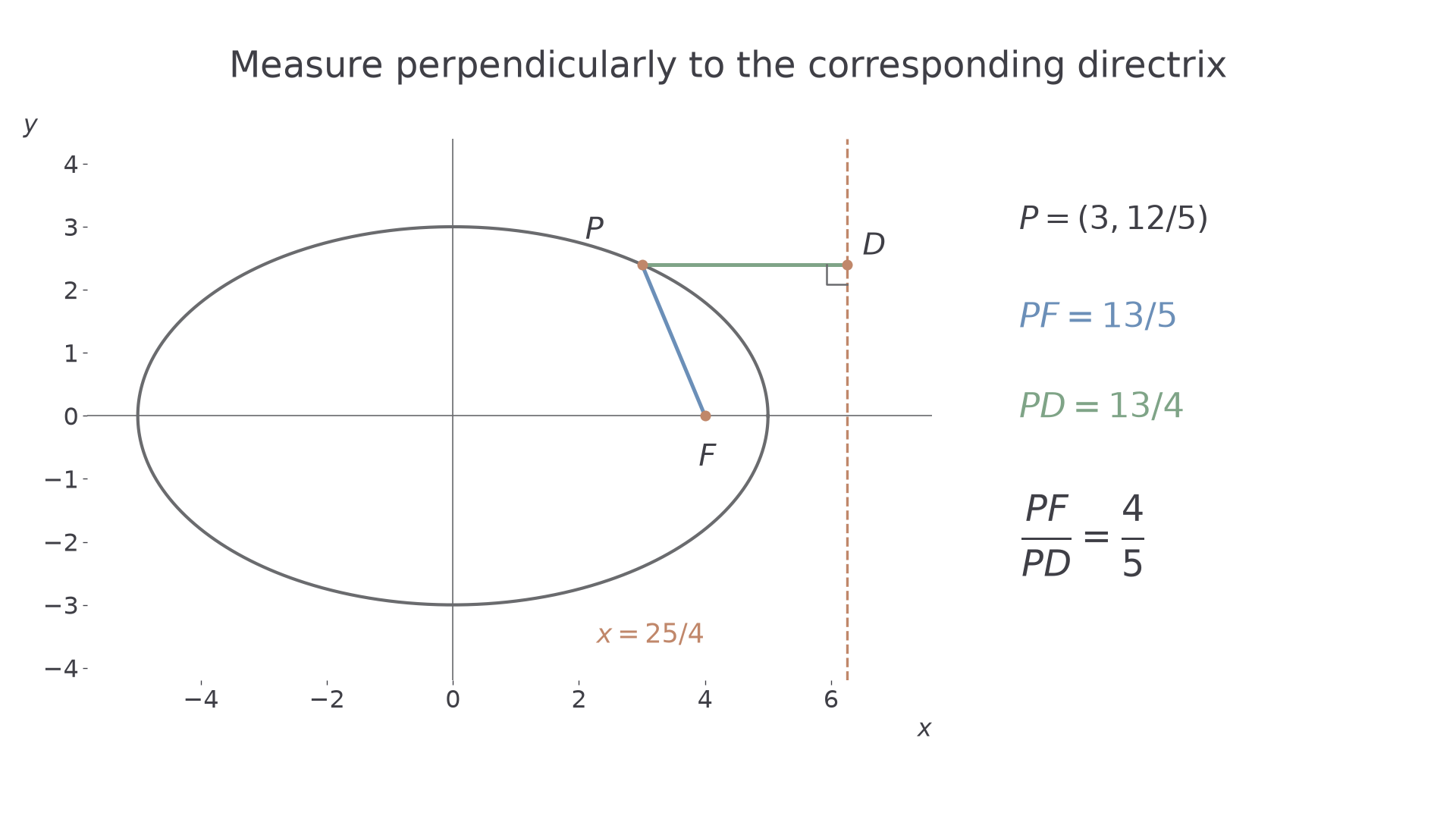
Fix a point , called the focus, and a line , called the directrix, with not on . For a point , let be the foot of the perpendicular from to . The focus-directrix property is
The positive constant is the eccentricity. The ratio uses ordinary non-negative distances, not signed horizontal displacements.
Eccentricity and conic type
For the non-degenerate focus-directrix conics,
The printed table gives these types and their parameter relations. A circle is the limiting ellipse with ; it has no finite directrix in this description.
In the formula booklet.
An ellipse or hyperbola has two corresponding focus-directrix pairs. Use one pair consistently: the positive focus goes with the positive directrix in the horizontal standard form. Do not measure to whichever focus or line happens to be nearest.
Key idea
Fix one focus and its corresponding directrix. The conic consists of points with the same non-negative distance ratio , using perpendicular distance for .
Check the chosen focus-directrix pair geometrically before calculating either distance.
[DIAGRAM: asset_name: Perpendicular distance to an ellipse directrix; asset_slug: 9fm0-fp171-focus-distance; caption: Eccentricity compares a focus distance with a perpendicular line distance; description: An equal-scale graph shows the ellipse x squared over 25 plus y squared over 9 equals 1, its right focus F at (4,0), and the vertical directrix x equals 25 over 4. The point P is (3,12 over 5) and its perpendicular foot D is (25 over 4,12 over 5). A blue segment PF and a sage horizontal segment PD are shown with a right-angle marker at D. A separate side panel gives PF equals 13 over 5, PD equals 13 over 4, and PF over PD equals 4 over 5. All distance labels are outside the curve.]
Watch out
Wrong: take to be the distance between the foci. Right: eccentricity is a dimensionless ratio. Enlarging a conic changes its lengths but not its eccentricity.
Use the ratio definition directly.
Equal distances give the parabola
For focus and directrix , the property gives
Conversely, this equation gives the squared distance equality, and non-negative square roots recover the original distance equality. No extra branch is introduced.
Parabola geometry
For , where , the focus is , the directrix is and . The vertex is halfway between the focus and directrix along the symmetry axis.
In the formula booklet.
The focus and directrix are on opposite sides of the vertex.
Worked example 1: an equation from equal distances
Question. Find the locus of points equidistant from and the line , identifying the curve.
Plan. Set the point distance equal to the perpendicular line distance and square.
Why this step? The distance to the vertical line is , independent of . Using a sloping distance to a point on the line would describe a different locus.
Answer. The parabola , with vertex , focus , directrix , eccentricity .
Check. At , the focus distance is and the line distance is .
Change only the common focus/directrix scale from to .
Worked example 2: a wider distance scale
Question. Find the locus equidistant from and .
Plan. Use the same equality with the new positions.
Why this step? The eccentricity remains because the distances remain equal; changing the scale does not change the type.
Answer. , a parabola with focus and directrix .
Check. Its point is units from both the focus and the line.
The printed geometry also works after translating or interchanging coordinates. For example, has focus and directrix ; these translated forms follow by moving the whole picture.
Watch out
Wrong: the focus of is . Right: compare with ; the focus is .
Change the distance scale once more.
Ellipse geometry from its semiaxes
For a horizontal major axis, take . The ellipse relation is , so its eccentricity is the positive square root .
To see the focus-directrix property, choose and . The equation becomes
Thus the denominator of is exactly . Since distances and are non-negative, the squared relation is equivalent to .
Horizontal ellipse geometry
For , with ,
The two foci lie inside the ellipse; the two directrices lie outside it. If the major axis is vertical, interchange the coordinate roles before applying the formulas.
In the formula booklet.
Work with until the final positive square root. The symbol denotes a ratio, so it has no negative alternative.
Worked example 3: a rational eccentricity
Question. Find the eccentricity, foci and directrices of .
Plan. Read , calculate , then use and for different purposes.
Why this step? Multiplication gives the focus position, while division gives the directrix position. They are not interchangeable.
Answer. ; foci ; directrices .
Check. : each positive focus is inside its positive vertex and the corresponding directrix is beyond it.
Change only the vertical semiaxis from to .
Worked example 4: the foci move outwards
Question. Find the eccentricity, foci and directrices of .
Plan. Use the new , keeping .
Why this step? Reducing the vertical semiaxis with fixed horizontal semiaxis increases , so the foci move towards the vertices.
Answer. ; foci ; directrices .
Check. For , and for the positive pair; the ratio is , as in the diagram.
Continue this lesson.
You’re previewing NovaLearn without an account. Create a free account to read the rest.
Create free account