FM2 1.2 - Motion in a vertical circle
In a vertical circle, gravity changes the speed as well as the force needed to turn the particle. You will combine energy with radial and tangential equations, find complete-circle conditions, and decide whether a particle turns back, a string becomes slack, or contact with a surface ends. Each circular-motion equation applies only while the circular constraint still holds.
Use height to find speed around the circle
If a particle has just enough energy to reach the top of a circle, must its string stay taut all the way? Not necessarily. Energy can predict a speed at a point the string cannot actually make the particle reach along a circle. You will need a force check as well.
You already know
With gravity as the only force doing work, . Use vertical height, not distance along a path. A smooth fixed constraint's normal force does no work; a taut inextensible string's tension is perpendicular to instantaneous motion and also does no work.
Take the lowest point as height zero. Let be the angle the radius makes with the downward vertical, increasing as the particle rises on the right of the circle. At the bottom , at the side , and at the top . The height is .
Energy from the bottom of a vertical circle
For a particle launched at speed from the bottom of a fixed circle of radius , with no resistance and no other working force,
Hence
This gives a possible speed while the stated circular motion remains valid; alone does not guarantee a taut string or contact.
Not in the formula booklet: learn it.
Tension can change the direction without changing the kinetic energy directly. Gravity transfers energy between kinetic and gravitational potential forms as the height changes.
Worked example 1: speed at an angle
Question. A particle is attached to a fixed point by a light inextensible string of length . It is projected horizontally from the lowest point at . Find its speed when the string has turned through . Assume the string remains taut to this point and neglect resistance.
Plan. Find the height gained and subtract its gravitational energy from the initial kinetic energy.
Why this step? The string length is the circle radius here, but the rise is only , not the full radius or the arc length.
Answer. The speed is .
Check. Per unit mass, kinetic energy falls from to , a loss equal to .
Change only the observation angle, from to .
Worked example 2: speed at the side
Question. The same particle is launched at on the one-metre string. Find its speed at the side of the circle, assuming the string remains taut.
Plan. Use the new height gain , retaining the same initial energy.
Why this step? The additional rise reduces speed further. The radial acceleration therefore varies around the circle even though its radius is fixed.
Answer. The speed is .
Check. The energy decrease per unit mass is , equal to times the one-metre rise.
These examples use energy to find a candidate speed. The next part tests the force required to keep that candidate motion circular.
Watch out
Wrong: adding both as potential energy gained and a separate negative gravity-work term. Choose one energy account. Also, the speed is not constant around a vertical circle.
Change only the observation angle again.
Resolve radially and tangentially
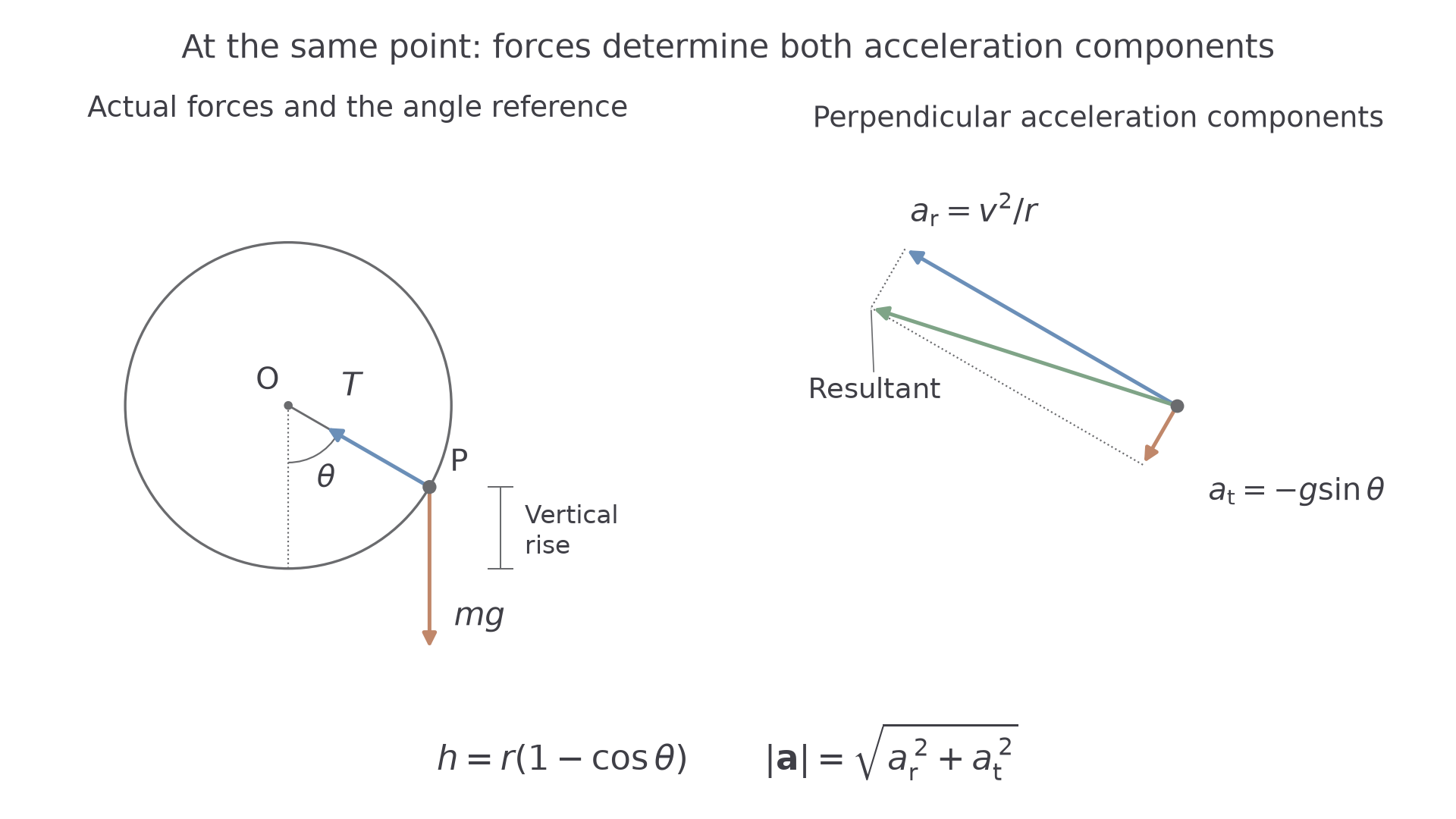
Radial acceleration turns the velocity; tangential acceleration changes its magnitude. These directions are perpendicular at each point. In a vertical circle both can be non-zero, so the magnitude of the total acceleration is generally larger than .
Acceleration components for a fixed circle
With inwards taken as the positive radial direction, and increasing as the positive tangential direction,
Here is the signed tangential velocity; during the upward motion considered here it is positive. The booklet calls the tangential direction “transverse” and prints its acceleration as ; its radial component is negative when outwards is positive.
In the formula booklet.
Now put in the actual forces. For a taut string, tension is wholly inward. Gravity has inward component , and component in the positive upward tangent direction.
Forces for a string-supported vertical circle
While a light inextensible string of length remains taut, with resistance neglected,
Thus , and because the components are perpendicular,
The tension must be non-negative. The angle is measured from the downward vertical as defined above.
Not in the formula booklet: learn it.
At the bottom gravity opposes the inward direction, giving . At the top it helps, giving . Drawing those two cases is a useful sign check.
[DIAGRAM: asset_name: Radial and tangential components in a vertical circle; asset_slug: 9fm0-fm149-components; caption: Resolve gravity once because radial and tangential accelerations are perpendicular; description: At theta sixty degrees from the downward vertical, a left panel shows a circular path, tension inward along the radius, weight vertically down, and the angle reference. A separate acceleration panel at the same position shows radial acceleration inward and tangential acceleration down the tangent, perpendicular to each other. It states the total magnitude uses the two components, not radial acceleration combined with the whole of g.]
Worked example 3: tension and the full acceleration
Question. A particle is projected from the bottom on a one-metre light inextensible string at . At , its speed squared is . Find the tension and magnitude of its acceleration. Neglect resistance.
Plan. Use the radial force equation for tension, and combine radial and tangential accelerations for the magnitude.
Why this step? Part of gravity is already included in the radial resultant. Combine the radial acceleration with the tangential component of gravity, not with the whole .
Answer. , and .
Check. , matching the required radial acceleration; tension is positive.
Change only the position to the side of the same circle. Energy gives there.
Worked example 4: gravity is entirely tangential at the side
Question. Find the tension and acceleration magnitude for the same particle at , where .
Plan. Set the radial gravity component to zero and retain the whole gravitational acceleration in the tangent direction.
Why this step? Only at this particular position is gravity perpendicular to the radius, so here combining the radial acceleration with the whole happens to be correct.
Answer. , and acceleration magnitude is .
Check. The tension supplies horizontally, while gravity supplies vertically. These are perpendicular.
A correctly resolved equation should contain either forces throughout or accelerations throughout. Do not combine a tension in newtons with an acceleration in metres per second squared.
Watch out
Wrong in general: . Right: use for the tangential component. The formula with the whole only works at the side, where .
Change only the angle once more, using the already established energy result.
A complete circle needs a force condition at the top
Energy alone would require to reach the top height. A string imposes more: it cannot push outwards. At the top, gravity must not exceed the required inward resultant, or the calculated tension would be negative.
At the top, , so requires . Combining this with the energy equation gives the complete-circle threshold.
Complete-circle threshold for a string
For launch at speed from the bottom on a light inextensible string of length , with no resistance,
is the limiting complete-circle condition allowing zero tension at the top instant. If strictly positive tension is required at every point, use .
At any angle while taut,
so tension is smallest at the top. Checking the top therefore checks the whole circle.
Not in the formula booklet: learn it.
The minimum bottom speed is , rather than the energy-only . At that threshold the top speed is still ; the particle has not come to rest at the top.
Worked example 5: the limiting complete circle
Question. A particle is launched horizontally from the bottom on a one-metre light inextensible string. Find the least launch speed for a complete vertical circle in the limiting model, and the tension at the bottom at that speed. Neglect resistance.
Plan. Set top tension to zero, use energy down to the bottom, then find the bottom tension.
Why this step? Setting the top speed to zero would demand a negative top tension. The limiting string has zero tension, not zero speed.
Answer. The limiting least speed is , with bottom tension .
Check. At the threshold, bottom tension is , side tension , and top tension zero. The previous examples used exactly this launch speed.
Change only the string length, and therefore the radius, to .
Worked example 6: a larger vertical circle
Question. A particle is launched from the bottom on a light inextensible string. Find the limiting least speed for a complete circle and the bottom tension then.
Plan. Use the new radius in the top condition and energy equation.
Why this step? The threshold speed grows with , but at that threshold, so the bottom tension stays .
Answer. The limiting least speed is , with bottom tension .
Check. , and every lower point has greater tension.
Continue this lesson.
You’re previewing NovaLearn without an account. Create a free account to read the rest.
Create free account