D1 3.2 - Travelling salesman lower bounds
You will derive lower bounds by deleting a node, finding a residual minimum spanning tree and restoring two connections. You will compare bounds correctly and prove optimality when a lower bound meets an actual tour length.
Why a lower bound is not a route
The previous lesson found a tour of length . Is that the optimum, or merely the best tour tried so far? A lower bound of would settle it: no tour could be shorter, and one of exactly that length already exists.
You already know
An upper bound comes from a feasible tour, and the smallest available upper bound is strongest. The complete shortest-distance network satisfies the triangle inequality. A minimum spanning tree minimises connection weight but need not be a tour.
A lower bound is a length that the optimum cannot fall below. It can come from a simpler connection problem whose requirements every tour must at least meet.
Lower bound
If is the optimal tour length, a valid lower bound satisfies
A larger valid lower bound is stronger. It need not be the length of any feasible tour.
The full network's MST weight is one lower bound: remove an arc from any Hamiltonian cycle to leave a spanning path. An MST cannot be heavier than that spanning tree. But the full MST usually imposes too few tour requirements; the residual-tree method adds the requirement of two connections at a selected node.
Key idea
A lower bound proves that every tour costs at least that much. A drawn connection structure can establish a bound without itself being a Hamiltonian cycle.
Keep feasibility and necessity separate.
The residual minimum spanning tree method
Choose a node to remove from the complete network. A Hamiltonian cycle uses exactly two arcs incident to that node. Removing it and those two arcs leaves a spanning path through the remaining nodes, whose weight cannot be smaller than their MST weight.
Residual-tree lower bound
Delete node and all its incident arcs. Let be an MST weight on the remaining nodes, and let be the two least weights on distinct arcs incident to in the original complete network. Then
is a lower bound for the optimal tour length.
Not in the formula booklet: learn it.
Why choose two distinct incident arcs? A Hamiltonian cycle enters and leaves through two different neighbours. The two smallest weights can tie, but taking the same arc twice does not meet that requirement.
Use the complete shortest-distance matrix from the previous lesson:
Deleting a node here is a bounding calculation, not a road closure. Keep all remaining matrix entries as given; do not recalculate journeys as though the town were physically inaccessible.
[DIAGRAM: asset_name: A residual-tree lower-bound construction; asset_slug: 9fm0-d1-171-residual-bound; caption: Delete A, find a residual MST of weight 12, then add AB and AD of total 6 to obtain lower bound 18.; description: Residual tree BC 4, BE 4, CD 4 shown in blue and the two least incident arcs at A, AB 2 and AD 4, shown separately in sage; the construction is labelled as a lower bound, not a tour.]
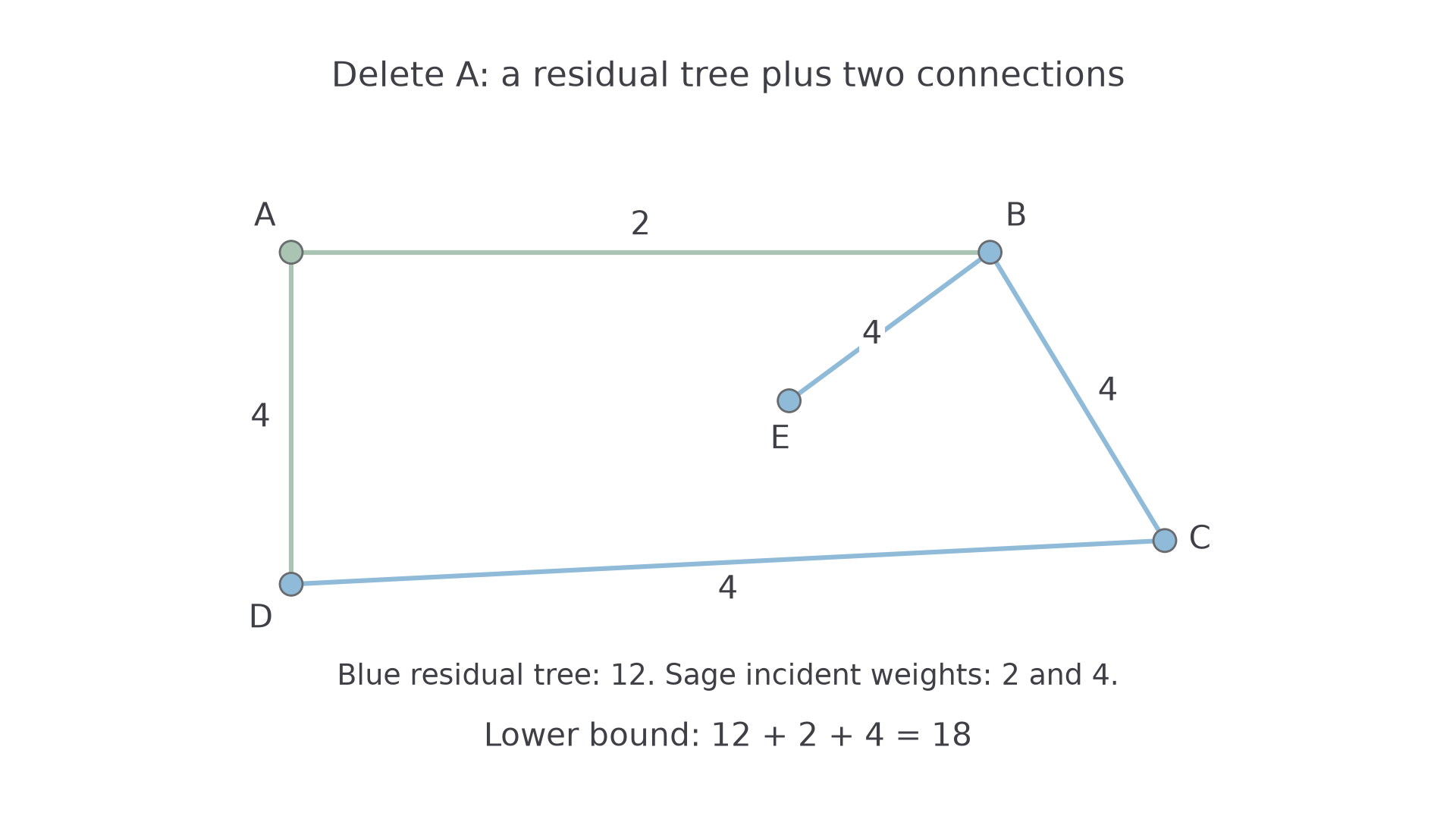
Worked example 1: deleting A
Question. Use deletion of to obtain a lower bound for the tour length.
Plan. Find an MST on , then add the two smallest distinct incident weights at .
Prim from can select , each of weight , giving
The two least -incident weights are and .
Why not add the two smallest weights anywhere in the original matrix? Both restored arcs must meet the deleted node .
Answer. Deleting gives lower bound .
Check. The residual tree includes exactly the four remaining nodes with three arcs. The restored connections go to two different neighbours of .
Worked example 2 changes only the deleted node, from to .
Worked example 2: a stronger bound from another deletion
Question. Obtain a lower bound by deleting .
Plan. Recompute an MST on , then examine the original row for .
An MST can use , with weight
The -incident weights are . The least two are and either or .
Why can either weight- arc be chosen? They are tied distinct alternatives for the second least incident weight; either gives the same lower bound.
Answer. Deleting gives lower bound , stronger than .
Check. is still no greater than the known feasible tour length , so the bounds are consistent.
The restored construction is not required to be a Hamiltonian cycle. Nor does one non-Hamiltonian construction prove a strict inequality: another tied residual tree or incident-arc choice may attain the same cost as a valid tour.
Watch out
Wrong: find an MST of the full network and add two arcs, or choose only one cheapest incident weight twice. Right: delete the node first, build the residual MST, then add two distinct original incident arcs.
Change the deleted node again.
Continue this lesson.
You’re previewing NovaLearn without an account. Create a free account to read the rest.
Create free account