Recognise reciprocal square-root integrals giving arsinh or arcosh, and choose hyperbolic substitutions for associated integrals (CP 8.5). Completing the square reveals the structure; the real domain and the sign of a square root determine the correct branch.
A sum of squares gives arsinh
Why does
∫x2+4dx
give an inverse hyperbolic sine, while changing the plus sign to a minus sign gives a different inverse and a restricted domain? The right substitution turns the square root into a single hyperbolic factor, which cancels against the differential.
For a sum of squares, cosh2t−sinh2t=1 rearranges to 1+sinh2t=cosh2t. This suggests x=asinht when a>0.
You already know
Substitution changes the differential as well as the integrand; inverse trigonometric integrals have different denominator structures, as in ∫(a2−x2)−1/2dx=arcsin(x/a)+C. From hyperbolic functions, cosh2t−sinh2t=1, cosht>0, and the inverse logarithmic forms have specific real domains.
With x=asinht,
dxx2+a2∫x2+a2dx=acoshtdt=a1+sinh2t=acosht=∫1dt=t+Cdifferentiate the substitutioncosht>0cancel identical factors
Since t=arsinh(x/a), this yields the standard result for every real x.
The reciprocal sum-of-squares square root
For a>0 and real x,
∫x2+a2dx=arsinh(ax)+C
An equivalent logarithmic answer is ln(x+x2+a2)+C. The inverse form contains an additional constant −lna, which is absorbed into the arbitrary integration constant.
In the formula booklet.
The cancellation explains why no factor 1/a appears outside the inverse. A separate scale multiplying x, however, still creates its own differential factor.
Worked example 1: a standard sum of squares
Question. Find ∫(x2+9)−1/2dx.
Plan. Use x=3sinht, which makes the radical 3cosht.
xx2+9∫x2+9dx=3sinht,dx=3coshtdt=3cosht=∫1dt=arsinh3x+Cchosen substitutionfundamental identitycancel and return
Why this step? Both the square root and differential contain the same factor 3cosht; there is no leftover 1/3.
Answer.arsinh(x/3)+C, for all real x.
Check. Differentiating the inverse form gives (1/3)/1+x2/9=1/x2+9.
Change only the coefficient of x2. The radical now contains 2x, so scaling the variable contributes an outside factor.
Worked example 2: a scale inside the radical
Question. Find ∫(4x2+9)−1/2dx.
Plan. Put u=2x, then apply the standard sum-of-squares result.
u∫4x2+9dx=2x,dx=21du=21∫u2+9du=21arsinh(32x)+Cscale the variableinclude the differential factorstandard result
Why this step? The factor 1/2 comes from replacing x by u/2, not from the radius parameter 3.
Answer.21arsinh(2x/3)+C, for all real x.
Check. Differentiation gives
211+4x2/92/3=4x2+91
Compare the whole denominator before choosing an inverse. A reciprocal sum of squares without a square root gives an arctangent form, not this arsinh form.
Watch out
Wrong: ∫(x2+9)−1/2dx=31arsinh(x/3)+C. Differentiation leaves an unwanted 1/3. Right: arsinh(x/3)+C.
Match a new pair of scales.
A difference of squares and its branches
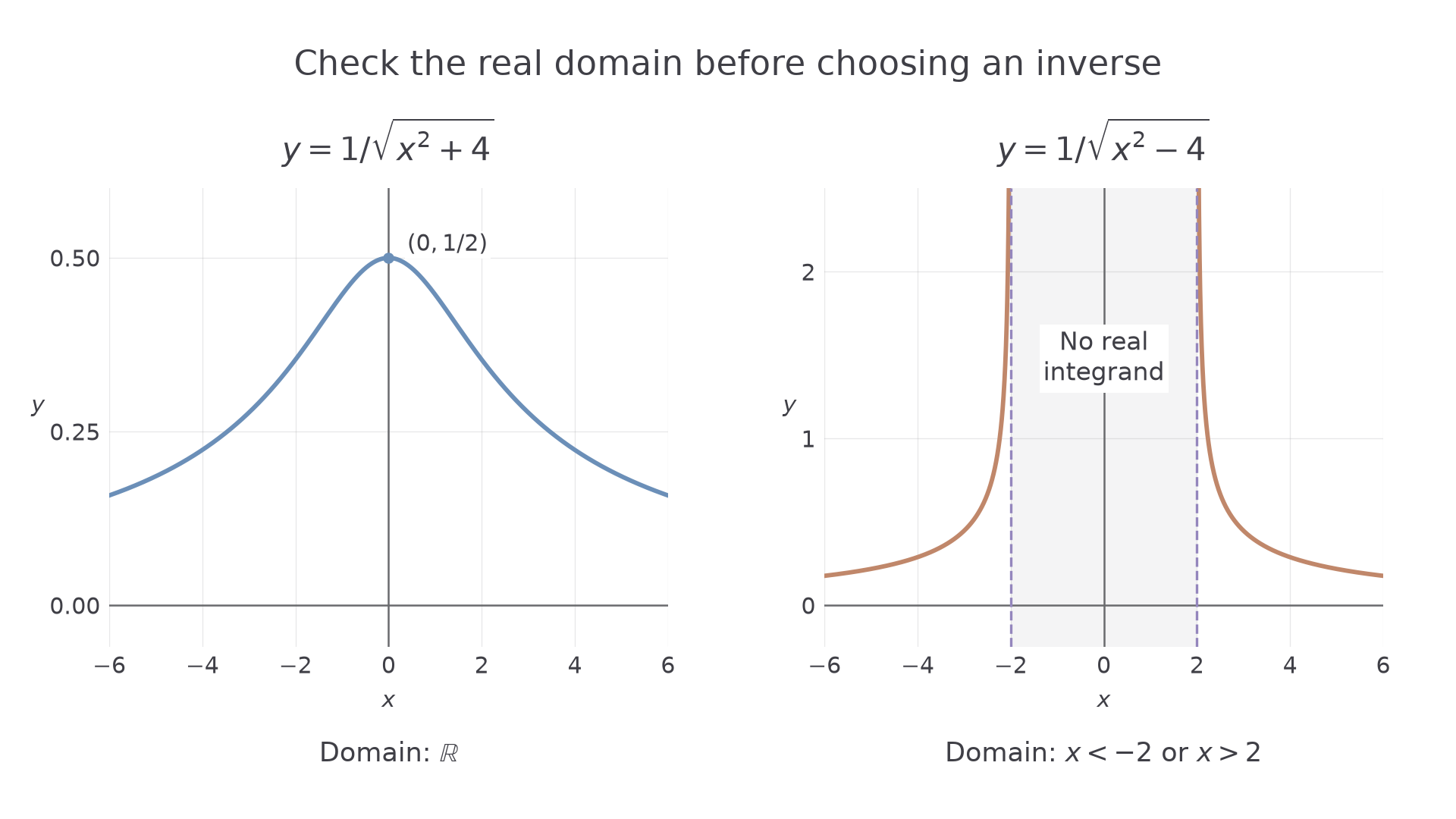
The reciprocal square root of x2−a2 is real only on the two exterior intervals x>a and x<−a, and the substitution must respect which interval you are using.
On x>a>0, put x=acosht with t>0. Then
dxx2−a2∫x2−a2dx=asinhtdt=asinh2t=asinht=∫1dt=arcoshax+Cdifferentiatet>0cancel and return
The strict domain excludes x=a, where the reciprocal integrand is undefined.
The positive exterior branch
For a>0 and x>a,
∫x2−a2dx=arcosh(ax)+C
An equivalent logarithmic primitive is ln(x+x2−a2)+C, with the constant shift absorbed.
In the formula booklet.
For x<−a, the real integrand still exists, but x/a<−1 is outside the domain of arcosh. Instead put x=−acosht, t>0. The square root is still asinht>0, while dx=−asinhtdt. Their quotient is now −dt.
The negative exterior branch
For a>0 and x<−a,
∫x2−a2dx=−arcosh(a−x)+C
On either exterior interval, a logarithmic primitive is
lnx+x2−a2+C
The two intervals may have different arbitrary constants. This extends the booklet's stated x>a form.
Not in the formula booklet: learn it.
The minus sign in the negative branch makes its derivative positive, as the original integrand is positive on both intervals. Simply writing arcosh(−x/a) without that minus sign would produce a negative derivative.
[DIAGRAM: asset_name: Domains of reciprocal square-root integrands; asset_slug: 9fm0-hyperbolic-integral-domains; caption: A sum of squares permits every real input; a difference permits only the two exterior intervals; description: Two Cartesian panels show y equals one over root of x squared plus 4 as a smooth positive curve for all real x, and y equals one over root of x squared minus 4 as two positive exterior branches with vertical asymptotes x equals minus 2 and x equals 2. The interval between those asymptotes is pale grey and labelled no real integrand; neither endpoint belongs to the domain.]
Worked example 3: the positive branch
Question. Find ∫(x2−9)−1/2dx, for x>3.
Plan. Put x=3cosht, with t>0, so the radical and differential share a positive factor.
Why this step? The restriction t>0 justifies replacing sinh2t by sinht, instead of an absolute value with unknown sign.
Answer.arcosh(x/3)+C, for x>3.
Check. Its derivative is (1/3)/x2/9−1=1/x2−9.
Change only the interval of x. The radicand is unchanged, but the substitution and the inverse answer acquire the appropriate signs.
Worked example 4: the negative branch
Question. Find ∫(x2−9)−1/2dx, for x<−3.
Plan. Use x=−3cosht, t>0, so that the inverse's input is positive.
dx∫x2−9dx=−3sinhtdt,x2−9=3sinht=−∫1dt=−t+C=−arcosh(3−x)+Ct>0retain the differential signreturn to x
Why this step? The square root is a non-negative length; its sign does not follow the negative sign of x. That sign belongs in the differential.
Answer.−arcosh(−x/3)+C, for x<−3.
Check. Differentiating gives
−x2/9−1−1/3=x2−91
At x=−5, this is 1/4>0.
The same sign issue underlies u2=∣u∣. Choosing a range for the substitution before simplifying the radical prevents a later branch correction from being forgotten.
Watch out
Wrong: arcosh(x/a) on x<−a. That inverse has no real value there. Right: use the negative-branch answer, or the logarithmic primitive with an absolute value, and state the interval.
Use a new parameter on the negative interval.
Completing the square and choosing a substitution
A quadratic expression may hide its sum or difference of squares, so complete the square before selecting an inverse or a substitution.
Continue this lesson.
You’re previewing NovaLearn without an account. Create a free account to read the rest.