CP 2.6 - Multiplying and dividing in modulus-argument form
Multiply and divide complex numbers by working with their lengths and directions (CP 2.6). You will derive the rules from compound angles, return calculated directions to the principal range and interpret a complex multiplication as a rotation and a change of scale.
Multiply moduli and add directions
Why does multiplying by and then by double a complex number? The algebra says . The geometry will explain how two changes of direction can cancel while their changes of scale combine.
Start with . Both factors have modulus and argument ; the answer has modulus and argument . The lengths multiplied, while the directions added. This happens for every non-zero pair.
You already know
Modulus-argument form is , with ; the principal argument lies in . From A-level Mathematics, the compound-angle formulae give and .
Write and . Expansion gives
The two real expressions are exactly the compound-angle formulae. No new trigonometric identity is being smuggled in.
Product in modulus-argument form
For non-zero with moduli and arguments ,
A direction of the product is . Add or subtract multiples of , if necessary, to give its principal argument.
Not in the formula booklet: learn it.
The modulus identity also holds if a factor is zero, but an argument cannot be assigned to that zero factor or to the zero product. The angle rule needs both factors non-zero.
Worked example 1: the product points straight up
Question. Given
find in modulus-argument form and in Cartesian form.
Plan. Multiply the moduli, add the angles and evaluate the resulting exact trigonometric values.
Why this step? Multiplication combines directions by addition; multiplying the two angles has no geometric or algebraic justification.
Answer. .
Check. In Cartesian form, and . Their real product terms cancel and their imaginary terms total .
Now change only the angle of , from to . The sum of the angles leaves the principal range, so it needs one full-turn correction.
Worked example 2: a product beyond the principal range
Question. Keep , but let . Find , and in Cartesian form.
Plan. Add directions, subtract if required and then recover the coordinates.
Why this step? describes the correct direction, but the principal argument must lie above and at most .
Answer. Modulus , principal argument , and product .
Check. The Cartesian modulus is ; both coordinates are negative, consistent with .
When principal arguments are used, the familiar line “arguments add” always comes with this full-turn qualification.
Watch out
Wrong: as a principal argument. Right: . The equality of directions is modulo ; do not change the modulus when correcting an angle.
Apply the same correction when the sum is further round the circle.
Divide moduli and subtract directions
Division undoes multiplication: divide the lengths and subtract the direction of the denominator from the direction of the numerator.
For , its reciprocal is
Multiplying this expression by gives modulus and angle zero, so the product is . Multiplying by this reciprocal establishes the quotient rule. The reciprocal's direction may itself need a full-turn correction at the principal endpoint, but its sine and cosine are unchanged.
Quotient in modulus-argument form
For non-zero with moduli and arguments ,
A direction of the quotient is ; adjust by multiples of to obtain its principal argument. Division requires ; an argument for the quotient also requires .
Not in the formula booklet: learn it.
The order matters: denominator direction is subtracted from numerator direction. Unlike multiplication, reversing the two numbers changes the result.
Worked example 3: an exact quotient
Question. Given
find in Cartesian form.
Plan. Divide the moduli and subtract the denominator's angle, then evaluate the trigonometric values.
Why this step? Multiplying the quotient by must add back and recover the numerator's angle .
Answer. .
Check. , and .
The second example changes only the denominator's angle, making it negative. Subtracting that negative direction increases the angle.
Worked example 4: subtracting a negative angle
Question. Keep , but let . Find and its principal argument.
Plan. Subtract the signed denominator angle, reduce the result to the principal range and convert to Cartesian form.
Why this step? The parentheses preserve the sign of the denominator angle. Without them it is easy to subtract instead.
Answer. , with principal argument .
Check. Here ; multiplying it by gives .
A reciprocal both reverses a direction and replaces a scale factor by its reciprocal. These are two separate operations.
Watch out
Wrong: dividing the arguments, such as . Angles are subtracted, not divided. Right: . Only the moduli are divided.
Use the same subtraction when the denominator lies below the real axis.
Multiplication rotates and changes scale
Multiplication by a fixed non-zero complex number rotates every position vector through the same angle and multiplies every length by the same positive factor.
Let the fixed multiplier be . For any non-zero , the product has modulus and direction . That is a rotation through about the origin followed by an enlargement with scale factor . You can apply them in either order; the origin itself stays at the origin.
Geometric effect of a complex multiplier
Multiplication by has enlargement scale factor and rotation angle , measured anticlockwise if positive. For example, multiplication by doubles lengths and rotates through . Multiplication by a negative real number is not a reflection: it includes a rotation through .
For a concrete case, multiplying by gives . The modulus changes from to , and the angle changes from to . The picture displays the same calculation as a turn and a stretch.
[DIAGRAM: asset_name: Multiplication by 2i as a rotation and an enlargement; asset_slug: 9fm0-complex-multiplier; caption: Multiplication by 2i turns a vector through a right angle and doubles its length; description: Equal-scale Argand axes show z equals 1 plus i at (1,1) and 2iz equals minus 2 plus 2i at (minus 2,2). Blue and clay position arrows have labelled lengths root 2 and 2root 2. A curved arrow around the origin marks an anticlockwise rotation of pi over 2.]
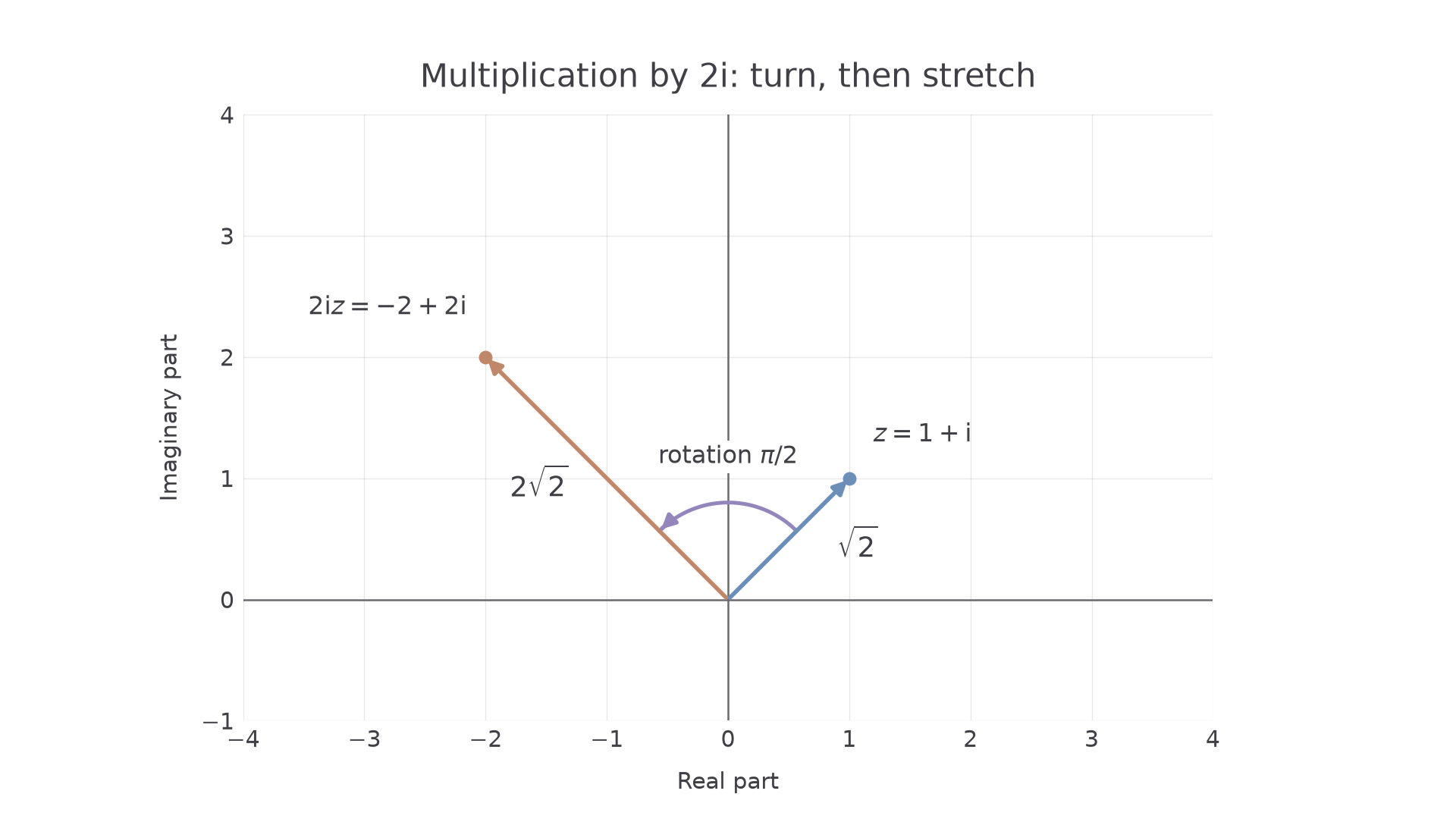
Division by reverses both changes: scale factor and rotation through . In particular, division by is a clockwise quarter-turn, because . A multiplier of modulus rotates without changing any length; a positive real multiplier changes scale without changing direction.
Now return to the opening puzzle. Both and have modulus , and their arguments are and . The opposite turns cancel, while the scale factors multiply to . The pair doubles every complex number. Turning back does not undo the stretching!
Key idea
A product combines a change of scale with a change of direction: multiply the positive scale factors and add the directed angles.
The following flawed argument mixes up those two jobs.
Quick Recap
- Multiply moduli and add directions for a product.
- Divide moduli and subtract the denominator direction for a quotient.
- Correct directions by whole multiples of when a principal argument is required; zero has no argument.
- Multiplication by enlarges by and rotates by ; division reverses both changes.
The opening multipliers have opposite angles but both have scale factor . Their turns cancel and their combined scale factor is .