FM1 3.1 - Hooke's law for strings and springs
An elastic force depends on how far a string or spring has changed from its natural length. You will use Hooke's law to calculate that force, find unknown elastic parameters, and combine it with equilibrium or Newton's second law. You will distinguish a slack string from a compressed spring throughout.
Measure extension from the natural length
Cut a uniform elastic string into two equal halves. Does each half need more or less force to stretch it by the same amount? The material has not changed, but the natural length has. Hooke's law will show why that difference matters.
You already know
Forces are vectors. A string pulls along its length, and a particle in equilibrium has zero resultant force. Draw the forces on the particle, then resolve them in suitable directions; do not assume a tension equals the weight without checking the geometry.
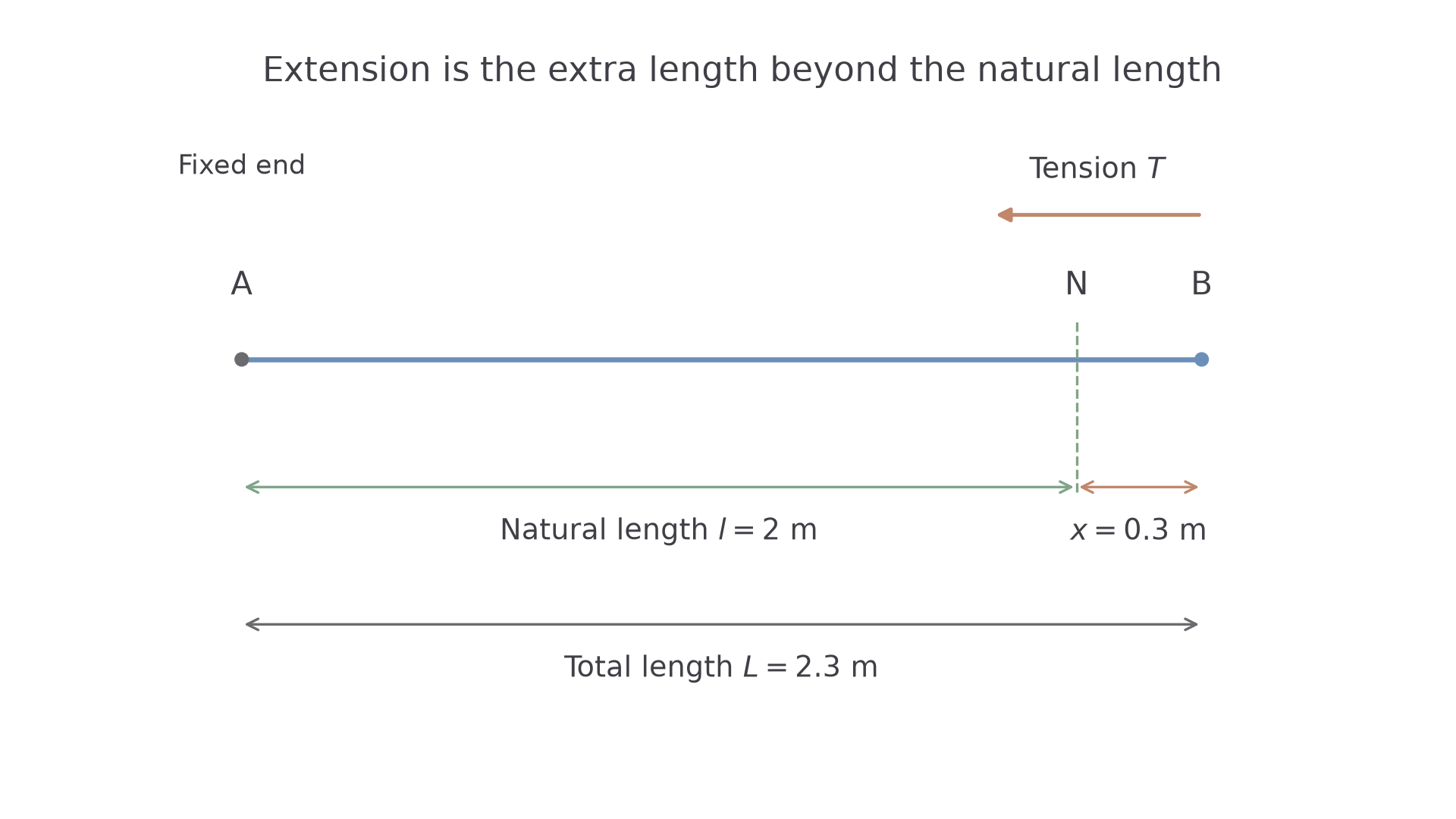
A string with natural length , stretched straight to , has extension . The extension is the extra length, not the whole distance between the ends.
[DIAGRAM: asset_name: Natural length and extension are different distances; asset_slug: 9fm0-fm140-length-and-extension; caption: Hooke's law uses the extra length x, with the natural length l kept in the denominator; description: A fixed endpoint A and a stretched endpoint B are separated by 2.3 metres. A marked reference point N is two metres from A. Separate dimension arrows show natural length l equals two metres from A to N, extension x equals 0.3 metres from N to B, and total stretched length L equals 2.3 metres from A to B. The tension on the right endpoint points left towards A.]
Natural length, extension and modulus
The natural length is the length of an unstretched elastic string or spring. When it is stretched straight to length , its extension is . Its modulus of elasticity is the positive constant in Hooke's law, measured in newtons. It is not a spring stiffness: stiffness has units .
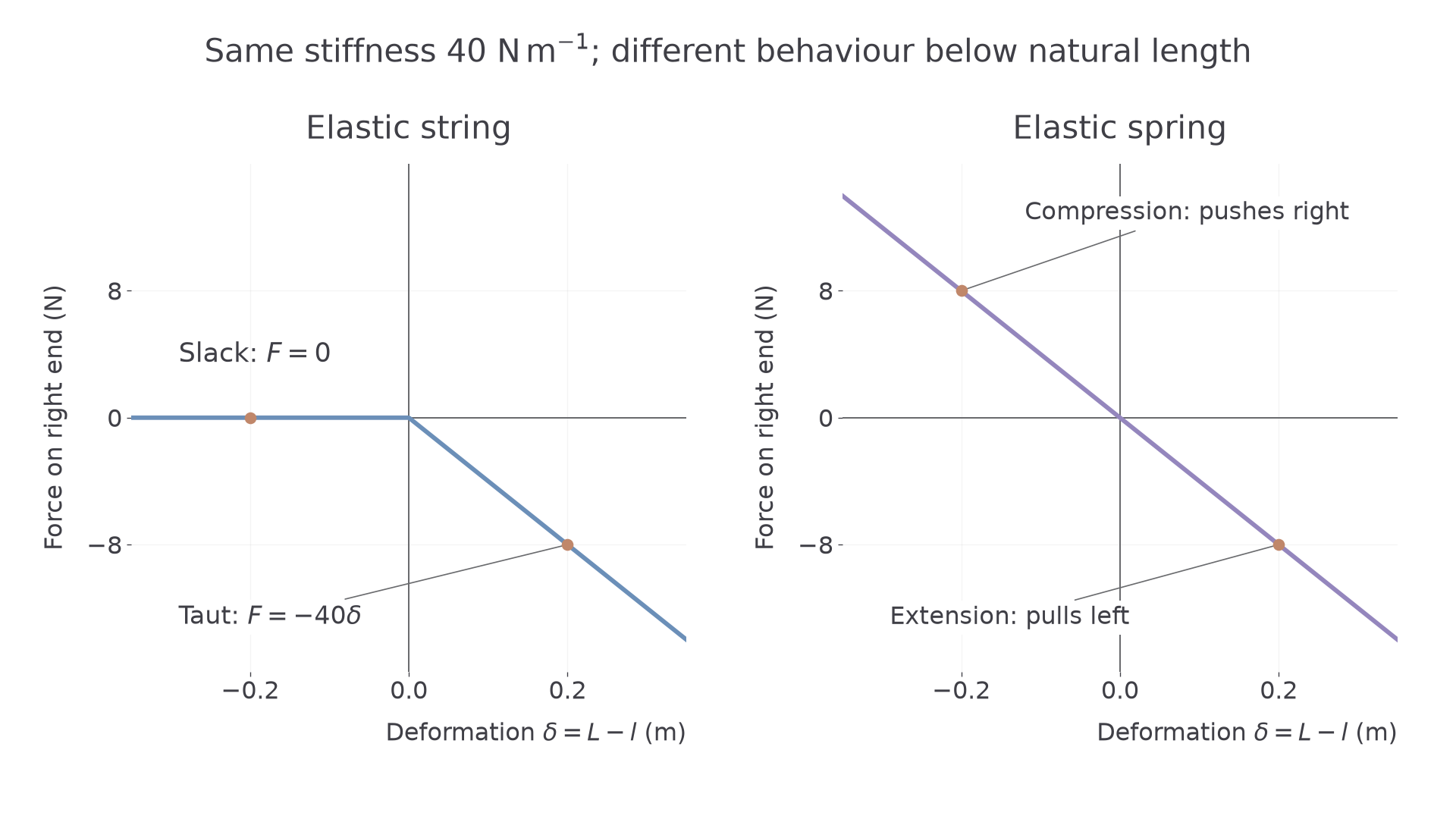
An ideal light string has negligible mass. When taut, its tension acts along the string and is the same throughout it. It can pull, but cannot push. If its endpoints are closer than its natural length, it is slack and the model gives zero tension.
Hooke's law for an elastic string
For a taut ideal elastic string of natural length , modulus and extension ,
At natural length the tension is zero. If the endpoint separation is less than , the string is slack and , rather than a negative tension. Use consistent length units and assume the model obeys Hooke's law over the stated range.
Not in the formula booklet: learn it.
First calculate a tension from the stretched length.
Worked example 1: a taut string
Question. A light elastic string has natural length and modulus . Its endpoints are held apart. Find its tension.
Plan. Subtract the natural length from the endpoint separation, then apply Hooke's law.
Why this step? The numerator contains the extension , while the denominator remains the natural length . They are different quantities.
Answer. The tension is , pulling each endpoint towards the other.
Check. The extension is of the natural length, so .
Change only the endpoint separation to . The string's state changes, so check whether the formula's taut-string condition still holds.
Worked example 2: a string cannot push
Question. A light elastic string has natural length and modulus . Its endpoints are held apart. Find its tension.
Plan. Compare endpoint separation with natural length before applying Hooke's law.
Why this step? The negative difference does not describe a compressed string pushing its ends apart. The string simply loses tension and need not remain straight.
Answer. The tension is .
Check. A string cannot exert the compressive force that a negative value of would suggest.
The endpoint distance must therefore be interpreted before the arithmetic begins.
Watch out
Wrong for Worked example 1: . The numerator needs , not the stretched length. Wrong for Worked example 2: a tension of . A slack string has zero tension, not negative tension.
Change the separation again, checking the state first.
Finding a natural length and modulus
Two measured tensions at two stretched lengths can determine both the natural length and the modulus. Keep the unknown natural length in each extension; the measurements are lengths, not extensions.
Stiffness and two stretched states
Writing
gives , with stiffness in . For two taut states of the same ideal string,
After finding , use , then . These equations require the same unchanged string and a valid Hooke's-law model.
Not in the formula booklet: learn it.
Subtracting the two equations removes the natural length from the brackets. It does not remove it from the definition of stiffness.
Worked example 3: two tension measurements
Question. A light elastic string has tension when its length is , and tension when its length is . Find its natural length and modulus.
Plan. Subtract the two Hooke's-law equations to find stiffness, then recover natural length and modulus.
Why this step? The change in length is also the change in extension, because both measurements use the same natural length.
Answer. The natural length is , and the modulus is .
Check. The extensions are and . Hooke's law gives and .
Change only the first measured tension to . Both parameters must be recalculated; the second measurement alone cannot determine them.
Worked example 4: a changed first reading
Question. A light elastic string has tension when its length is , and tension when its length is . Find its natural length and modulus.
Plan. Find the new slope of tension against length and use it in either original equation.
Why this step? The smaller change in tension over the same length interval gives a smaller stiffness. A natural length must still be found before converting stiffness to modulus.
Answer. The natural length is , and the modulus is .
Check. The extensions are and ; and . Both lengths exceed the natural length, as required.
You can also solve directly in and by dividing the original equations. The stiffness method makes the straight-line relationship easier to see.
Watch out
Wrong: the gradient is the modulus. Its units are , so it is stiffness . Multiply by the natural length to obtain the modulus in newtons.
Change only the first tension once more.
A spring can pull or push
An ideal elastic spring differs from a string at lengths below its natural length. The spring can remain straight and compressed, pushing its ends apart. Its force still acts to restore its natural length.
Compression and restoring force
A spring of natural length , compressed to length , has compression . Its restoring force pushes outwards; a stretched spring pulls inwards. “Restoring” describes the force's direction towards natural length, not necessarily the direction in which the attached particle is moving.
For a spring fixed at its left end, use right as positive for the force on its right end. Extension gives a leftward force; compression gives a rightward force.
Hooke's law for an ideal spring
With natural length , modulus and stiffness ,
If is signed deformation, the force on the right end of a spring fixed at its left end is
This assumes an ideal light spring obeying Hooke's law over the stated extensions and compressions.
Not in the formula booklet: learn it.
The following force graphs show the crucial difference on the compressed side. The sign refers to the force on the right endpoint, with right positive.
[DIAGRAM: asset_name: A slack string and a compressed spring have different forces; asset_slug: 9fm0-fm140-string-spring-forces; caption: A string stops pulling when slack, while a compressed spring pushes; description: Two signed force-deformation graphs use stiffness forty newtons per metre and right positive. For a string, force on the right endpoint is zero for negative deformation and minus forty times deformation for positive deformation. For a spring, force is minus forty times deformation on both sides of zero. Points at deformation plus 0.2 metres have force minus eight newtons in both panels, while deformation minus 0.2 gives zero for the string and plus eight newtons for the spring.]
Continue this lesson.
You’re previewing NovaLearn without an account. Create a free account to read the rest.
Create free account