FP2 5.1, 5.2 - The Euclidean algorithm and Bezout's identity
Use division with remainder to find highest common factors and express them as integer combinations (FP2 5.1, 5.2). You will run the Euclidean algorithm forwards, then use its own equations backwards.
Division with a controlled remainder
Two lengths measure and whole units. What is the greatest whole-number length that fits exactly into both, and can you certify your answer without listing their factors? The useful move is to keep the remainder after each division.
You already know
An integer divides an integer if for some integer . We write . The highest common factor of two positive integers is their greatest positive common divisor; we write it as . Ordinary division and rearranging an equation are all we need to begin.
The quotient counts complete groups. The division theorem chooses a remainder in one fixed interval, so that every integer has exactly one permitted quotient–remainder pair.
The division theorem
For an integer and a positive integer , there are unique integers such that
Here is the quotient and the remainder. Equivalently, , the greatest integer no larger than . Two integers have the same remainder on division by exactly when their difference is a multiple of .
Not in the formula booklet: learn it.
Why insist on that interval? If , then . The right-hand side lies strictly between and , so its only possible multiple of is . Thus both quotients and both remainders agree. The rule works for negative dividends too: the quotient rounds down, while the remainder stays nonnegative.
Worked example 1: a positive dividend
Question. Use the division theorem to divide by .
Plan. Find consecutive multiples of surrounding , then measure from the lower one.
Why this step? The inequalities certify the division-theorem pair, rather than merely an equation involving .
Answer. .
Check. .
Change only the sign of the dividend. The permitted remainder interval stays exactly the same.
Worked example 2: a negative dividend
Question. Use the division theorem to divide by .
Plan. Locate the negative dividend between consecutive multiples of ; use the lower multiple.
Why this step? Writing gives an integer equality, but its negative remainder fails the division theorem's condition.
Answer. .
Check. ; also .
The sign of the dividend changes the quotient, not the allowed remainder interval.
Watch out
The line is an equality, but it is not a division-theorem answer: the remainder is negative. Use , with .
The diagram makes the change of quotient visible: a remainder measures forwards from the lower multiple.
[DIAGRAM: asset_name: Remainders for positive and negative dividends; asset_slug: division-positive-negative; caption: Both remainders lie between zero and seventeen, although the dividends have opposite signs.; description: Two number lines show 239 one unit after 238, and minus239 sixteen units after minus255. Each adjacent pair of multiples is seventeen units apart.]
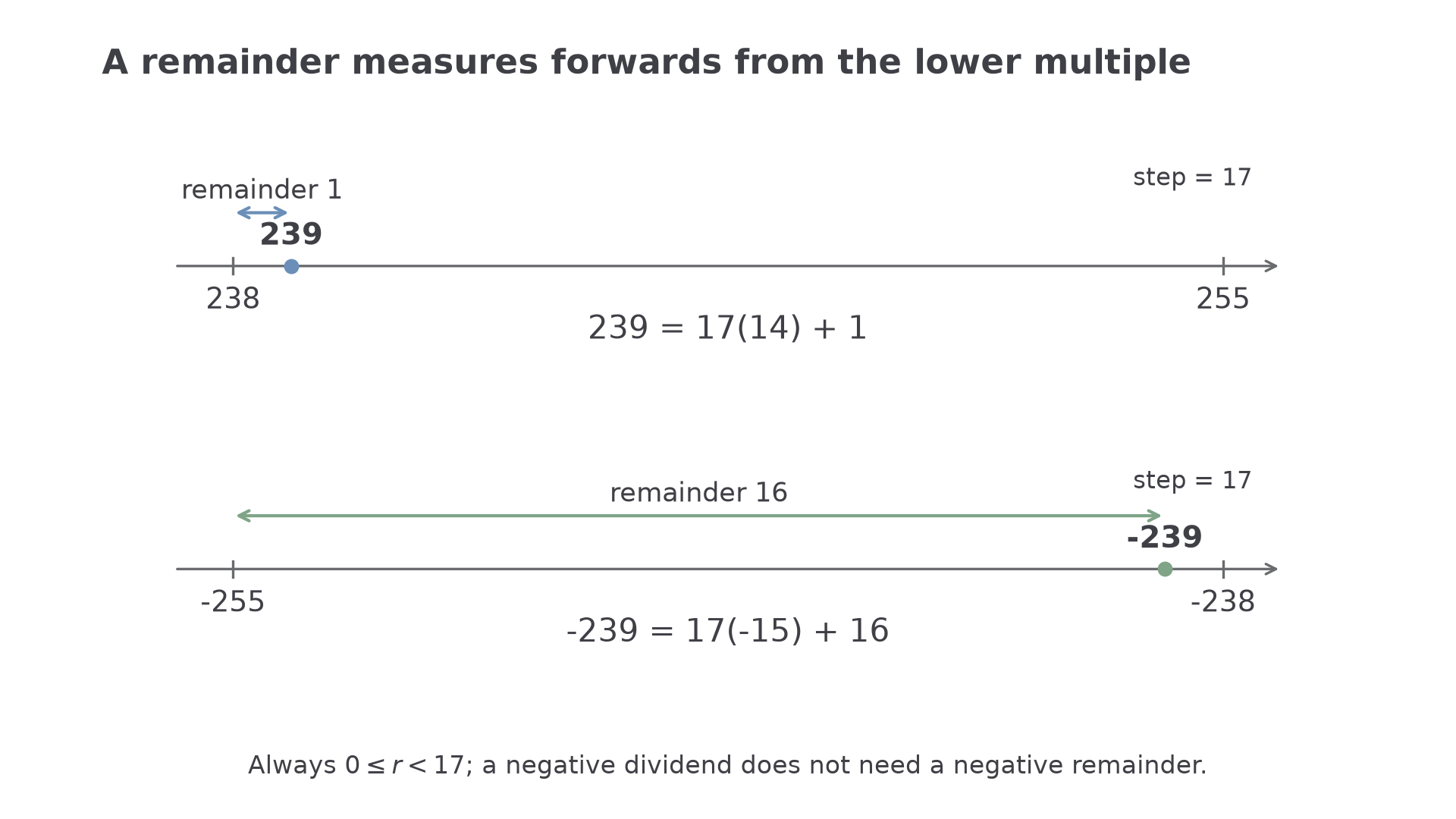
The remainder also prepares the language of congruences. Two integers have the same remainder on division by exactly when their difference is a multiple of : subtract their division equations for one direction, or add a multiple of for the other.
Run the Euclidean algorithm forwards
A long factor list is unnecessary because a division step preserves every common divisor. If , any divisor of both divides . Conversely, any divisor of both divides .
The Euclidean algorithm
For positive integers , if with , then
Repeat division, replacing the pair by the divisor and remainder each time. The highest common factor is the last nonzero remainder; if the first remainder is zero, it is the original divisor.
The process stops because the nonzero remainders form a strictly decreasing sequence of positive integers.
Not in the formula booklet: learn it.
Keep the final zero-remainder line. It shows that the previous remainder divides everything left in the chain; it does not make the highest common factor zero.
Worked example 3: the common unit
Question. Use the Euclidean algorithm to determine .
Plan. Divide the larger integer by the smaller, then repeatedly divide by the latest nonzero remainder.
Why this step? Each replacement preserves the common divisors, so the last positive remainder solves the original problem.
Answer. .
Check. and ; the algorithm certifies that no larger common divisor exists.
Reduce the first integer by just , keeping the second fixed. A small change in the inputs can change the entire remainder chain.
Continue this lesson.
You’re previewing NovaLearn without an account. Create a free account to read the rest.
Create free account