CP 9.9 - Coupled first-order equations
Two changing quantities can affect each other's rates of change. You will build and interpret linear coupled models, eliminate one variable to obtain a second-order equation, and recover the other variable with the same two linked constants.
Two quantities sharing one time variable
Can you solve two first-order equations by solving each independently? If each rate depends on both quantities, the two solutions must fit together at every instant. Choosing four unrelated constants would describe motions that the original equations do not permit.
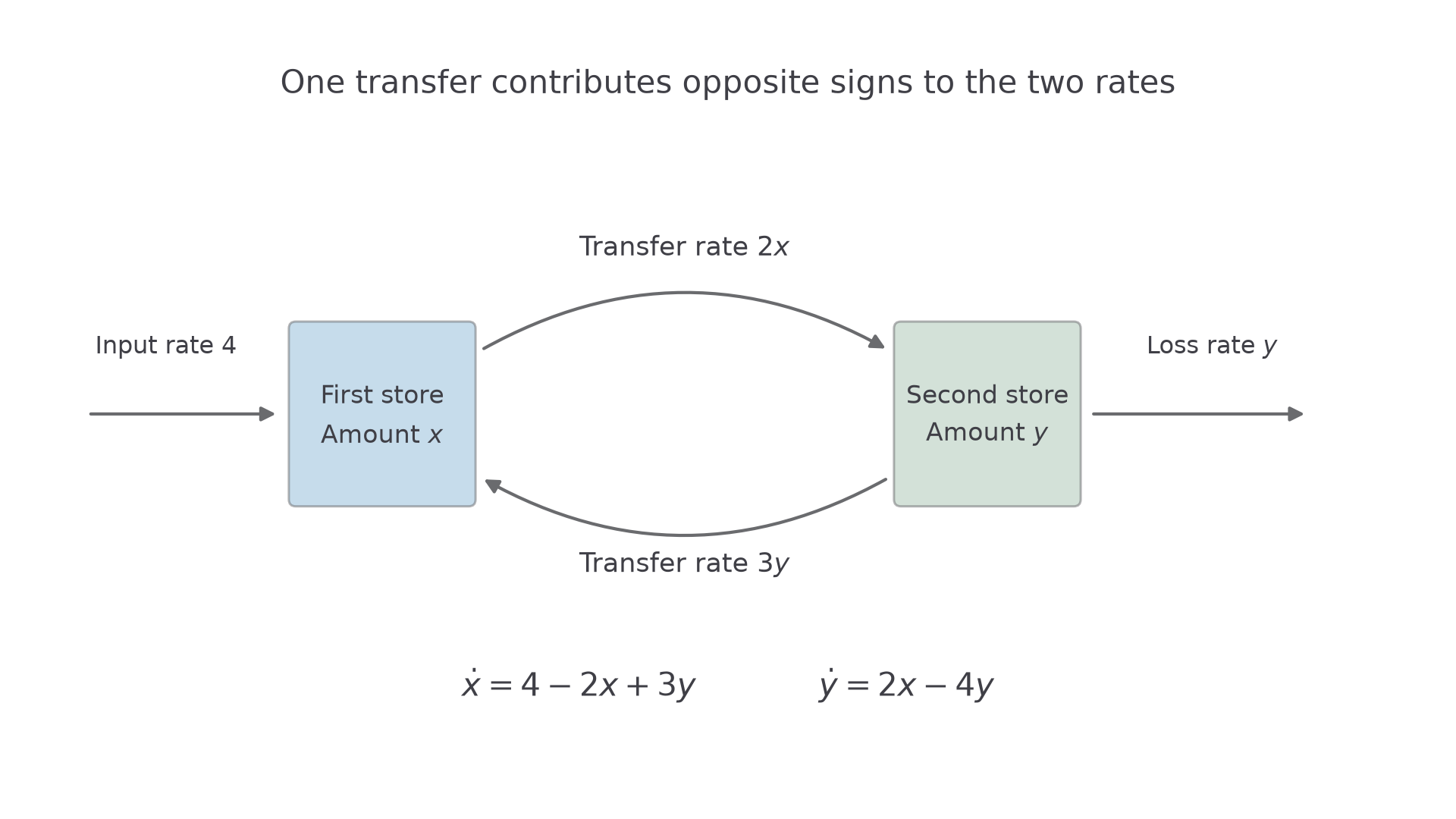
Consider two stores containing amounts and . Material transfers from the first to the second at rate , and back at rate . An external input of enters the first store, while material leaves the second at rate . Each internal transfer has one minus sign and one plus sign:
[DIAGRAM: asset_name: Transfers in a two-variable linear model; asset_slug: 9fm0-cp99-coupled-stores; caption: Every internal transfer leaves one store and enters the other; description: Two labelled boxes contain x and y. An upper arrow from x to y is labelled rate 2x, a lower arrow from y to x is labelled rate 3y, an external arrow of rate 4 enters x from the left, and an external arrow of rate y leaves the second store to the right. Below are the equations x dot=4-2x+3y and y dot=2x-4y.]
You already know
The independent variable is time ; and are dependent variables. You can solve a second-order constant-coefficient equation and use initial data to determine two constants. A derivative of a time-dependent forcing term must be included when differentiating an equation.
A linear coupled model has the form
with constant coefficients. Terms such as or would make it non-linear and require different methods.
In a simplified predator-prey model, a positive prey contribution to predator growth and a negative predator contribution to prey growth give opposite signs in the cross terms. A linear model may be useful over a limited range; do not assume it predicts meaningful non-negative population counts for arbitrarily long times.
For the two stores, adding the equations gives a useful surprise:
The internal transfers cancel completely. The total's instantaneous rate depends only on external input and loss, although each store's individual rate depends on both stores.
Key idea
Coupling links rates and constants. Check the signs against the physical interpretation, then check both original equations against any proposed pair of solutions.
Match the arrows to the equations in this diagnostic check.
Eliminating one variable
Differentiate one equation, replace the other variable's derivative using the second equation, then remove the other variable itself using the first equation. The result is a familiar second-order equation.
Keep a clear distinction between , and . Substituting a rate equation for the variable itself is a common source of sign errors.
Worked example 1: two real auxiliary roots
Question. Given , , find a general expression for .
Plan. Differentiate the first equation and use both original equations to eliminate .
Thus , with auxiliary equation .
Why differentiate only one equation? It raises that variable to second order, creating a single equation with the two constants the pair originally needs.
Answer. .
Check. , .
Worked example 2 changes only the coefficient of in the second equation, from to . The elimination steps are the same, but the auxiliary roots become complex.
Worked example 2: a complex auxiliary pair
Question. Given , , find a general expression for .
Plan. Differentiate the first equation, replace , then use .
The auxiliary equation is , with roots .
Why substitute ? That removes the final occurrence of the second dependent variable, rather than leaving a disguised coupled equation.
Answer. .
Check. The exponential rate and angular frequency correspond to the real and imaginary parts of the roots.
The solution for alone is only an intermediate result when a question asks for both dependent variables. The original first equation will recover next.
Watch out
Wrong: after differentiating, replace by the expression for . Right: first replace with its rate equation, then rearrange an original equation to replace .
Change the cross coefficient once more.
Recovering the second variable with linked constants
Once is known, recover directly from an original equation. This automatically keeps the two constants consistent across both solutions.
In both previous examples, the first equation gives . Differentiate the expression for , subtract , then simplify. Starting a new second-order solution for introduces extra constants that would have to be reconciled afterwards.
Continue this lesson.
You’re previewing NovaLearn without an account. Create a free account to read the rest.
Create free account