CP 7.3 - Tangents to polar curves
Find tangents parallel or perpendicular to the initial line by differentiating Cartesian components of a polar curve. You will check both parametric derivatives, find every valid angle and handle tangents at the pole using the direction of approach.
A polar derivative is not a Cartesian gradient
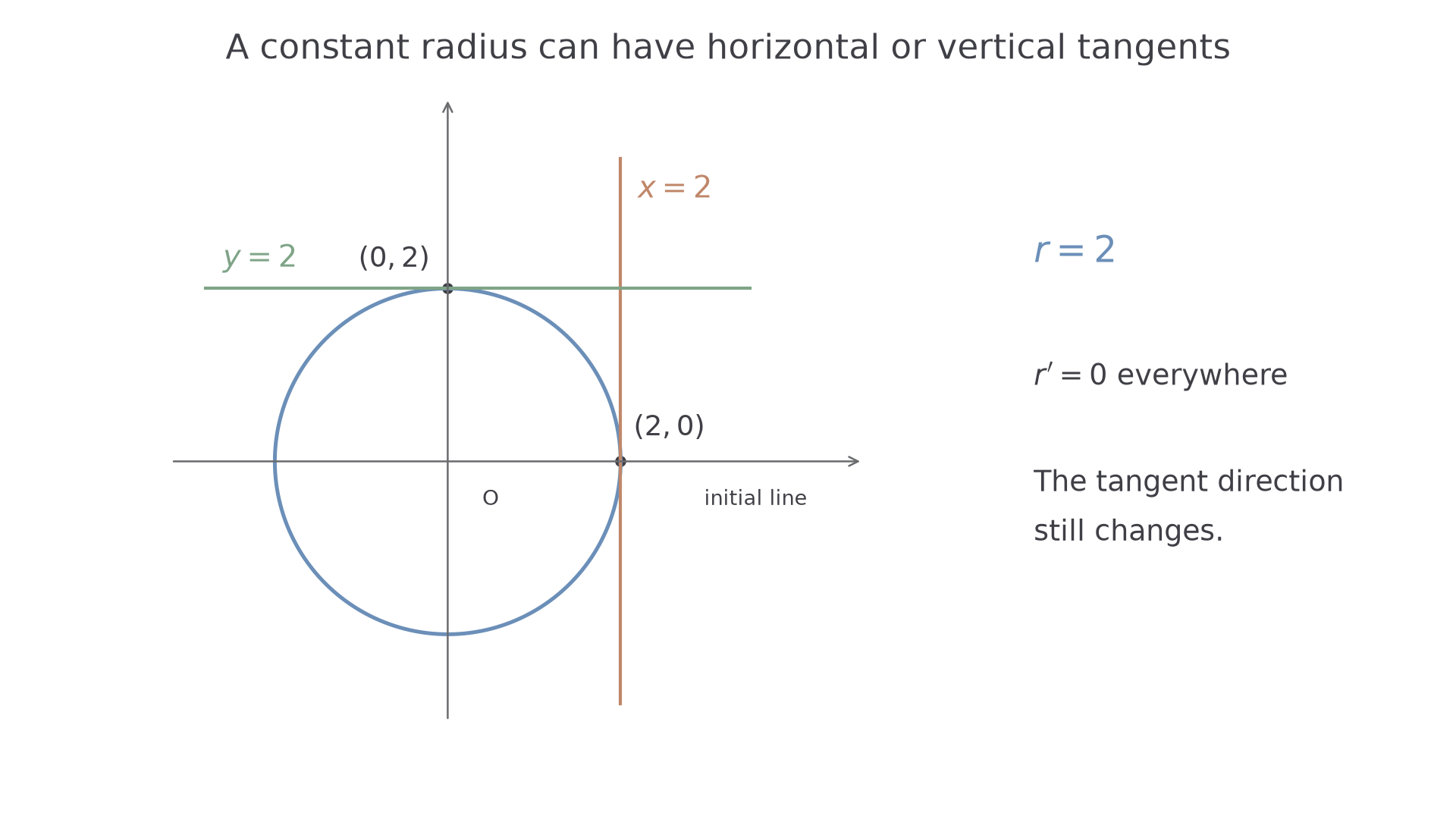
On the circle , the derivative is zero everywhere. Does that make every tangent horizontal? Of course not: at the tangent is vertical, while at it is horizontal. Radius change and Cartesian gradient measure different things.
You already know
From A-level Mathematics, a parametrised curve has wherever the denominator is non-zero. Use the product rule on and . The polar sketch supplies the allowed angle interval and any pole directions.
Write . Differentiating the components gives
The velocity of this parametrisation points along the curve. A non-zero horizontal velocity has zero vertical component; a non-zero vertical velocity has zero horizontal component.
Regular horizontal and vertical tangents
For differentiable , at a point where the two component derivatives are not both zero,
A horizontal tangent requires and . A vertical tangent requires and . If both vanish, examine the curve separately.
Not in the formula booklet: learn it.
For , the derivatives are and . At , they are and , giving the vertical tangent . At , they are and , giving the horizontal tangent . This resolves the opening puzzle.
[DIAGRAM: asset_name: Constant radius with two different tangent directions; asset_slug: 9fm0-cp48-circle-tangents; caption: A constant polar radius does not mean a constant Cartesian tangent direction; description: A circle of radius 2 centred at the pole has point (2,0) marked with a vertical clay tangent x equals 2 and point (0,2) marked with a horizontal sage tangent y equals 2. Both points have r prime equals zero. The initial line and pole are labelled.]
Key idea
Horizontal means the vertical component stops changing; vertical means the horizontal component stops changing. A stationary radius alone establishes neither.
Check which condition really describes a horizontal tangent at a regular point.
Tangents parallel to the initial line
To find horizontal tangents, differentiate , set the result to zero and solve over the full allowed angle interval. Then check , find the point and state the horizontal line .
For the right-facing cardioid , use to turn the equation into a quadratic in cosine. Keep every root until the point and derivative checks decide whether it belongs to the requested set.
Worked example 1: horizontal tangents away from the pole
Question. Find all tangents parallel to the initial line at points away from the pole on , .
Plan. Differentiate , solve the resulting cosine equation, exclude the pole from this question and check the other derivative.
Thus or . The value gives , , which is the excluded pole. The remaining angles are and , both with .
Why this step? A root of the vertical-component derivative is only a candidate. The pole makes both derivatives zero, so it needs the separate analysis in the last part.
Answer. Polar points , ; tangent lines .
Check. At , , while the vertical derivative is zero.
Change only the radial scale, from to . The tangent angles remain the same, while their heights double.
Worked example 2: scaling the horizontal tangents
Question. Find all horizontal tangents away from the pole on , .
Plan. Solve the same factored cosine equation and use the new radii for the line heights.
Why this step? Multiplying the whole curve by a positive scale factor does not change which derivative factors vanish.
Answer. Polar points , ; lines .
Check. At the upper point, , and the height is twice the previous upper height.
These line values are derived results and are not in the formula booklet. Symmetry predicts equal positive and negative heights, but it does not replace solving the full angular equation.
Watch out
Wrong: divide by before checking it. Right: retain its zero as a candidate, then identify the pole and analyse it separately if the question includes it.
An intermediate scale tests the same derivative decisions with new radii.
Tangents perpendicular to the initial line
For a vertical tangent, use . Set its derivative to zero, check the vertical derivative is non-zero and calculate the constant horizontal coordinate . The tangent equation is .
Factoring is useful here, but do not cancel a sine or cosine factor: it may contain valid axis points. Count distinct points over the given interval, and remember that two different points can share one tangent line.
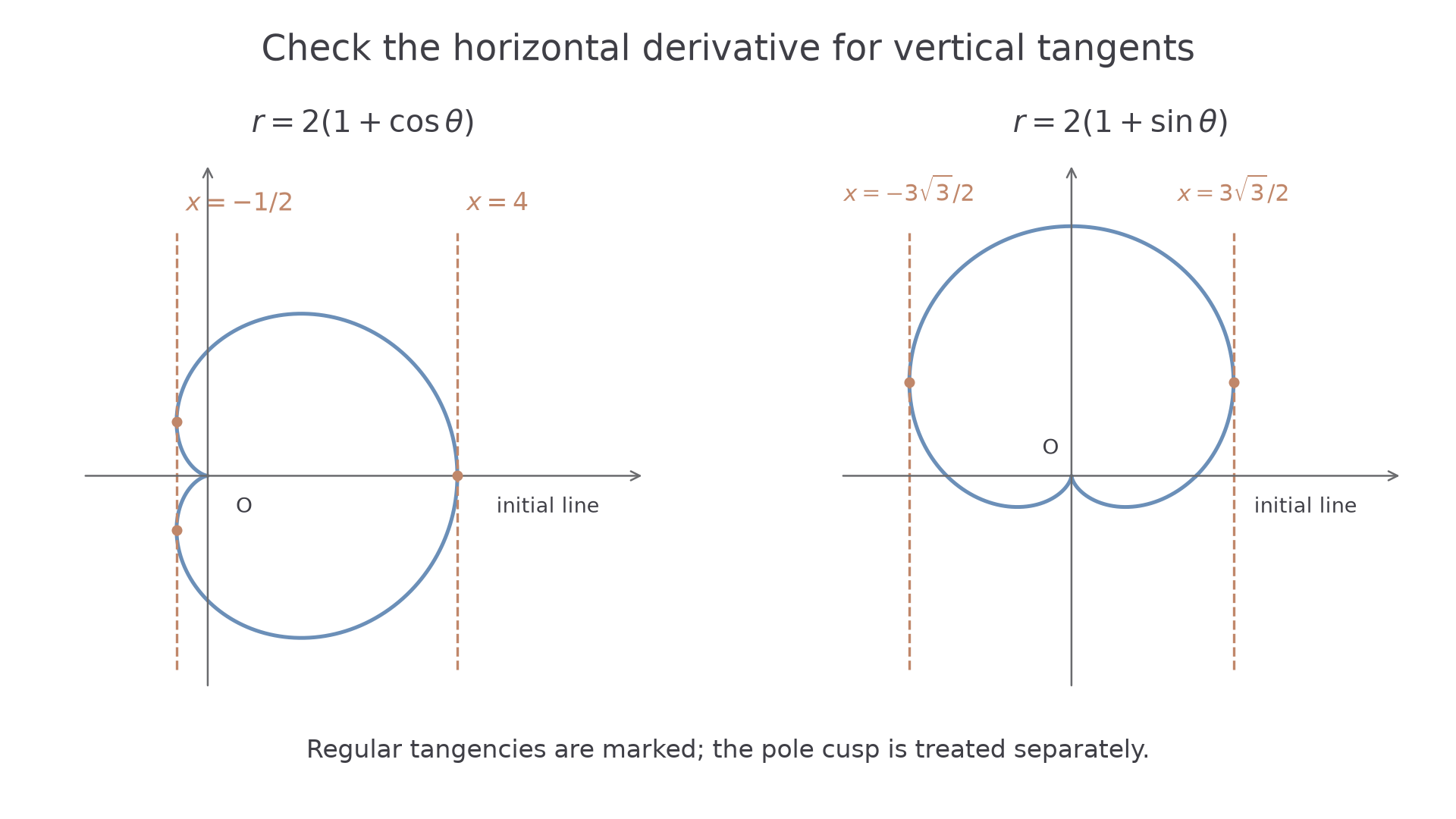
[DIAGRAM: asset_name: Vertical tangents on two rotated cardioids; asset_slug: 9fm0-cp48-vertical-cardioids; caption: Different tangent points can share a vertical tangent line; description: The left panel shows r equals 2 times one plus cos theta with vertical tangents x equals 4 and x equals minus one half; the latter touches at two points. The right panel shows r equals 2 times one plus sin theta with regular vertical tangents x equals plus and minus three root 3 over 2. The pole cusp is marked but its separate tangent is left for the pole analysis. Legends and line labels sit outside the curves.]
Worked example 3: three points but two vertical lines
Question. Find all vertical tangents away from the pole on , .
Plan. Factor the horizontal-component derivative and check every angle it gives.
The angle gives the excluded pole. At , , . At the other two retained angles, , .
Why this step? All three retained points have non-zero vertical derivative, so they really have vertical tangents. The two off-axis points have the same horizontal coordinate.
Answer. Tangent points , , in polar coordinates; distinct tangent lines and .
Check. The off-axis Cartesian points are , so one vertical line touches the cardioid twice. A tangent line need not have just one point of contact.
Change only the orientation by replacing cosine with sine. This rotates the cardioid through a right angle; still differentiate because the requested tangents are still vertical.
Worked example 4: vertical tangents after a rotation
Question. Find all vertical tangents away from the pole on , .
Plan. Differentiate its horizontal component and solve a quadratic in sine.
The root gives the pole at . The retained angles are , with .
Why this step? Rotating the curve does not swap the meaning of and in the fixed coordinate system. Vertical tangents still require the horizontal derivative to vanish.
Answer. Polar points , ; lines .
Check. Their vertical coordinates are both , and their horizontal coordinates are equal and opposite, consistent with symmetry about the vertical axis.
The particular tangent lines in these examples are not printed in the formula booklet. The product-rule setup and the full set of angular solutions are what make the method reliable.
Watch out
Wrong: for a vertical tangent, solve . That seeks a horizontal tangent. Right: differentiate , then check the other derivative and calculate .
Keep the upward-facing orientation and change the scale.
Tangents at the pole come from the approach direction
A zero radius identifies the pole, but it does not remove that point from the curve. When both component derivatives vanish, or when is not finite, examine the direction of the branch as it approaches the pole.
The pole itself has no unique polar angle. A branch, however, can approach it with a definite limiting angle . Every chord from the pole to a nearby point on that branch lies along that point's radius, so its limiting line makes angle with the initial line, modulo .
Approach direction at the pole
On a branch with and , use the limiting chord direction:
when the tangent is not vertical. For a vertical direction, use . Each admissible approach direction must be considered; opposite directions give the same tangent line.
Not in the formula booklet: learn it.
For the cardioid , the pole occurs at , where both component derivatives vanish. Nevertheless, along the curve, so its cusp has tangent . Add this to the two regular horizontal tangents found earlier. For the rotated cardioid , the pole direction is ; , so the cusp has vertical tangent , in addition to its two regular vertical tangents.
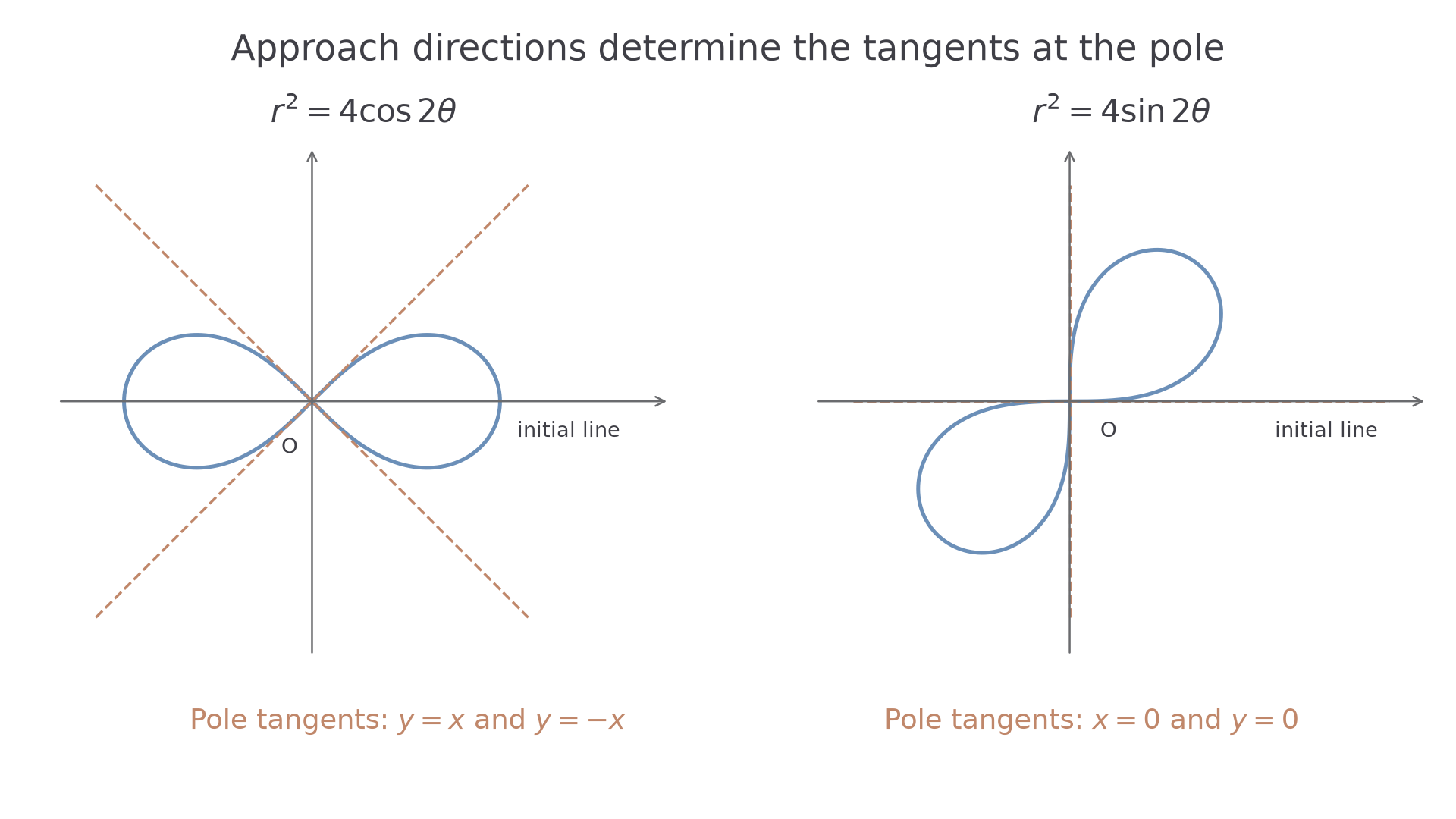
[DIAGRAM: asset_name: Tangent directions where two loops meet the pole; asset_slug: 9fm0-cp48-pole-directions; caption: Different admissible approaches can give different tangent lines at one pole; description: Equal-scale panels show r squared equals 4 cos 2theta with two horizontal loops and tangent lines y equals x and y equals minus x at the pole, and the rotated curve r squared equals 4 sin 2theta with loops in the first and third quadrants and pole tangents along the two coordinate axes. Dashed clay lines mark limiting tangent directions; no signed-radius extra loops appear.]
Worked example 5: two tangent lines at one pole
Question. Find all tangent lines at the pole on , .
Plan. Find the admissible branch endpoints with zero radius, then identify their limiting directions.
Why this step? Each listed angle is approached from an interval where . We need branch directions, rather than an arbitrary angle assigned to the pole as a point.
Answer. Two distinct lines, and . Neither is horizontal nor vertical.
Check. The right-loop endpoint approached as has ; the left-loop endpoint at has , matching the diagram.
Change only the trigonometric factor from cosine to sine. This rotates the two-loop curve through , because .
Worked example 6: horizontal and vertical pole tangents
Question. Find all tangent lines at the pole on , .
Plan. Solve the zero-radius equation and retain the endpoints of the non-negative-radius intervals.
At , the chord slopes tend to zero. At , their reciprocal slopes tend to zero.
Why this step? The two coordinate-axis lines each collect two opposite approach directions. Counting four angles does not mean four distinct tangent lines.
Answer. Horizontal tangent and vertical tangent at the pole.
Check. The first-quadrant loop approaches the pole from angles near and , so its two endpoint tangents point along the horizontal and vertical axes respectively.
These particular pole tangent lines are not printed in the formula booklet. The direction test also works when a squared-radius equation makes unbounded at the pole, so it avoids dividing by a quantity that is not defined there.
Watch out
Wrong: “Both component derivatives are zero, so there is no tangent.” The derivative quotient is inconclusive. Right: examine the branch's limiting chord direction; a cusp can have a perfectly definite tangent, and different branches can have different tangents at the same pole.
An enlargement preserves these limiting directions.
Quick Recap
- Differentiate and ; is not the Cartesian gradient.
- A regular horizontal tangent has zero vertical derivative and non-zero horizontal derivative; reverse those conditions for a vertical tangent.
- Solve over the complete allowed angle interval, check every factor and state the actual line equation.
- At the pole, use admissible limiting branch directions when the derivative quotient is inconclusive; opposite directions give one line.
The opening circle has constant radius but changing tangent direction: at its rightmost point and at its top.