FP1 7.1 - Algebraic and modulus inequalities
Solve rational and modulus inequalities while preserving signs, domains and endpoint conditions. You will build sign charts, handle a parameter whose position changes the answer and combine cases without losing isolated solutions or excluded values.
Keep an inequality equivalent at every step
Can the solution of an inequality contain one isolated point as well as a whole interval? For , the answer is or . Dividing by too early would erase the isolated point. We will explain why it belongs.
You already know
From A-level Mathematics, multiplying or dividing by a negative quantity reverses an inequality. Recall quadratic sign regions, algebraic fractions, interval notation and for , for . A denominator cannot be zero.
Equations and inequalities behave differently when a multiplier has an unknown sign. Multiplying by preserves the direction when , reverses it when , and cannot clear an original denominator at , where the expression is undefined.
Safe multiplication and squaring
On a stated domain, multiplying by a strictly positive expression preserves an inequality; multiplying by a strictly negative one reverses it. For example, if , then
because multiplying by is safe.
Squaring preserves the order of two non-negative quantities. It does not preserve arbitrary signed comparisons: is true, but is false.
Not in the formula booklet: learn it.
A sign chart records the intervals where an expression keeps one sign. Its critical values include numerator zeros and excluded denominator zeros. A repeated factor of even multiplicity need not change sign at its zero; check the factors rather than automatically alternating signs.
Key idea
Keep the same solution set through every step. State the original domain first, then choose a multiplier or a case whose sign is known; carry those restrictions into the final ranges.
At the end, include a numerator zero only when the inequality allows equality and the original expression is defined. A denominator zero is excluded even from a non-strict inequality.
Watch out
Wrong: clear a denominator without discussing its sign. Right: combine into one fraction and use signs, split into sign cases, or multiply by a square that is positive on the original domain.
Choose the multiplier whose sign is known throughout the given domain.
Put a rational inequality over one denominator
Move everything to one side, combine the fractions, factor where possible and list every zero or pole in increasing order. Test one value in each open interval, or multiply the factor signs.
For the general comparison , the equivalent single fraction is
The numerator's real roots, if any, join the denominator exclusions in the sign chart. The parameters must be given or their order considered; cross-multiplication alone cannot decide the signs.
[DIAGRAM: asset_name: A rational sign chart with two excluded poles; asset_slug: 9fm0-fp179-rational-signs; caption: Numerator zeros and denominator poles both divide the sign intervals; description: An upper graph shows f of x equals (4 minus x) over ((x minus 1)(x plus 2)), with separate branches, vertical dashed lines at minus 2 and 1, and a zero at 4. A lower number line highlights x less than minus 2 and 1 less than x less than 4, with open endpoint circles. Poles and the numerator zero have separate labels. The graph and number line share the same horizontal scale.]
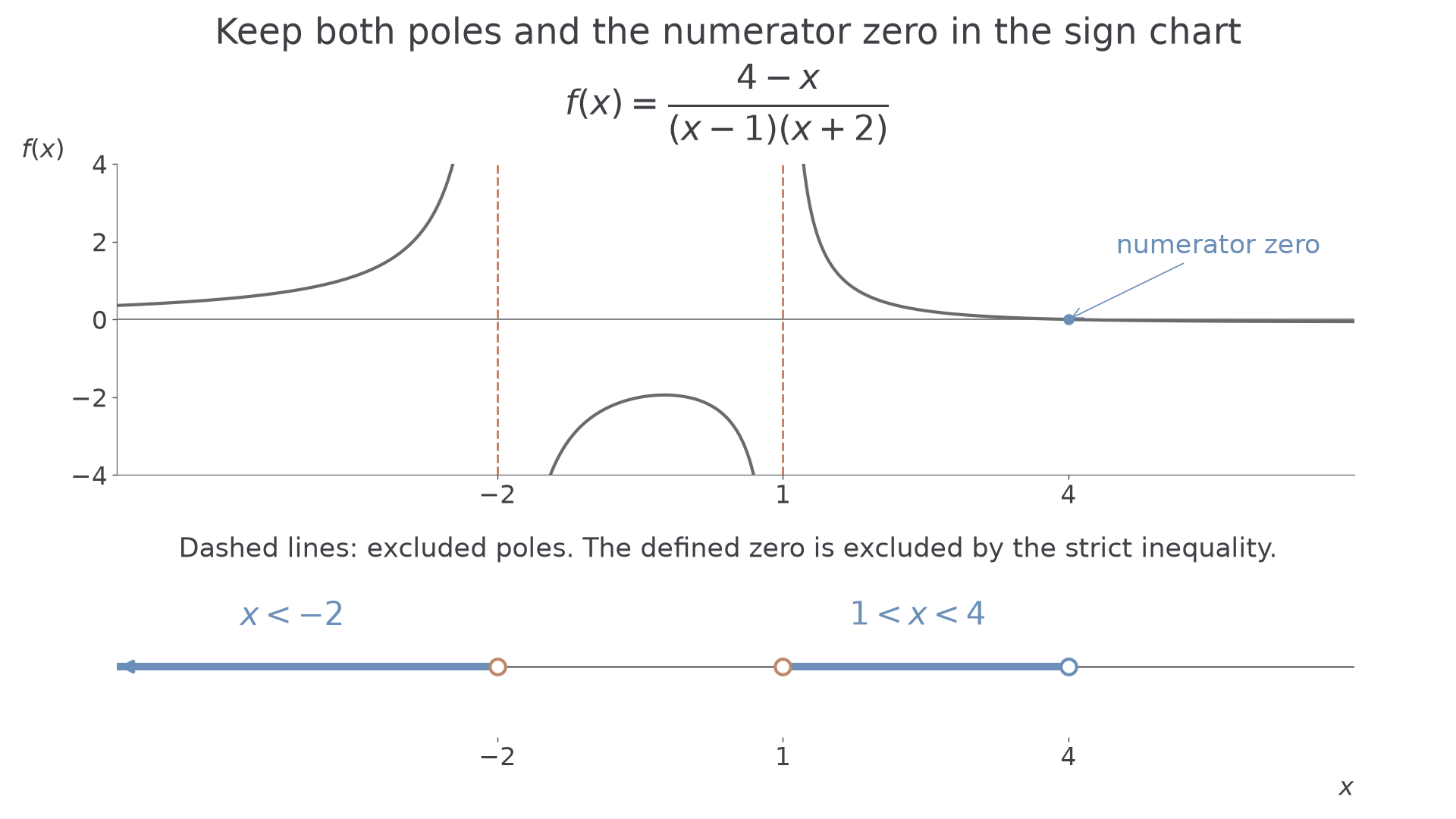
Worked example 1: two fractions and three critical values
Question. Solve .
Plan. State the exclusions, combine the fractions and use a sign chart.
The signs are
| Interval | ||||
|---|---|---|---|---|
| Quotient |
Why this step? The denominator is negative between its two zeros. Ignoring that interval would reverse which original fraction is larger.
Answer. or .
Check. At , , while at , is false. The zero is excluded because the inequality is strict; the two poles are undefined.
Change only the numerator of the second fraction from to . The poles stay fixed while the numerator zero moves.
Worked example 2: a moved numerator zero
Question. Solve .
Plan. Keep the two exclusions and recompute the common numerator.
The numerator is positive before and negative after it. The denominator remains positive outside and negative between its poles, giving signs across the four intervals.
Why this step? Reusing the previous numerator zero would keep the wrong right-hand endpoint, even though the denominator factors have not changed.
Answer. or .
Check. At , is true; at , is false.
These solutions are derived, not booklet entries. Cancellation also keeps original exclusions: only for . An even zero behaves differently from a pole; for example, gives , with , since the squared numerator stays positive on either side of .
Watch out
Wrong: write and for the opening example. No point can belong to both disjoint regions. Right: write or . State final ranges as inequalities or a correct union of intervals: alternatives use “or” or , while an intersection requires both conditions at once.
Move the numerator zero again.
A parameter can change the order of the boundaries
For , the numerator zero is , while the excluded pole is . Which comes first depends on . Sorting them is part of the solution, not a detail to guess.
When the two values coincide, cancellation changes the form of the calculation but does not repair the original missing point. All resulting ranges in this part are derived and are not in the formula booklet.
Worked example 3: the numerator zero comes first
Question. Solve , given .
Plan. Order the two critical values and compare the numerator and denominator signs.
At , the quotient is zero and is defined; at , it is undefined.
Why this step? Equality includes a numerator zero, but never a denominator zero. The endpoints have different roles even though both appear in the chart.
Answer. or , for .
Check. Taking , gives , while gives , matching the intervals.
Change only the order assumption, to .
Worked example 4: the pole comes first
Question. Solve the same inequality when .
Plan. Reverse the order of the critical values before reading the signs.
Why this step? The sign pattern is similar, but the included zero is now on the right. Carrying over from the previous case would include the whole wrong middle interval.
Answer. or , for .
Check. With , gives , while gives .
For the remaining case , the quotient is at every allowed point, so the non-strict inequality holds for every . There is no numerator-zero solution at , because the original quotient is undefined there.
Watch out
Wrong: combine parameter cases without checking . Right: separate , and retain the original domain after any cancellation.
Reverse the inequality and give all parameter cases.
A modulus upper bound can leave an isolated point
Since , an upper bound can hold only where . On that domain it is equivalent to the two simultaneous inequalities
They must both hold, so intersect their solution sets. This standard modulus equivalence is not printed in the formula booklet: learn it.
Continue this lesson.
You’re previewing NovaLearn without an account. Create a free account to read the rest.
Create free account