CP 2.4 - Argand diagrams
An Argand diagram gives each complex number a position in a plane. You will plot numbers, interpret conjugation and show sums and differences as vectors (CP 2.4), so that the geometry explains the arithmetic.
Complex numbers as points and vectors
If and , where should appear on a diagram, and which arrow represents ? You can answer both questions without measuring an angle. The trick is to give the real and imaginary parts different axes.
The number sits three units right and two units up from the origin. The number sits one unit left and three units up. A complex number records two real coordinates in one expression.
You already know
From A-level Mathematics, a two-dimensional vector records a horizontal displacement and vertical displacement . From complex arithmetic, has real part , imaginary part , and conjugate .
Use the same coordinate idea, but give the axes their complex-number names.
Argand diagram
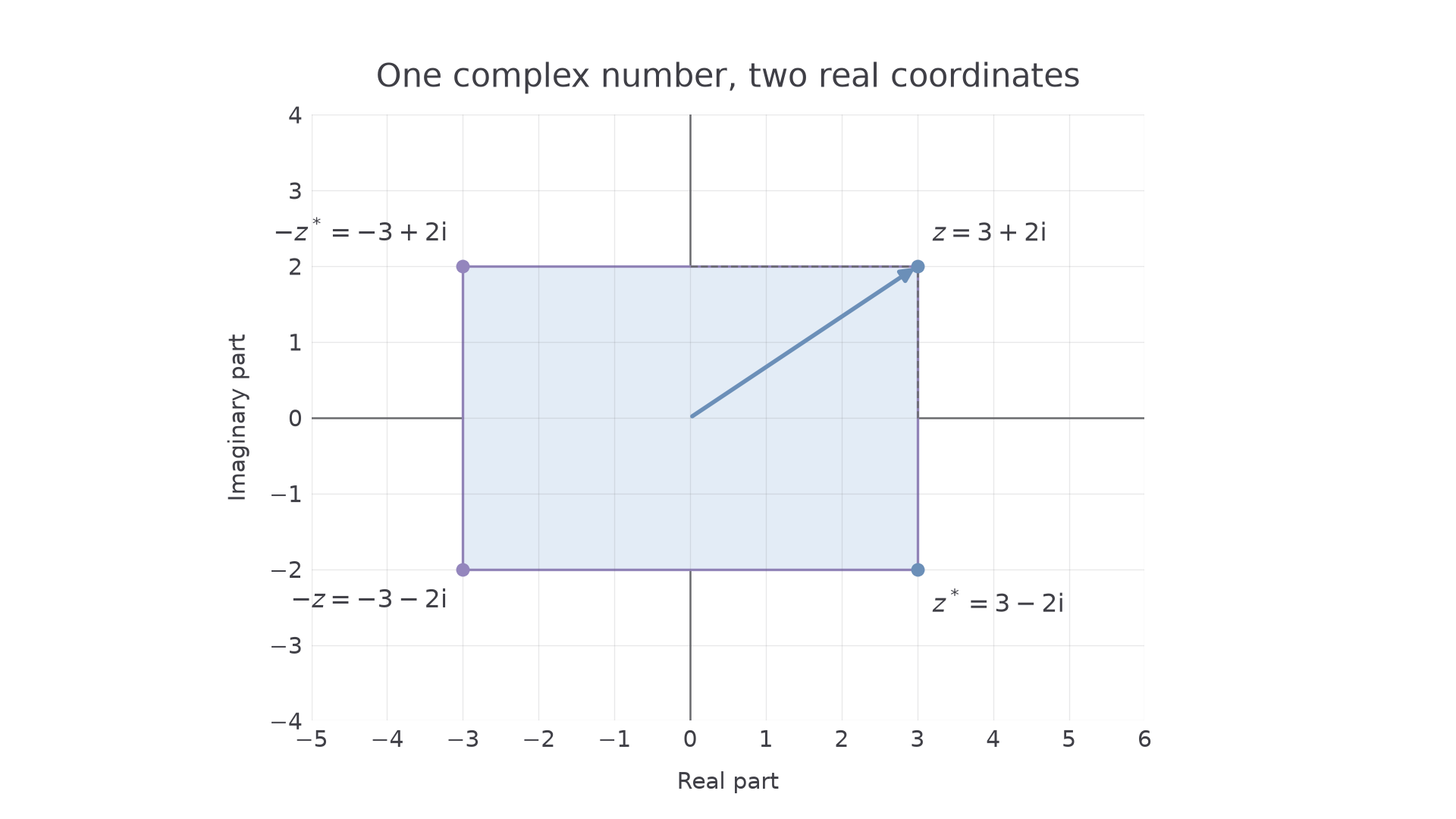
An Argand diagram is a plane whose horizontal axis is the real axis and whose vertical axis is the imaginary axis. The complex number is represented by the point , or by the position vector . For example, is plotted at . It is not plotted at : the real part goes first.
The point and the arrow represent the same complex number in different ways. The point shows its position; the arrow from the origin shows the displacement needed to reach it. An arrow copied elsewhere keeps its displacement, although it is no longer a position vector from the origin.
[DIAGRAM: asset_name: Coordinates and conjugation on an Argand diagram; asset_slug: 9fm0-argand-coordinates; caption: Real parts run horizontally, imaginary parts vertically, and conjugation reflects in the real axis; description: Equal-scale real and imaginary axes show z equals 3 plus 2i at (3,2), its conjugate at (3,minus 2), minus z at (minus 3,minus 2) and minus z star at (minus 3,2). The four points form a pale rectangle. Dashed projections from z label its real part 3 and imaginary part 2, and an arrow goes from the origin to z.]
Worked example 1: plotting a number and its conjugate
Question. Describe the positions of and on an Argand diagram, and state the geometric relationship between them.
Plan. Read the two coordinates, then change the sign of only the imaginary coordinate for the conjugate.
Why this step? Conjugation changes the imaginary part alone, so the point crosses the real axis without moving sideways.
Answer. Plot at and at . They are reflections in the real axis.
Check. Their horizontal coordinates agree, while their signed vertical coordinates are opposites.
Now change the real part to zero. A point on an axis is still a perfectly ordinary complex number.
Worked example 2: a purely imaginary number
Question. Show and its conjugate on an Argand diagram. State their position vectors.
Plan. Insert the missing real part as zero, then plot each vertical coordinate.
Why this step? Writing the zero prevents from being mistaken for a point on the real axis.
Answer. Both points lie on the imaginary axis: four units below the origin and four units above it.
Check. Reflection in the real axis takes to , just as conjugation requires.
There is a neat shape hiding in four sign choices. If with , the points for are the four corners of a rectangle centred at the origin. If either coordinate is zero, two pairs coincide and the rectangle collapses to a segment. The algebra tells you both the shape and its exceptional case.
Watch out
Wrong: labelling the imaginary coordinate of as in the ordered pair. The coordinate is the real number , so the point is . The axis name supplies its imaginary meaning.
Use the reflection rule to describe another pair, without relying on the picture above.
Adding with a triangle or parallelogram
Adding complex numbers adds their horizontal and vertical displacements, so the sum is found by placing the second vector at the end of the first.
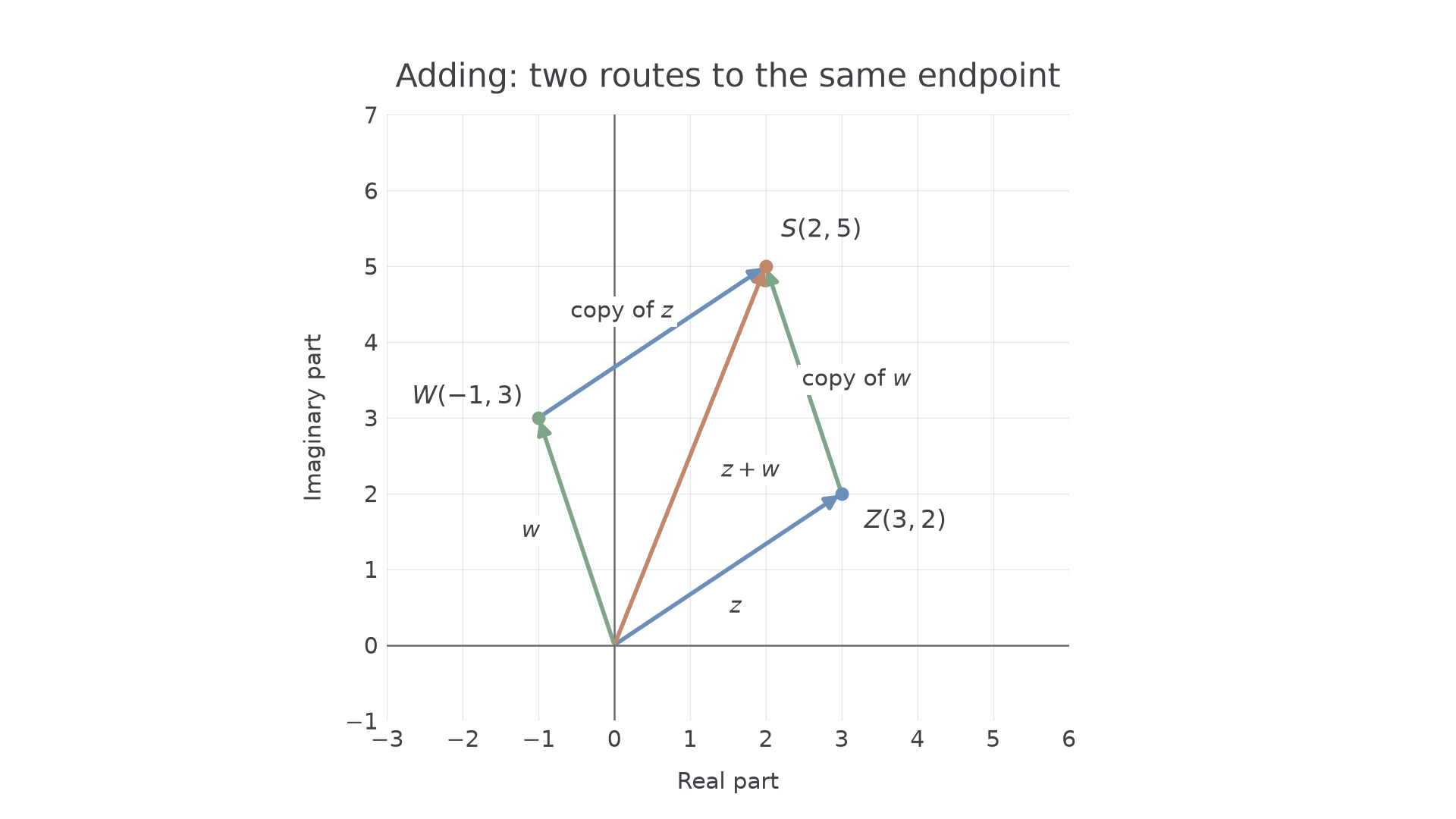
For followed by , move three right and two up, then one left and three up. You finish two right and five up. This is the same component addition you use for vectors.
The vector for a sum
For and ,
Copy the vector for to the endpoint of the vector for . The vector from the origin to the final endpoint represents . Equivalently, is the opposite vertex in the parallelogram with sides and , when those sides are not parallel.
Not in the formula booklet: learn it.
The second arrow must keep both its length and its direction when copied. Sliding it is allowed; rotating it would change the number.
[DIAGRAM: asset_name: The triangle and parallelogram rules for a complex sum; asset_slug: 9fm0-argand-sum; caption: Copy the w arrow to the end of z to reach z plus w; description: Equal-scale Argand axes show O, Z at (3,2), W at (minus 1,3) and S at (2,5). Blue arrows go from O to Z and from W to S, sage arrows go from O to W and from Z to S, and a clay arrow from O to S is labelled z plus w equals 2 plus 5i. Labels sit clear of the parallelogram sides.]
Worked example 3: a sum above both starting points
Question. Given and , find and explain its triangle construction.
Plan. Add corresponding components, then copy the displacement for from the endpoint of .
Why this step? The copied arrow starts at , so its endpoint is reached by adding its displacement to 's coordinates.
Answer. . Draw the arrow one unit left and three units up from ; the arrow from to its endpoint is the sum.
Check. Starting with and then copying reaches the same endpoint: .
The second example changes only the sign of the imaginary part of . The copied arrow now goes down, and the sum can lie below the real axis.
Worked example 4: opposing vertical displacements
Question. Given and , find and describe its position.
Plan. Add components, keeping the downward displacement negative.
Why this step? A downward movement subtracts from the vertical coordinate, even when the arrow starts above the axis.
Answer. The sum is , represented by in the fourth quadrant.
Check. From the final point , subtracting the displacement returns .
The parallelogram rule explains why the order of addition makes no difference: the two routes use the same two displacements.
Watch out
Wrong: joining the endpoints and and calling that arrow . Addition uses the arrow from the origin to the opposite parallelogram vertex. The arrow joining and represents a difference.
A sum does not have to lie between its two starting points.
The direction of a difference
The difference is the displacement from the point for to the point for : destination minus starting point.
To see why, let and have position vectors and . The route to followed by to must end at , so . Rearranging gives the direction as well as the components.
The vector for a difference
If represents and represents ,
As a position vector from the origin, is obtained by adding to . Multiplication by reverses a vector.
Not in the formula booklet: learn it.
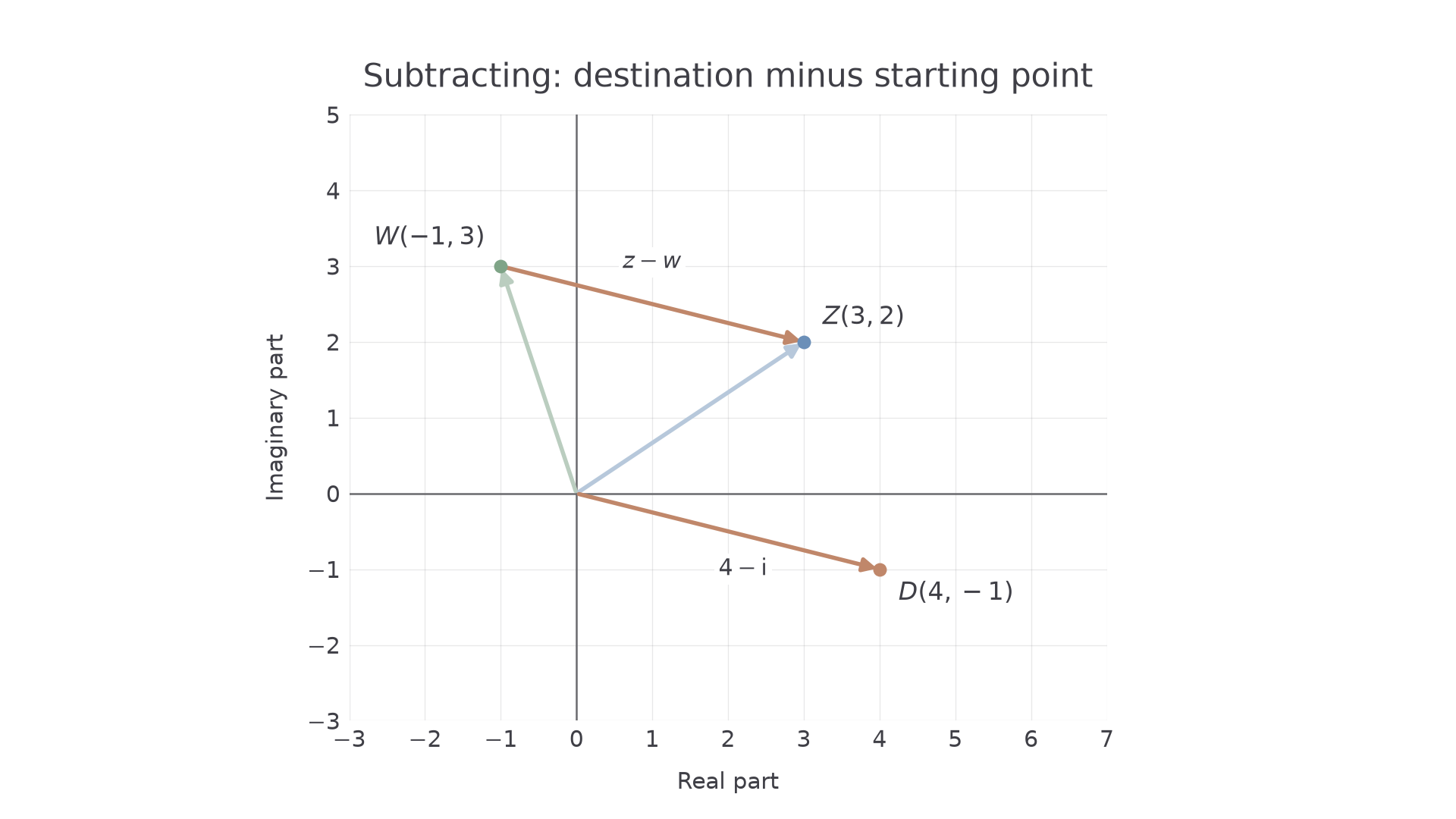
These are two drawings of the same displacement: the connecting arrow from to , and a parallel copy starting at the origin. Their endpoints need not coincide.
[DIAGRAM: asset_name: A difference as a connecting arrow and a position vector; asset_slug: 9fm0-argand-difference; caption: z minus w points from W to Z; its copy from O has endpoint (4,minus 1); description: Equal-scale axes show Z at (3,2) and W at (minus 1,3). A clay arrow points from W to Z and is labelled z minus w. A second parallel clay arrow goes from the origin to D at (4,minus 1), labelled 4 minus i. Faint position arrows show O to Z and O to W.]
Worked example 5: destination minus start
Question. Given and , find and identify its connecting arrow.
Plan. Subtract the coordinates of from those of , then state the arrow's start and finish.
Why this step? The check starts at . Adding the difference must take you to , which fixes the direction unambiguously.
Answer. , represented by the arrow to .
Check. .
Now reverse the subtraction and change nothing else. The connecting arrow must reverse too.
Worked example 6: reversing a difference
Question. For the same numbers, find and explain its relationship to .
Plan. Reverse the start and destination, or negate the previous difference.
Why this step? Negating both components reverses an arrow while leaving its length unchanged.
Answer. , the arrow to . It is the reverse of the arrow for .
Check. Starting at , the displacement reaches .
The arrow's direction is part of the answer, as well as its components.
Watch out
Wrong: the arrow from to represents . Its destination is , so it represents . The correct arrow for runs from to : destination minus start.
You can now answer both opening questions: the sum reaches , and the difference points from to . The same two starting points produce two quite different constructions.
Exam tip
Label the real and imaginary axes, put points in sensible proportions, and give every connecting arrow a direction. An unlabelled segment alone cannot distinguish from .
Keep “destination minus start” in mind for this final check.
Quick Recap
- Plot at , with real parts across and imaginary parts up.
- Conjugation reflects a point in the real axis; negation reverses its position vector.
- Add vectors head to tail, or complete a parallelogram, to represent a sum.
- The arrow from to represents : destination minus start.
For the opening pair, , while is the arrow from to .