CP 2.5 - Modulus-argument form
Describe a complex number by its distance from the origin and its direction, then convert between this modulus-argument form and Cartesian form (CP 2.5). You will choose angles in the correct quadrant, keep exact values when possible and recognise the exceptional case at zero.
Modulus measures distance
The numbers and are equally far from the origin. How can a distance and one angle distinguish them exactly? First measure the distance; then the direction will resolve the ambiguity.
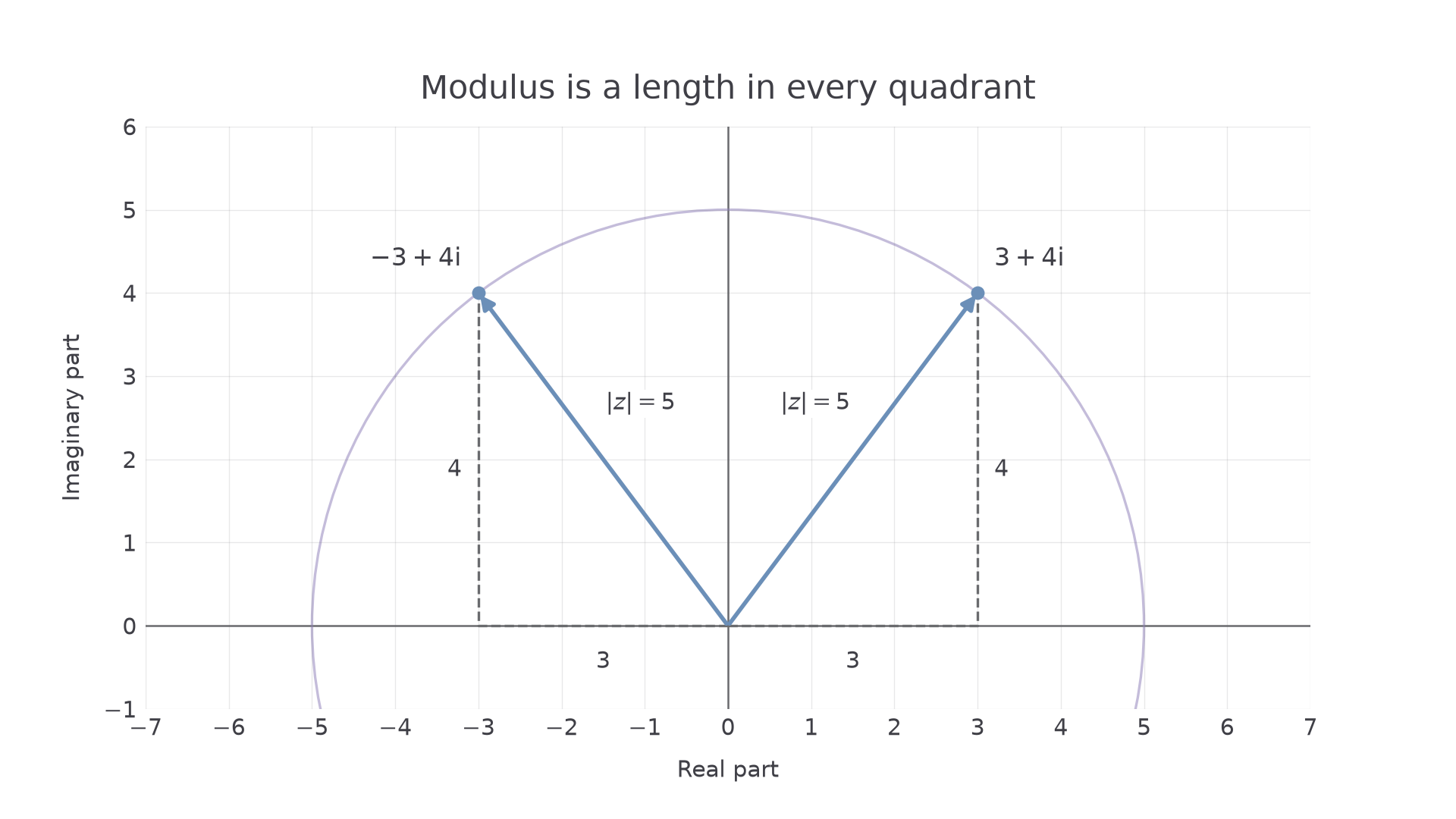
For , the horizontal and vertical displacements form the perpendicular sides of a right-angled triangle. Pythagoras gives a distance of . Changing a coordinate's sign moves the point but does not change the square of that coordinate.
You already know
An Argand diagram plots at . From A-level Mathematics, Pythagoras gives lengths and trigonometric ratios relate a right triangle's sides to an angle. Angles measured in radians make one full turn , not .
The notation for this length is a modulus sign, just as for the size of a real number.
Modulus
The modulus of a complex number is its distance from the origin in an Argand diagram. It is a non-negative real number. For example, . Not an example: the modulus is not itself, nor can it be negative.
Pythagoras works in every quadrant because the coordinates are squared. Combining this with the conjugate calculation from complex arithmetic gives two ways to find the same quantity.
Modulus from Cartesian form
For real and ,
In particular, exactly when .
Not in the formula booklet: learn it.
The triangle below explains why a negative horizontal coordinate still contributes a positive square.
[DIAGRAM: asset_name: Modulus is the hypotenuse in any quadrant; asset_slug: 9fm0-modulus-triangle; caption: Both 3 plus 4i and minus 3 plus 4i are five units from the origin; description: Equal-scale Argand axes show the two points (3,4) and (minus 3,4), with blue lines of length 5 from the origin to each. Dashed vertical sides have length 4 and horizontal sides have length 3. A pale circle of radius 5 passes through both points, and the two hypotenuses are labelled modulus 5.]
Worked example 1: a familiar right triangle
Question. Find .
Plan. Square the real and imaginary parts, add, then take the non-negative square root.
Why this step? A length is non-negative, so the final answer is , not .
Answer. .
Check. .
Change just the sign of the real part. The point moves into the second quadrant, while the modulus stays the same.
Worked example 2: a negative coordinate
Question. Find the modulus of .
Plan. Put the signed coordinates into the sum of squares.
Why this step? Squaring the whole real coordinate gives . Writing would square only the , then negate it.
Answer. The modulus is .
Check. Reflection in the imaginary axis takes to without changing its distance from the origin.
A useful surprise lives on the unit circle. If , then , so the reciprocal of is just its reflection: . For instance, has reciprocal ; their product is .
Watch out
Wrong: . The real coordinate is , whose square is . Right: . Modulus also never means “add the two coordinates”.
Apply the distance rule when both coordinates are negative.
Choosing the principal argument
The argument gives the direction of a non-zero complex number, measured from the positive real axis, and the quadrant decides which angle is correct.
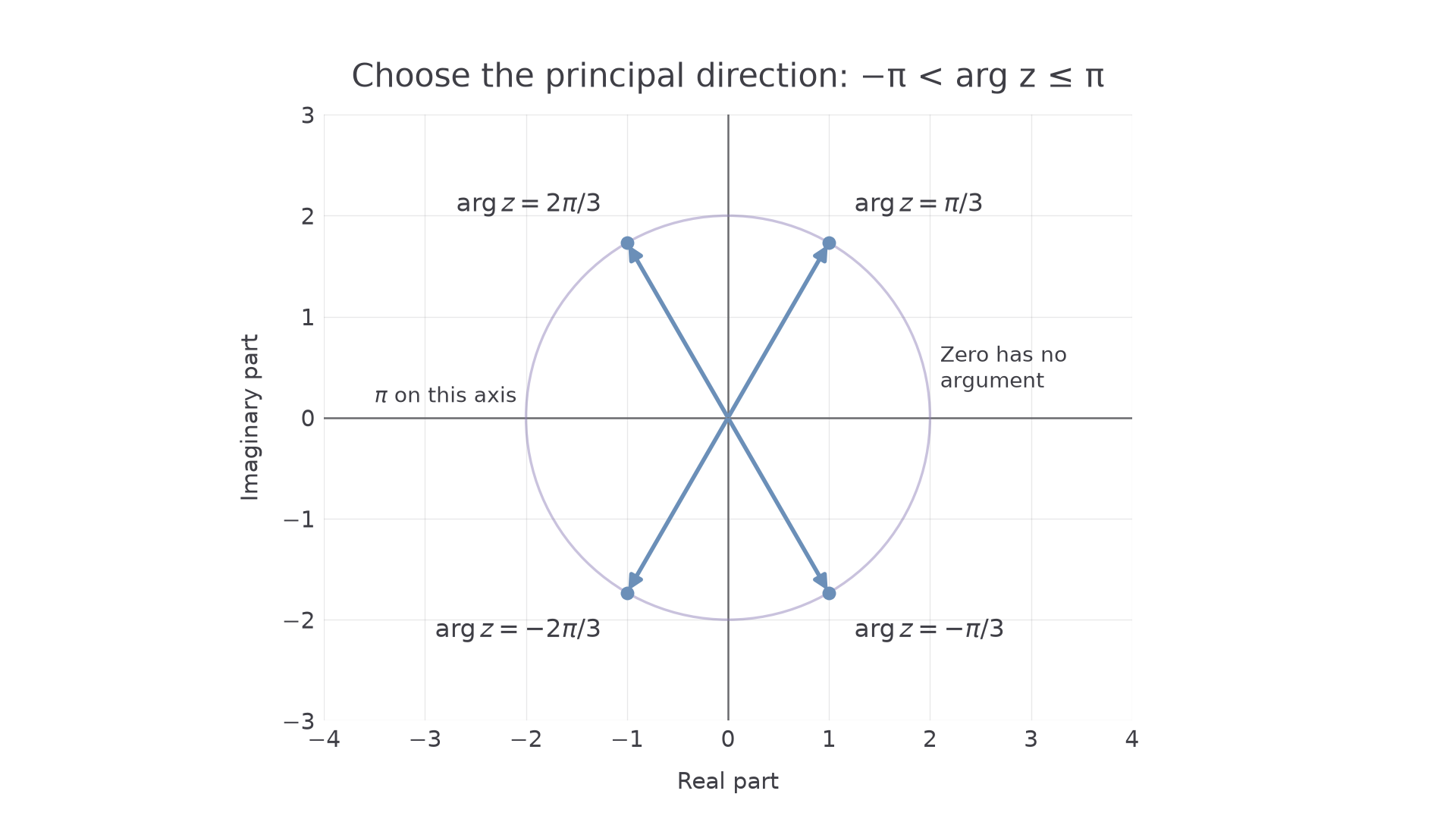
The angle to is about radians. The angle to is about radians. The points have the same modulus, but these different directions distinguish them.
Principal argument
For , the principal argument is the directed angle from the positive real axis to the position vector of , chosen in the range . Positive angles turn anticlockwise; negative angles turn clockwise. For example, and . Zero has no argument because it has no direction.
A full turn changes an angle by without changing the point. The principal range selects one representative. On the negative real axis choose , since is excluded; on the positive real axis choose zero.
For a point off the axes, first find the acute reference angle , then use the signs of the coordinates. This avoids trusting a calculator's inverse tangent to find the quadrant for you.
| Quadrant | Signs of | Principal argument |
|---|---|---|
| First | ||
| Second | ||
| Third | ||
| Fourth |
The rule is a direction rule rather than a formula to apply at the axes: when , division by is unavailable, but the diagram gives immediately. These argument conventions and the reference-angle procedure are not in the formula booklet; learn them.
[DIAGRAM: asset_name: Principal arguments in the four quadrants; asset_slug: 9fm0-principal-arguments; caption: The same reference angle gives different principal arguments in different quadrants; description: Equal-scale Argand axes show four points at (1,root 3), (minus 1,root 3), (minus 1,minus root 3) and (1,minus root 3). Each lies on a faint circle of radius 2. Clear labels give principal arguments pi over 3, 2pi over 3, minus 2pi over 3 and minus pi over 3 respectively. A note identifies pi on the negative real axis and says zero has no argument.]
Worked example 3: the second quadrant
Question. Find the principal argument of .
Plan. Find the reference angle from the coordinate ratio, then use the second quadrant.
Why this step? The calculator value points into the fourth quadrant, which disagrees with the signs of .
Answer. .
Check. and , so the direction has negative real and positive imaginary parts.
Change only the sign of the imaginary part. The point moves below the real axis, so the principal direction is now clockwise.
Worked example 4: the third quadrant
Question. Find the principal argument of .
Plan. Keep the same reference angle and choose the third-quadrant angle in the principal range.
Why this step? The anticlockwise angle reaches the point too, but subtracting makes it principal.
Answer. .
Check. Reflecting in the real axis reverses its angle from to .
Inverse tangent knows a ratio. A sketch supplies the information about the signs that the ratio can lose.
Watch out
Wrong: “, so the argument is positive.” Both coordinates can be negative. For , the ratio is positive but the principal argument is . Identify the quadrant first.
Use a different reference angle for this point below the real axis.
Converting between the two forms
A modulus and an argument recover the original coordinates through cosine and sine, so distance and direction contain exactly the same information as Cartesian form.
If the position vector has length and angle , its horizontal projection is and its vertical projection is . Signed trigonometric values make this work in all four quadrants, not just in a right triangle drawn above the axis.
Modulus-argument form
For , set and choose . Then
To go from Cartesian form, calculate and choose using the quadrant. Equivalent directions differ by whole multiples of .
Not in the formula booklet: learn it.
The booklet uses this notation inside de Moivre's theorem, but it does not supply the conversion procedure. Keep the bracket: multiplies both trigonometric terms.
For instance, has and , so its modulus-argument form is . Multiplying back gives .
Worked example 5: Cartesian to modulus-argument
Question. Express in modulus-argument form, using its principal argument.
Plan. Calculate the modulus, identify the quadrant and find the angle from its reference triangle.
Why this step? The ratio alone gives a reference angle; the negative real part and positive imaginary part choose the second quadrant.
Answer. .
Check. Multiplying by and gives the original coordinates and .
Now change just the sign of the imaginary coordinate. The radius and reference triangle stay the same; the principal argument changes sign.
Worked example 6: Cartesian form below the axis
Question. Express in modulus-argument form, using its principal argument.
Plan. Keep the modulus and reference angle from the reflected point, then choose the third-quadrant direction.
Why this step? The anticlockwise angle would describe the same point, but it lies outside the principal range.
Answer. .
Check. Cosine and sine are both , recovering .
For the reverse direction, the trigonometric values supply the coordinates directly. The next pair keeps the modulus fixed while changing the quadrant.
Worked example 7: modulus-argument to Cartesian
Question. Express in Cartesian form.
Plan. Substitute exact trigonometric values and multiply both parts by the modulus.
Why this step? The radius scales both coordinates; multiplying only the real part would change the angle as well as the distance.
Answer. .
Check. , and the point is in the first quadrant with .
The second example changes only the angle, from the first quadrant to the second. The cosine changes sign while the sine stays positive.
Worked example 8: converting in a different quadrant
Question. Express in the form , with exact real numbers.
Plan. Use the signs of sine and cosine in the second quadrant, then distribute the modulus.
Why this step? The reference angle is still ; the quadrant determines which coordinate is negative.
Answer. , so and .
Check. The modulus remains , and negative real part with positive imaginary part matches .
Distribute the modulus before reading off either coordinate.
Watch out
Wrong: . The bracket scales both terms. The correct expansion is , giving coordinates .
This answers the opening question. Both and have modulus . If , their forms are and : same distance, different direction.
Exam tip
When modulus-argument form is requested, give the complete expression , with the angle in radians. A pair of values for and is useful working, but finish in the requested form.
Here the angle is clockwise. Recover its coordinates before checking its quadrant.
Quick Recap
- is a non-negative distance, and .
- For , choose ; zero has no argument.
- Use a reference angle and the quadrant, rather than trusting alone.
- Convert with , where and .
The opening points share modulus ; their different principal arguments distinguish their positions exactly.