FP2 4.2 - Transformations from z-plane to w-plane
Find complete images of points, loci and regions under complex transformations (FP2 4.2). You will square in Cartesian or polar form, invert fractional transformations and preserve poles, missing points and boundary restrictions.
Squaring can bend a straight line
How can a straight line become a parabola, while another simple transformation sends a line onto a circle with one point missing? A complex formula changes whole sets of points. Finding an equation for the image is only part of finding its complete image.
You already know
Write in the source plane and in the image plane. Complex multiplication can be calculated by expansion or polar form. A locus and its domain exclusions must be kept together; argument conditions always exclude a zero displacement.
Expanding gives two ordinary real equations.
Squaring in Cartesian coordinates
For ,
The origin maps to the origin. For , the two square roots and have the same image; the origin is its own single preimage.
Not in the formula booklet: learn it.
For a power map, polar form explains the change in modulus and direction. The underlying theorem is supplied.
De Moivre's theorem
For and positive integer ,
In the formula booklet.
Thus sends modulus to . For , its angle becomes , then is reduced to if a principal argument is requested. These image interpretations are not separately printed. They do not describe a single fixed enlargement or rotation of the plane.
Worked example 1: the image of a vertical line
Question. Under , find the complete image of the line .
Plan. Set , then eliminate between the equations for .
Why this step? Every real gives a real source parameter , establishing the whole parabola rather than just a necessary equation.
Answer. The complete parabola , for all real .
Check. maps to , giving , which satisfies the parabola.
Change only the source line from to .
Worked example 2: a shifted source line
Question. Find the image of under .
Plan. Substitute , then eliminate the new relationship between and .
Why this step? The coefficient of changes as well as the vertex; this is not merely a translation of the earlier image.
Answer. The complete parabola , for all real .
Check. maps to , and .
A line through the origin is a boundary case worth checking directly: gives , including the origin if the original line includes .
Watch out
The statement “ enlarges every distance by factor ” is wrong: modulus becomes , rather than . Moduli are squared and arguments doubled; the changes depend on the original point.
Change the fixed real part once more.
Map radii and angles, then choose principal directions
For an annular sector, power maps separate neatly into a radial interval and an angular interval. Keep the angle temporarily unwrapped so that crossing the principal cut does not discard an edge.
Squaring an annular sector
For positive radii and an allowed source angle , squaring gives
Map the entire angle interval before expressing the answer in principal arguments. Boundary inclusion follows from which source points are actually allowed.
Not in the formula booklet: learn it.
A full circle maps to the full circle . A restricted source arc may cover it once, twice or only partly; check the actual angle interval.
Worked example 3: an upper half-annulus
Question. Find the image under of
Plan. Square the radius bounds and double every allowed angle.
Why this step? Any image radius between and has an allowed square-root radius, and any angle between and has an allowed half-angle.
Answer. The closed upper half-annulus . Both circular arcs and the real-axis radial edges are included.
Check. is allowed and maps to , inside the image.
Rotate only the source angle interval by , keeping both radius bounds unchanged.
Worked example 4: the lower half and a principal-endpoint trap
Question. Find the image of
under .
Plan. Double the unwrapped angles first, then describe their directions geometrically.
Why this step? The negative real image edge has principal argument , even though nearby lower-half points have principal arguments just above .
Answer. The closed lower half-annulus . In principal-angle language, it has , together with .
Check. maps to . An allowed positive-imaginary source point maps to the negative real edge, so that edge is included.
For example, cubing instead sends to the open sector . The modulus is cubed; with no radial bound, all positive image radii occur.
[DIAGRAM: asset_name: A quarter-annulus squared into a half-annulus; asset_slug: square-annular-sector; caption: Squaring turns radii one and two into one and four, while doubling the source angle interval.; description: A source-plane quarter-annulus with1 at most radius at most2 and angles0 to pi/2 is paired with its image-plane upper half-annulus with radii1 and4. All circular and radial edges are solid. Each panel has independently labelled equal-scale axes, and the radius ranges and angle ranges are shown in dark ink.]
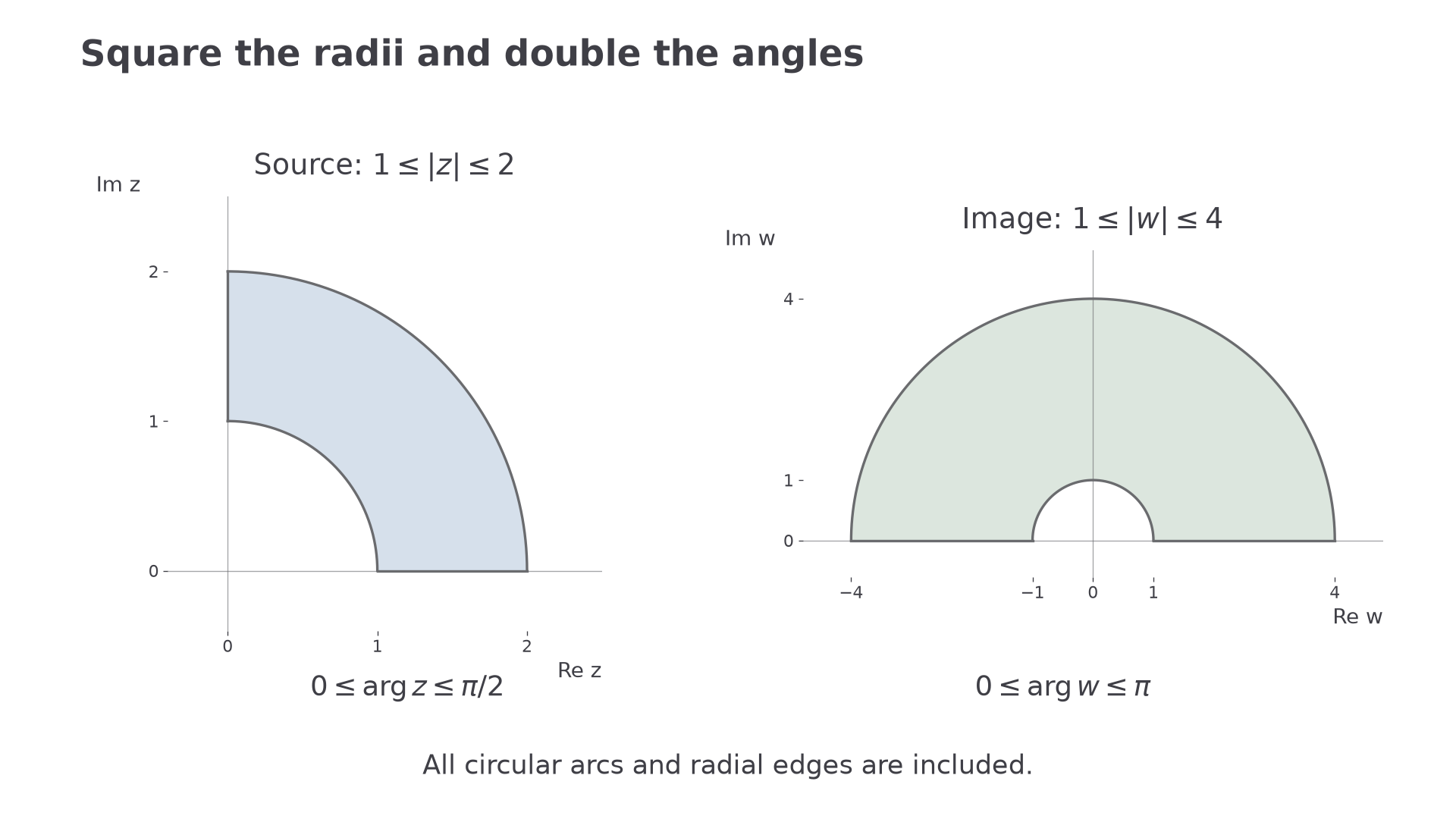
A geometric half-plane condition can express the image more cleanly than a principal interval split across the negative real axis.
Watch out
Writing only for the second image loses its negative real edge. That edge has principal argument . Use , or add the separate condition .
Shift only the angular window, preserving the same annular radii.
Invert a fractional transformation and record its missing values
For a fractional transformation, the denominator controls which source points are allowed. Solving for identifies which image values can occur.
A nonconstant fractional transformation
Let
Then
For , the source excludes the pole , and the image of the full allowed plane excludes .
For , nonzero requires : the map is affine, , and maps the full plane bijectively onto the full plane.
Not in the formula booklet: learn it.
The nonzero- condition matters. If and the denominator is not identically zero, the map is constant wherever defined. For example,
has image , so is attained. The omitted-value rule for a nonconstant map does not apply. If , the denominator vanishes everywhere and no transformation is defined.
Worked example 5: a complex inverse
Question. For , find the inverse, its source exclusion and omitted image value. Find the image of .
Plan. Rearrange before using coordinates, then substitute the source point and rationalise its denominator.
Why this step? The inverse denominator reveals as impossible, rather than as a value to add later to an image equation.
Answer. , with source and image . The given point maps to .
Check. Setting in the original relation would require , impossible for a finite .
Change only the numerator's constant from to .
Worked example 6: the same pole, a different inverse
Question. Repeat the calculations for .
Plan. Preserve the altered constant while collecting .
Why this step? The pole stays at the denominator's zero, while the changed numerator alters the image of every ordinary source point.
Answer. , with , ; the given point maps to .
Check. At , ; the inverse then gives .
Continue this lesson.
You’re previewing NovaLearn without an account. Create a free account to read the rest.
Create free account