FM1 2.1 - Work-energy principle and energy conservation
Energy can replace a long calculation of forces and accelerations with one equation linking the start and finish of a journey. You will calculate signed work, use kinetic and gravitational potential energy, and decide when mechanical energy is conserved. You will also handle friction on slopes and resistance that changes with position.
Signed work changes kinetic energy
Why can doubling a particle's initial speed quadruple its stopping distance? Imagine the same particle being stopped on a level track by the same constant resistance. Twice the speed sounds like twice the task, but the energy calculation gives a different answer. Keep that question in mind as you build the method.
You already know
Use the resultant force in Newton's second law. Resolve forces parallel and perpendicular to a plane; while a particle slides, friction has magnitude and opposes its motion. These A-level Mathematics skills supply the forces; this lesson connects their work to energy.
Start with a constant force of acting in the direction of a displacement. Its work is . The same force acting against the displacement does of work. A perpendicular force does no work, however large it is.
Work and kinetic energy
The work done by a force measures its energy transfer through displacement. Work is a scalar and may be positive, negative or zero. A particle's kinetic energy is the energy associated with its motion; it is non-negative and depends on speed, not direction. Both quantities are measured in joules, , with .
Only the force component parallel to the displacement contributes to work.
Constant-force work and the work-energy principle
For a constant force of magnitude , displacement of magnitude , and angle between them,
For a particle of constant mass and speed ,
The resultant work is the sum of the work done by all forces. For initial and final speeds and , this is .
Not in the formula booklet: learn it.
Here is why the square of speed appears. For constant resultant force along a straight line, , while . Therefore . Adding the work over small successive displacements extends the principle to a varying force. The energy equation avoids having to find the time taken.
Worked example 1: adding positive and negative work
Question. A particle of mass moves along a horizontal track, initially at . A constant driving force of acts horizontally forwards and a constant resistance of opposes the motion. Find the speed after a displacement of . The particle remains in contact with the track.
Plan. Add the work of the driving and resisting forces and equate it to the kinetic energy increase.
Why this step? Resistance does negative work. Weight and the normal reaction are perpendicular to the horizontal displacement, so each does zero work.
Answer. The final speed is .
Check. The resultant force is , so . Independently, .
Change only the driving force's direction: it now acts at above the track. Its magnitude is unchanged, but less of it contributes to the work.
Worked example 2: a force at an angle
Question. A particle of mass moves along a horizontal track, initially at . A constant force of pulls forwards at above the horizontal; a constant resistance of opposes the motion. Find the speed after a horizontal displacement of . The particle remains in contact with the track.
Plan. Use the pull's horizontal component to calculate its work; retain the same resisting work.
Why this step? The displacement is horizontal. The pull's vertical component changes the normal reaction, but it makes no direct contribution to the work. The resistance here is given as , rather than calculated from a coefficient of friction.
Answer. The final speed is , approximately .
Check. The horizontal resultant is . Thus , agreeing with the energy calculation.
An upward pull can therefore do positive work without its whole magnitude contributing. The direction is part of the calculation.
Watch out
Wrong: . The first term is work in joules, but the second is force in newtons. Right: for the horizontal pull. Every work term needs the appropriate displacement.
Keep the angled-pull model and change only its magnitude.
Height changes and mechanical energy
Raise a particle by a vertical height at constant speed. An upward force of magnitude must do work . That energy can be recovered as kinetic energy when the particle descends without resistance.
Gravitational potential energy
The gravitational potential energy of a particle near the Earth's surface is , where is its vertical height above a chosen reference level. Only differences in potential energy affect a motion calculation. A negative , and hence a negative , is allowed below the chosen level.
Gravity does positive work on descent and negative work on ascent. You can account for that work using a potential energy change instead.
Gravitational energy and conservation
For constant and vertical height change ,
If gravity is the only force doing work,
Thus , the mechanical energy in this model, is constant. A stationary smooth track's normal reaction does no work because it is perpendicular to motion. Use .
Not in the formula booklet: learn it.
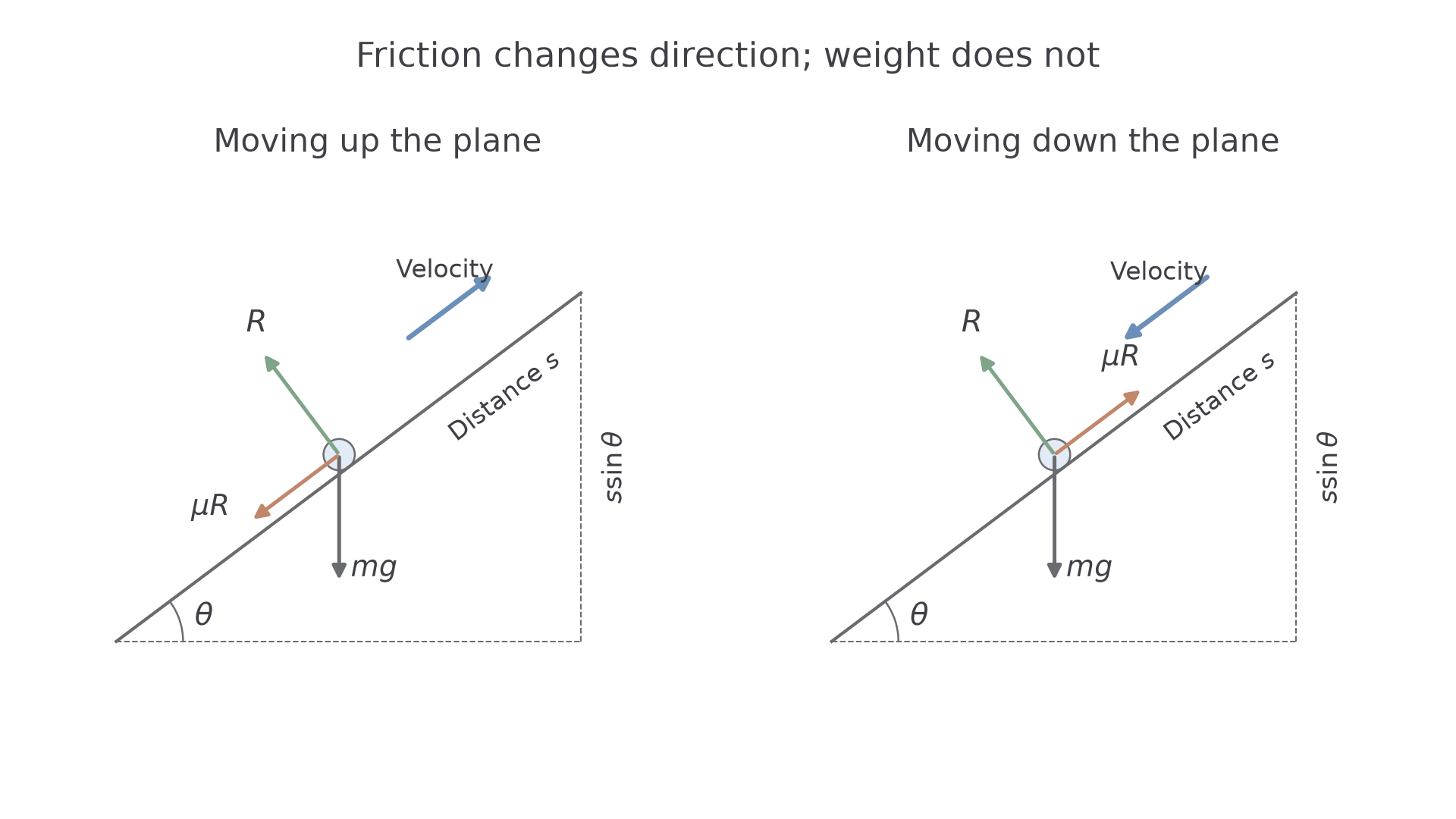
On a plane inclined at , moving distance up the line of greatest slope raises the particle by . Distance down the plane gives a height change of .
Worked example 3: ascending a smooth plane
Question. A particle of mass moves up a smooth fixed plane with initial speed . The plane is inclined at , where . Find its speed after travelling up the plane. Ignore air resistance.
Plan. Subtract the gain in gravitational potential energy from the initial kinetic energy.
Why this step? The plane's reaction does no work. Kinetic energy supplies the rise in potential energy, so the speed decreases.
Answer. The speed is .
Check. The energy remaining, , is positive, so the particle can reach this point. The gain and remaining total the initial .
Change only the direction of travel. The same distance down the same plane releases potential energy instead of using it.
Worked example 4: descending a smooth plane
Question. A particle of mass moves down a smooth fixed plane with initial speed . The plane is inclined at , where . Find its speed after travelling down the plane. Ignore air resistance.
Plan. Add the gravitational potential energy lost to the initial kinetic energy.
Why this step? The potential energy change is negative, so subtracting it increases the kinetic energy. A loss of potential energy is not a loss of total mechanical energy.
Answer. The speed is .
Check. With the starting height as zero, final potential energy is . Then final , the initial total.
The mass cancels from the general equation . In this model, particles of different masses with the same initial speed and height change reach the same final speed. A different smooth fixed path between the same heights also gives that speed, provided the particle reaches the endpoint and remains on the path. It need not give the same journey time.
Watch out
Do not include both as gravity's work and as potential energy gained in the same balance. Either use the work of every force to calculate , or move gravity into . Counting it twice gives a false energy loss or gain.
Change the initial speed for another descent.
Friction removes mechanical energy
On a rough plane, gravitational energy is only part of the balance. Friction does negative work whether the particle travels up or down. The energy it removes from the particle's mechanical energy is transferred to other forms, such as internal energy of the surfaces.
[DIAGRAM: asset_name: Friction opposes motion on ascent and descent; asset_slug: 9fm0-fm138-rough-plane; caption: Gravity acts down the slope in both cases, while friction reverses when the motion reverses; description: Two equal inclined-plane diagrams show a particle with weight vertically downward and reaction perpendicular outward. The left panel has an up-slope velocity arrow and friction down the slope. The right panel has a down-slope velocity arrow and friction up the slope. A labelled vertical rise equals s sin theta and the plane angle theta connect the slope distance with height.]
Continue this lesson.
You’re previewing NovaLearn without an account. Create a free account to read the rest.
Create free account