FP2 1.4 - Lagrange's theorem
Use Lagrange's theorem to restrict subgroup and element orders (FP2 1.4). You will see why subgroup sizes divide a finite group size, separate necessary conditions from existence claims, and explain why a group of prime order must be cyclic.
Why a subgroup size divides the group size
Could a group with elements contain a subgroup with elements? The obstacle is a counting one: a finite group can be partitioned into equally sized copies of any subgroup, with no leftovers.
You already know
A subgroup contains the original identity and is closed under the original operation and inverses. If has order , the generated subgroup has elements. Equal-sized disjoint sets have total size equal to the number of sets times their common size.
For a concrete picture, take addition modulo and . Adding , respectively, to all members of produces four disjoint three-element sets.
[DIAGRAM: asset_name: Equal-sized copies of an additive subgroup; asset_slug: lagrange-equal-copies; caption: Four disjoint copies, each with three members, account for all twelve group elements.; description: Four rows list H={0,4,8},1+H={1,5,9},2+H={2,6,10},3+H={3,7,11} in addition modulo12. Each row contains three equally sized cells. A separate equation says four times three equals twelve. Dark ink labels and two restrained accents distinguish the original subgroup from its translated copies.]
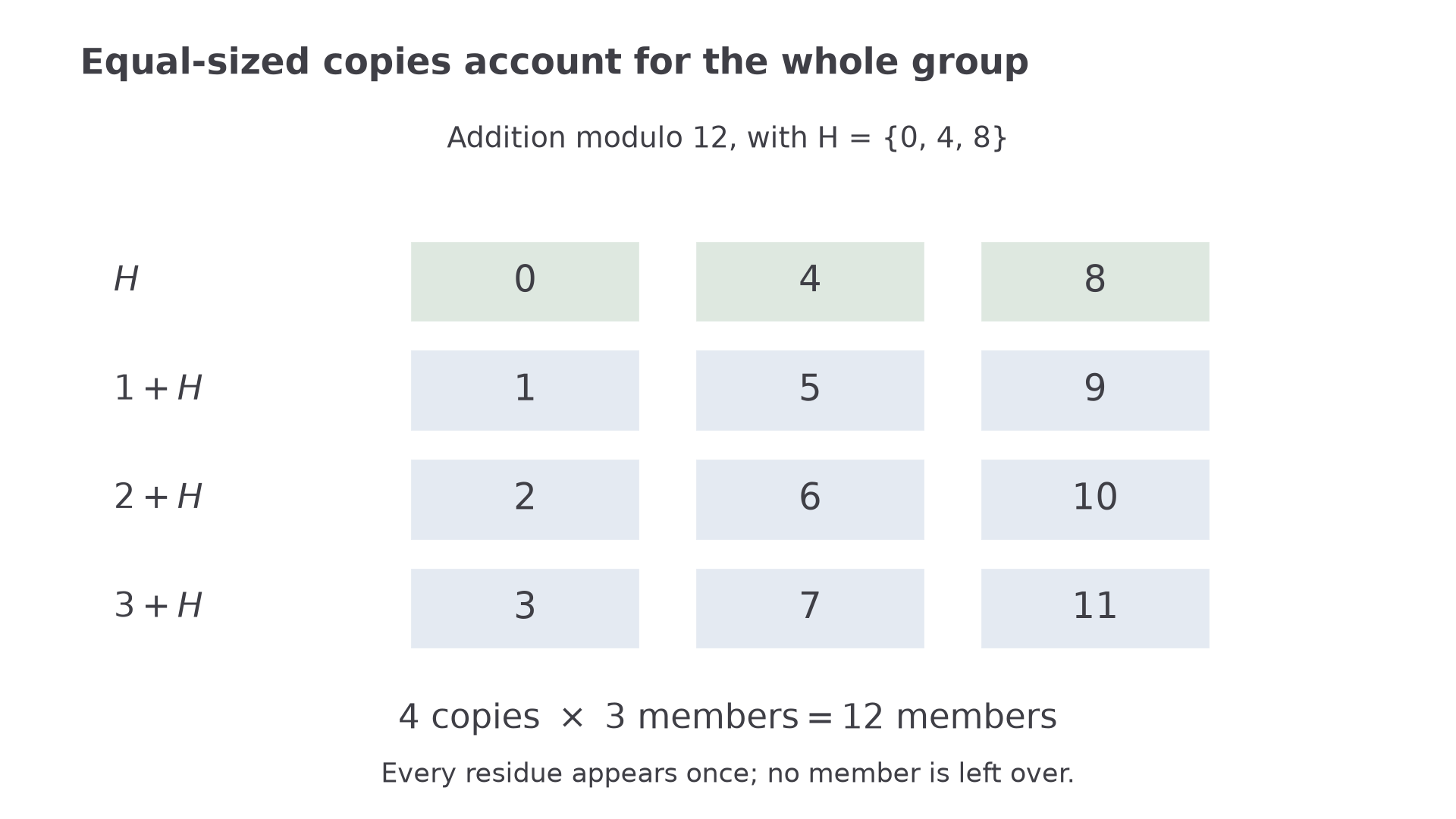
The other rows need not themselves be subgroups: , for example, does not contain the identity . They are equal-sized copies used for counting.
A translated copy of a subgroup
Writing an operation multiplicatively, for define
This is obtained by multiplying every member of on the left by the same . In an additive example, the corresponding notation is .
Here is why the counting works in any finite group. Cancellation makes one-to-one, so each has members. If two copies overlap, write . Then
and every lies in , since
The copies have the same finite size, so this inclusion makes them equal. Thus distinct copies are disjoint. They cover , because each belongs to through .
Lagrange's theorem
The notation means that is a subgroup of . If is finite, then
Equivalently, for some positive integer ,
The number counts the distinct equal-sized copies of .
Not in the formula booklet: learn it.
In the opening question, does not divide , so such a subgroup cannot exist.
Key idea
A subgroup partitions a finite group into equal-sized translated copies; divisibility is forced by that partition.
The theorem restricts possible sizes. It does not promise a subgroup of every size dividing .
Restrict subgroup and element orders
Apply the theorem first to a subgroup , then to the subgroup generated by an element . This gives restrictions on both kinds of order.
Element-order consequences
For an element of a finite group ,
Consequently,
Indeed, if with , then .
These are necessary restrictions. A divisor of is not automatically the order of some element or subgroup.
Not in the formula booklet: learn it.
A proper subgroup excludes the full size . If the question also says nontrivial, exclude size as well.
Worked example 1: the divisors of eighteen
Question. A group has order . List the subgroup orders that Lagrange permits for a proper subgroup, and the element orders it permits. Do these lists prove that all such objects exist?
Plan. List positive divisors, then apply the proper-subgroup restriction only to the subgroup list.
Why this step? An element may generate the whole group, so order remains permitted for elements even though the subgroup is required to be proper.
Answer. Proper-subgroup sizes permitted: . Element orders permitted: . Lagrange alone does not guarantee each one's existence.
Check. Each listed size divides ; a proposed subgroup size is excluded because is not an integer.
Change only the group order from to .
Continue this lesson.
You’re previewing NovaLearn without an account. Create a free account to read the rest.
Create free account