CP 6.3 - Angles between lines and planes
One scalar-product calculation can describe several different angles, so choosing the right vectors matters. You will find angles between two lines, between two planes, and between a line and a plane, including the complementary angle that is easy to miss.
Angles between two lines
A line rises from a floor at an angle, but a scalar-product calculation gives its complement. How can a correct calculation answer the wrong question?
First separate points from directions. A line's direction vector tells you its orientation; its anchor only tells you where it is. Translate two direction vectors to a common origin to measure their angle, even if the original lines are skew.
You already know
For non-zero vectors, . Positive, zero and negative products correspond to acute, right and obtuse vector angles. A line's direction vector can be replaced by any non-zero multiple.
An undirected line has no preferred arrow. Unless a particular angle is specified, use the acute angle between lines, with the right-angle and parallel cases included as endpoints.
Smaller angle between two lines
For non-zero direction vectors , the smaller angle satisfies
If an obtuse angle is requested, take the supplement of the acute angle. Not in the formula booklet: learn it.
The absolute value makes the result independent of which way each direction arrow points.
Worked example 1: direction vectors rather than anchors
Question. Two lines have direction vectors and . Find their acute angle to significant figures.
Plan. Calculate the dot product and magnitudes, then use inverse cosine.
Why this step? The two direction vectors encode the orientations; position vectors of arbitrary anchors would measure something else.
Answer. .
Check. A small positive cosine gives an acute angle nearer than .
Worked example 2 reverses only the second direction vector. The line itself, and therefore the acute angle, must stay unchanged.
Worked example 2: a reversed direction arrow
Question. Find the acute angle between directions and .
Plan. Take the absolute value of the scalar product before applying inverse cosine.
Why this step? Without the absolute value, is the angle between the chosen arrows, not the requested acute angle between lines.
Answer. .
Check. Reversing an arrow cannot change the physical line, and the two vector angles sum to .
This is a useful invariance: moving a line or reversing its equation's direction vector can leave an angle unchanged even though many coordinates change.
Watch out
Wrong: use the lines' anchor vectors in the dot product. Right: use their direction vectors. For an acute angle, a negative cosine is a signal to take the supplement or use the absolute-value formula.
Change the middle direction component in the next calculation.
Angles between two planes
The acute angle between two planes equals the acute angle between their normals.
Take a cross-section perpendicular to the line where the planes meet. Each plane becomes a line in that section, and each normal is a perpendicular to one of those lines. Turning both lines through a right angle preserves their acute angle. The constants in the plane equations move the surfaces, but do not change their normals' directions.
Acute angle between planes
For non-zero normals ,
Parallel planes have angle ; perpendicular planes have perpendicular normals and angle . Not in the formula booklet: learn it.
Read normals from the coefficients of . The right-hand constants are not vector components.
Worked example 3: normals read from Cartesian equations
Question. Find the acute angle between and .
Plan. Extract the normals and calculate their acute angle.
Why this step? A plane has many directions inside it; choosing one arbitrary in-plane direction would not determine its tilt relative to the other plane.
Answer. The acute angle is .
Check. Neither zero product nor proportional normals occurs, so the planes are neither perpendicular nor parallel.
Worked example 4 changes only how the second plane is written, multiplying its entire equation by .
Worked example 4: an equivalent plane equation
Question. Find the acute angle between and .
Plan. Use the new normal and check that its rescaling cancels in the angle ratio.
Why this step? A normal can be scaled or reversed without changing its plane's orientation, so the angle formula must remove that arbitrary choice.
Answer. .
Check. Dividing the second equation by recovers the plane from worked example 3.
Moving either plane by changing its constant also leaves this angle unchanged. Orientation lives in the coefficients, not the intercepts.
Watch out
Wrong: include the constant as a fourth entry of a normal vector. Right: the normal to is , with three components.
Use the same normal selection in the next pair.
The angle between a line and a plane
A line-plane angle is measured to the line's projection in the plane, so it complements the acute angle between the line and the plane's normal.
If is the acute direction-normal angle and is the line-plane angle, then . This is the source of the opening puzzle: using inverse cosine with the normal first gives , while the question asks for .
[DIAGRAM: asset_name: The complementary line-plane angles; asset_slug: 9fm0-cp42-complementary-angles; caption: The line-plane angle complements the angle to the normal; description: An exact cross-section shows a horizontal plane trace, its vertical normal, and a line rising at 30 degrees to the plane. A projection is shown horizontally. The angle to the plane is labelled gamma equals 30 degrees, and the angle to the normal is labelled theta equals 60 degrees. Both angle labels have white backgrounds and are clear of rays]
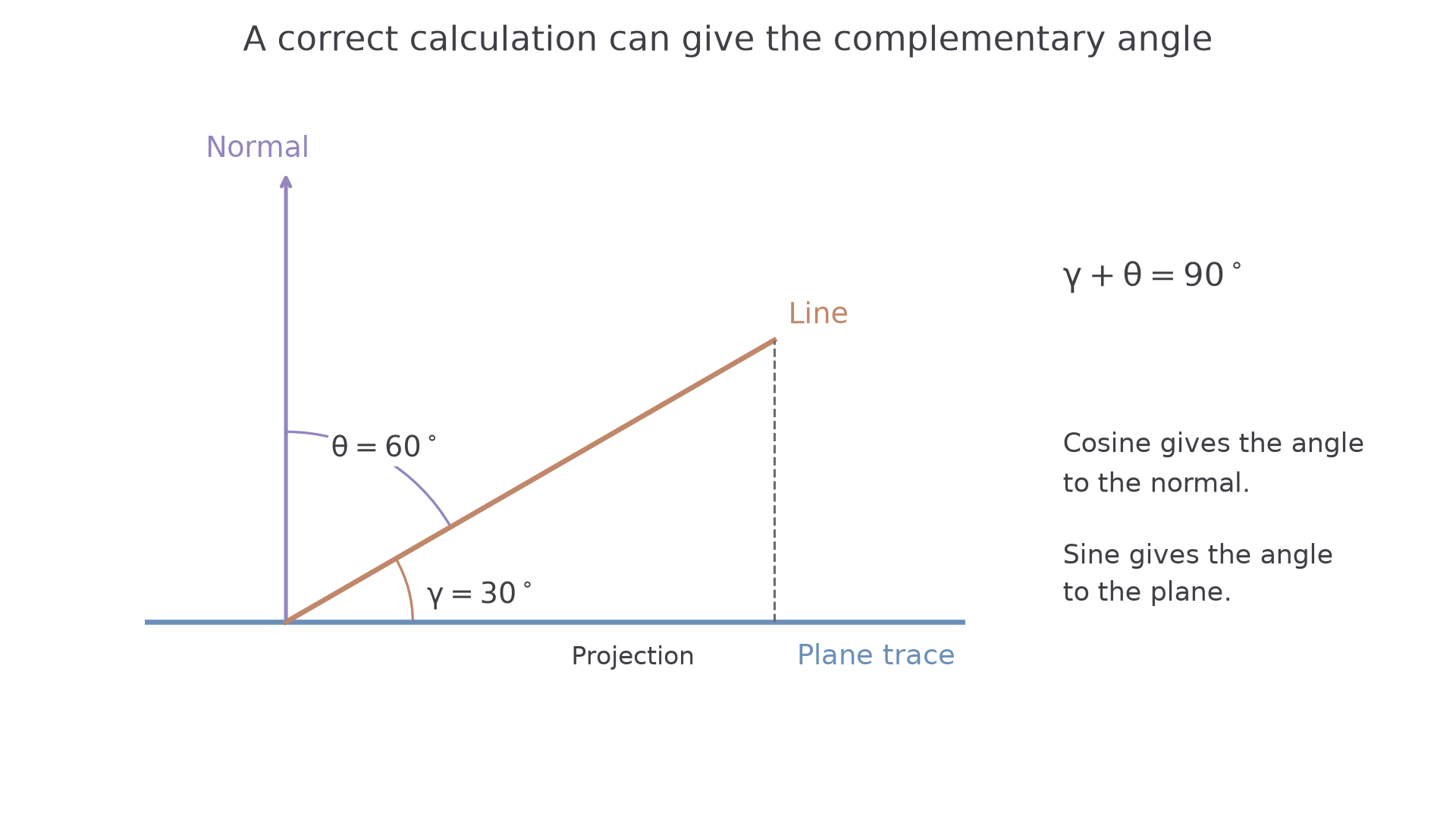
It is often cleaner to use sine directly, since .
Angle between a line and a plane
For non-zero line direction and plane normal ,
A parallel direction gives ; a normal direction gives . Not in the formula booklet: learn it.
The absolute value again removes an arbitrary direction choice, while sine selects the angle to the surface.
Worked example 5: a line above a horizontal plane
Question. Find the acute angle between a line of direction and the plane .
Plan. Use normal and inverse sine.
Why this step? Inverse cosine of gives , the angle to the vertical normal. The plane angle is its complement.
Answer. .
Check. The horizontal projection has length per step and the vertical rise is , so , giving the same answer.
Worked example 6 changes only the plane orientation: the plane is now , rather than .
Worked example 6: a different plane normal
Question. Find the acute angle between the same line direction and the plane .
Plan. Replace the normal by , keeping the line direction fixed.
Why this step? The normal changes with the plane; reusing the previous normal would measure the angle to a different surface.
Answer. .
Check. The component along this normal is smaller than before, so the line makes a smaller angle with this plane.
Choose the formula by the objects: directions and cosine for two lines; normals and cosine for two planes; a direction and a normal with sine for a line and a plane.
Watch out
Wrong: report the direction-normal cosine angle as the line-plane angle. Right: subtract it from , or use the sine formula directly. Pearson's accuracy mark needs the requested angle.
The opening puzzle is now resolved. Keep that complement in mind when the direction changes.
Quick Recap
- Two lines: use their direction vectors and the acute cosine ratio.
- Two planes: use their normals and the acute cosine ratio.
- A line and a plane: use the line direction and plane normal, with inverse sine.
- Position changes and reversed vector arrows do not change these acute orientation angles.
A correct direction-normal calculation can give the wrong requested angle: the line-plane angle is its complement.