FM2 2.1 - Centre of mass of particles
A collection of particles has one point that summarises how its mass is distributed. You will locate that centre of mass in one and two dimensions by matching moments, and use a prescribed centre to find an unknown mass. You will also distinguish a force's perpendicular moment arm from the distance to where it is applied.
A moment uses the perpendicular distance
Can the centre of mass lie where there is no particle at all? Two equal particles at opposite ends of a light connector have their centre halfway between them, in the empty space. To explain that point precisely, start with the turning effects their weights would produce.
You already know
From A-level Mathematics moments: a force's moment about a point is its magnitude multiplied by the perpendicular distance to its line of action. Clockwise and anticlockwise moments oppose each other. A force whose line of action passes through the point has zero moment, even if it is applied elsewhere.
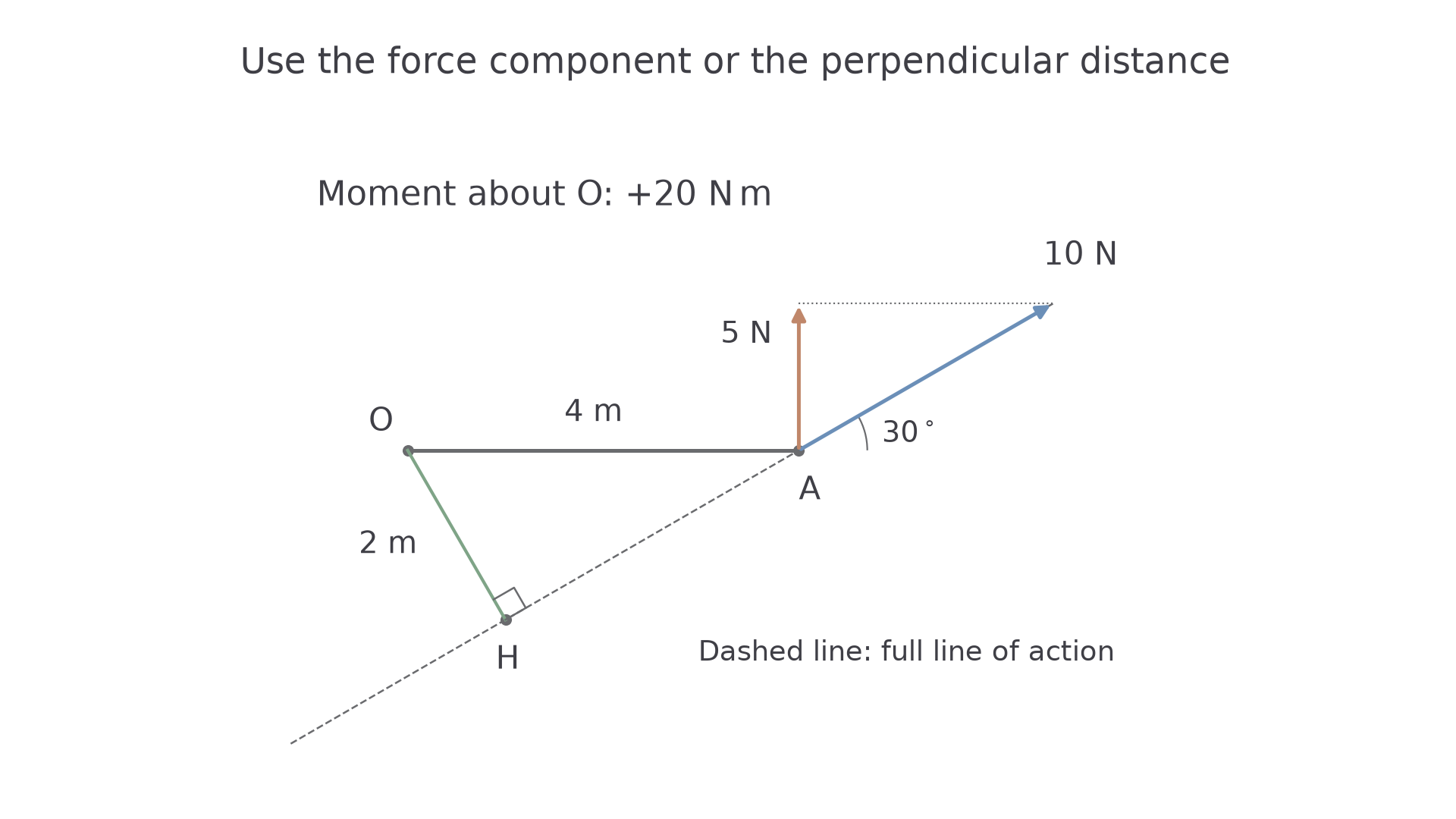
The line of action is the entire straight line through the force arrow, extended in both directions. For a force applied from a point along a horizontal rod, only its vertical component produces a moment about that point. Its horizontal component acts along a line through the point.
Signed moment of a force
For force magnitude and perpendicular distance from point to its line of action,
Moment has units . Declare a positive turning sense, then attach the appropriate sign. If a force acts at angle to a lever of length , its moment magnitude is ; use geometry or components to determine the sense.
Not in the formula booklet: learn it.
The distance is only the moment arm when the force is perpendicular to the lever. Resolving the force and finding a perpendicular distance are two equivalent methods, not two effects to add.
[DIAGRAM: asset_name: The perpendicular moment arm of an inclined force; asset_slug: 9fm0-fm150-moment-arm; caption: The moment uses distance to the force's line of action rather than simply OA; description: A horizontal lever OA of length four metres has a ten-newton force at A directed thirty degrees above the positive horizontal. Its full line of action is extended. A perpendicular from O to that line has length two metres and a right-angle marker. An upward five-newton component at A provides the same anticlockwise moment of twenty newton metres.]
Worked example 1: an inclined force
Question. A force of acts at , where and is horizontal to the right. The force points above the rightward horizontal. Find its moment about , taking anticlockwise as positive.
Plan. Use the force component perpendicular to .
Why this step? The horizontal component has zero moment about , so multiplying the full force by would overstate the turning effect.
Answer. The moment is , or anticlockwise.
Check. The perpendicular distance to the line of action is , giving .
Change only the force direction to anticlockwise from the rightward horizontal. Its horizontal component reverses, but its vertical component does not.
Worked example 2: a different line of action, the same moment
Question. The same force acts at the same point , right of , now directed anticlockwise from the rightward horizontal. Find its signed moment about .
Plan. Recalculate the perpendicular force component and identify its turning sense.
Why this step? A leftward component does not automatically mean a clockwise moment. Here that component acts along and has zero moment.
Answer. The moment remains anticlockwise.
Check. , so both perpendicular distances are .
If the force were directed downwards instead, its vertical component and its signed moment would both reverse. Always keep the geometry and the declared positive sense together.
Watch out
Wrong: for either inclined force. Right: with the correct sense. The moment arm is perpendicular to the line of action.
Change only the force angle once more.
A centre of mass is a mass-weighted average
Two equal particles at coordinates and balance in their turning effects about coordinate . If one particle becomes heavier, their centre moves towards it. An ordinary average of positions cannot capture that change; the positions must be weighted by mass.
Centre of mass of discrete particles
The centre of mass of a fixed distribution of particles is the point where its total mass may be regarded as concentrated for calculating the distribution's gravitational moment in a uniform gravitational field. For two equal particles it lies at their midpoint; it need not coincide with any particle or material. The centre exists whether or not the system is in equilibrium.
Replace the individual downward weights by their total weight at coordinate . Matching signed moments about the same reference gives . The common cancels.
Centre of mass on a line
For particles of positive masses at signed coordinates , with total mass ,
All positions must use one origin and one positive direction. Products have units ; they are mass moments, not force moments in .
Not in the formula booklet: learn it.
A negative coordinate means a particle lies on the negative side of the chosen origin. Its mass remains positive. A short table keeps those two signs distinct.
Worked example 3: particles on both sides of the origin
Question. Particles of masses lie at coordinates respectively on a line. Find their centre of mass.
Plan. Add the signed mass moments and divide by the total mass.
| Mass in | Position in | in |
|---|---|---|
Why this step? The particle left of the origin contributes a negative mass moment. Replacing its coordinate by a positive distance would locate a different system.
Answer. The centre is at , approximately .
Check. About that point, the signed mass moments sum to .
Change only the mass at coordinate , from to .
Worked example 4: move the centre by changing one mass
Question. Particles of masses lie at coordinates respectively. Find their centre of mass.
Plan. Update both the mass moment and total mass for the changed particle.
Why this step? Adding mass changes the numerator and denominator. Keeping the old total mass would not give a weighted average.
Answer. , approximately .
Check. The centre moves towards coordinate , and remains between the leftmost and rightmost particles.
With positive masses, always lies between the smallest and largest coordinates. Shifting the origin shifts every coordinate and the centre by the same amount; it cannot change the physical point.
Continue this lesson.
You’re previewing NovaLearn without an account. Create a free account to read the rest.
Create free account