CP 6.3, 6.4 - The scalar product and normal vectors
The scalar product turns two vectors into a number that measures their alignment. You will calculate it, use zero scalar products to test perpendicularity (CP 6.4), and express a plane using a normal vector and the equation (CP 6.3).
A number that measures alignment
Can two vectors with no zero components be perpendicular? The coordinate axes make right angles look easy; the scalar product will detect them in any direction.
Try and . Multiplying corresponding entries and adding gives . That cancellation is the signal we will explain.
You already know
For , its magnitude is . A plane has two non-parallel direction vectors; a line has one non-zero direction vector.
The scalar product is also called the dot product; Pearson writes the dot on the line between the vectors.
Scalar product
For and ,
The result is a scalar, not a vector. For example, .
Why should coordinate multiplication know about angles? In the triangle formed by , the cosine rule gives . Expanding the same squared length in coordinates gives the first two terms minus . Comparing the two gives the link.
Geometric meaning of the scalar product
For non-zero vectors and their angle ,
Thus a positive product means an acute vector angle, zero means a right angle, and a negative product means an obtuse vector angle. The coordinate rule also gives . Not in the formula booklet: learn it.
Calculate with signs intact: a negative component contributes its signed product.
Worked example 1: a positive scalar product
Question. Find for , , and state whether their angle is acute or obtuse.
Plan. Add the three coordinate products and use the sign.
Why this step? The geometric formula divides by positive magnitudes, so the product and have the same sign.
Answer. The scalar product is ; the vector angle is acute.
Check. , , and , consistent with an acute angle.
Worked example 2 changes only the last component of , from to .
Worked example 2: a negative scalar product
Question. Keep , but take . Find the scalar product and classify the vector angle.
Plan. Recalculate the affected coordinate product and interpret its sign.
Why this step? A magnitude is non-negative, but a scalar product can be negative because it includes directional information.
Answer. , so the vector angle is obtuse.
Check. The lengths are unchanged; the cosine has the opposite sign, so the new vector angle is supplementary to the previous one.
That last observation is useful: equal vector lengths do not imply equal scalar products. Turning a vector can change the sign without changing either length.
Watch out
Wrong: . Right: add those products to get one real number. The word “scalar” tells you the type of answer.
Try a new last coordinate.
Testing perpendicularity with a zero product
For non-zero vectors, the scalar product vanishes exactly when the vectors are perpendicular.
In , both magnitudes are positive, so the only way to obtain zero is . Within , that means .
Perpendicular-vector test
For , ,
The zero vector has zero scalar product with every vector, but has no direction and no defined angle. Not in the formula booklet: learn it.
A parameter in a perpendicularity problem therefore enters a simple equation, rather than an inverse-cosine calculation.
Worked example 3: a component fixed by perpendicularity
Question. Find if is perpendicular to .
Plan. Set their scalar product to zero and solve the linear equation.
Why this step? Zero is a condition on the complete scalar product, not on each coordinate product separately.
Answer. .
Check. , and neither vector is zero.
Worked example 4 changes only the final component of the second vector, from to .
Worked example 4: the sign changes the required component
Question. Find if is perpendicular to .
Plan. Update the last coordinate product, keeping the zero-product condition.
Why this step? The positive last product now needs a negative middle product to cancel it.
Answer. .
Check. . Both vectors have all three components non-zero, yet are perpendicular: the opening puzzle is solved.
For lines, perpendicular directions can occur even when the lines are skew. A right angle between their directions does not by itself prove that the lines intersect.
Watch out
Wrong: “Both directions have non-zero components, so they cannot be perpendicular.” Right: test the sum of coordinate products; cancellation can occur across all three terms.
The next check varies one component again.
Normal vectors and the equation of a plane
A normal vector points perpendicular to a plane, giving a shorter alternative to its two spanning directions.
If and a general point are on the plane, then is perpendicular to a normal . Hence . Expanding the coordinate products gives .
Normal vector
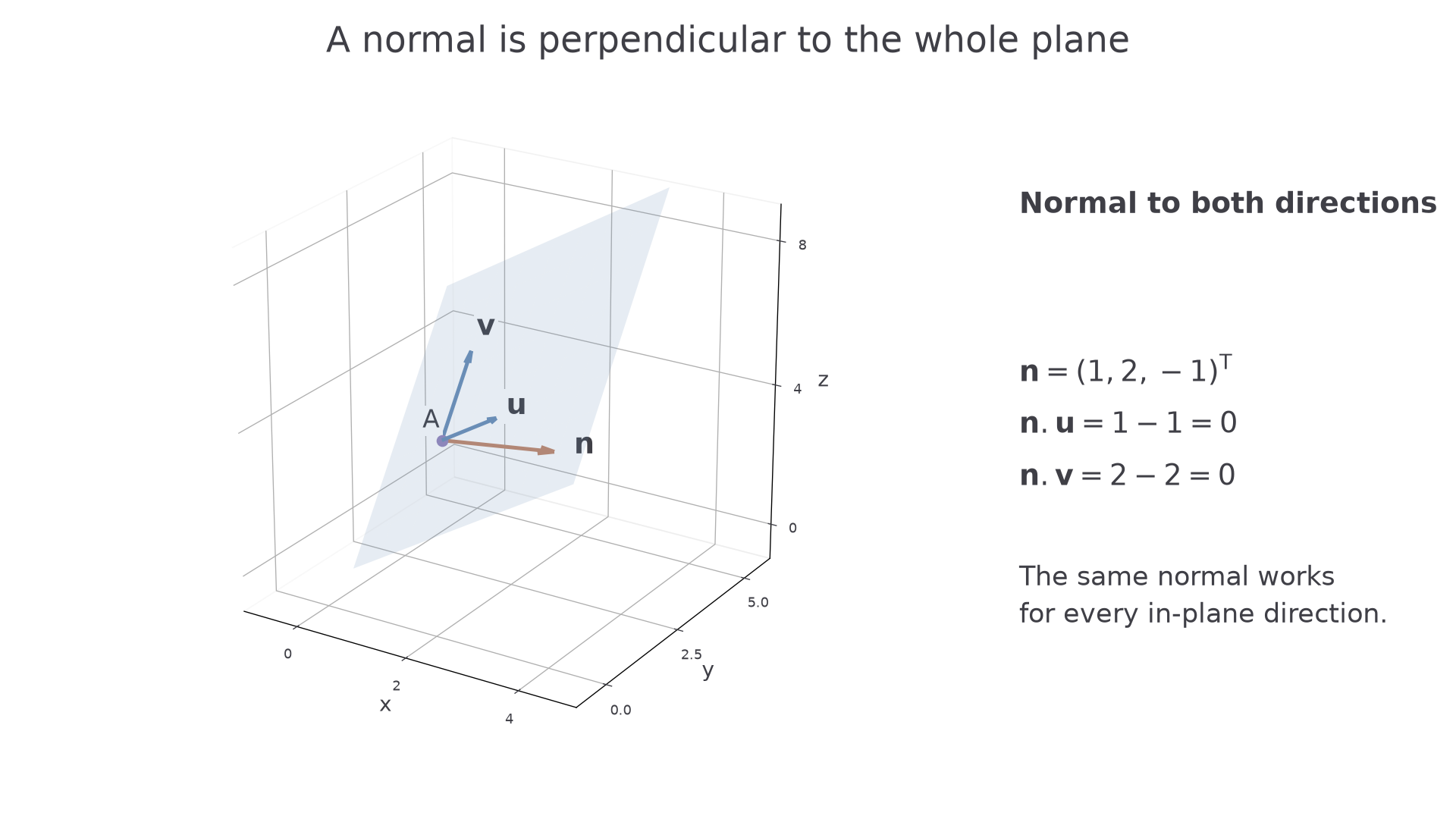
A normal to a plane is a non-zero vector perpendicular to every direction in the plane. It is enough to check perpendicularity to two non-parallel spanning directions: every plane displacement is a linear combination of them. A vector parallel to the plane is not a normal.
The distributive rule follows directly from coordinate expansion, so two zero products make every such product zero.
[DIAGRAM: asset_name: A normal perpendicular to two plane directions; asset_slug: 9fm0-cp41-plane-normal; caption: Checking two independent directions establishes a normal to the whole plane; description: An exact spatial diagram shows the plane through A at (1,2,3), with spanning directions u at (1,0,1) and v at (0,1,2). A clay normal arrow is the vector n at (1,2,minus 1). A side panel gives n dot u equals 1 minus 1 equals 0, and n dot v equals 2 minus 2 equals 0]
Normal form of a plane
For non-zero , the plane through has
Thus the coefficients of a Cartesian plane equation form a normal vector. Its Cartesian normal form is supplied in the booklet; the scalar-product expression and calculation rule are not printed. Not in the formula booklet: learn it.
To find a normal from two directions, use two scalar-product equations. You do not need a vector product.
Worked example 5: constructing a normal from two directions
Question. Find a normal and a Cartesian equation of the plane through , parallel to and .
Plan. Set a general normal's products with both directions to zero, choose a convenient scale, then use the given point.
Why this step? A normal's length does not matter; choosing removes unnecessary fractions.
Answer. One normal is ; the plane is , or .
Check. The two direction products are and , while the anchor satisfies the equation.
Worked example 6 changes only the second spanning direction's last component from to .
Worked example 6: the normal changes when the plane tilts
Question. Find a normal and Cartesian equation through , parallel to and .
Plan. Update the second zero-product equation and then recalculate the constant using the same anchor.
Why this step? The Cartesian constant belongs to the chosen normal: when the normal changes, recompute that constant too.
Answer. , with plane .
Check. Both direction products vanish, and .
This gives another way to recognise equivalent plane equations: multiplying both the normal and the constant by the same non-zero number leaves the plane unchanged.
Watch out
Wrong: use a position vector of a point in the plane as its normal. Right: a normal must be perpendicular to the spanning directions; only then use a point to find .
The final check gives a proposed normal, so show both zero products before writing the plane.
Quick Recap
- Multiply corresponding components and add to calculate a scalar product.
- ; for non-zero vectors a zero product means perpendicularity.
- A plane normal is perpendicular to two independent spanning directions.
- The plane through with normal is .
Vectors with no zero components can be perpendicular: .