CP 3.4 - Invariant points and lines
A transformation can move points while leaving a whole line in the same place. You will distinguish invariant points from invariant lines, find each algebraically, and check vertical lines and non-zero intercepts so that your answer includes every possibility.
Points that stay where they are
Reflect the line in the -axis. The point moves to , yet the image line is still . How can a line stay fixed while its points move? The difference between a fixed point and a line mapped to itself is the key to the whole lesson.
You already know
A matrix maps to . A non-vertical straight line has equation ; a vertical line has equation . Solving two simultaneous linear equations finds the coordinates satisfying both.
A point is invariant only if its own coordinates do not change. For the reflection above, requires ; every point on the -axis is fixed, but is not.
Invariant point and invariant line
An invariant point, also called a fixed point, maps to itself. An invariant line maps to itself as a line: its points may move to different positions on that same line. A line of invariant points is stronger: every point on it stays individually fixed. For example, under reflection in the -axis, the -axis is a line of invariant points, while is an invariant line whose points generally move.
All linear transformations fix the origin, because multiplying a zero column vector gives a zero column vector. Other fixed points are found by imposing equality of both coordinates.
Finding invariant points
For a linear transformation represented by , solve
Equivalently, . Not in the formula booklet: learn it.
The equations may have just the origin as a solution, a whole line of solutions, or every point. For the identity matrix every point is invariant; do not assume that a pair of equations always gives one isolated point.
Worked example 1: only the origin is fixed
Question. Find all invariant points of the transformation represented by .
Plan. Set each image coordinate equal to the corresponding original coordinate, then solve both equations.
Why this step? Both coordinates must return to their starting values. Keeping only the direction of the position vector would not make the point fixed.
Answer. The only invariant point is .
Check. ; the two equations rule out every non-zero coordinate.
The second example changes the matrix so the two equations express the same restriction. That leaves a full line of invariant points.
Worked example 2: a line of fixed points
Question. Find all invariant points of .
Plan. Equate original and image coordinates, keeping any free coordinate rather than assigning it a value.
Why this step? The equation is true for every ; it does not mean . Keep the whole family left by .
Answer. All points , where , are invariant: the line consists of invariant points.
Check. for every real .
A half-turn makes the distinction especially striking. Its matrix is , so only the origin is an invariant point. Yet every line through the origin is invariant: stays on , and the vertical line also maps to itself. Infinitely many invariant lines can coexist with just one invariant point.
Watch out
Wrong: “The point moves along the line, so it is an invariant point.” Right: the line may be invariant, but a point is invariant only when both its coordinates are unchanged.
Use the stronger fixed-point condition in this check.
Finding invariant lines with an intercept
For an invariant line, the image point must satisfy the same line equation; it need not have the same coordinates as its starting point.
Start from a general point on , and call its image . Invariance requires for every . The input and output are deliberately different letters: confusing them would impose the stronger fixed-point condition.
Non-vertical invariant-line condition
For the candidate line , calculate
and require
for every real . Equate both the coefficient of and the constant term. For the transformations below, satisfying this condition maps the whole line onto itself. Not in the formula booklet: learn it.
The phrase “for every ” turns an equation into an identity. If it simplifies to , then you need and . Solving it for one value of would find an individual intersection, rather than an invariant line. The image must also cover the whole line: must vary as varies. If is constant, then is constant too, so the line collapses to one point and is not an invariant line.
Worked example 3: a family of parallel invariant lines
Question. Determine all non-vertical invariant lines of the transformation represented by .
Plan. Transform a general point on , impose , then solve the coefficient and constant conditions.
Since this must hold for every ,
If , the second equation is true for every , so every line is invariant. If , the second equation gives , so is invariant.
Why this step? Each possible gradient has its own intercept condition. A free intercept gives a whole family, not just the member through the origin.
Answer. for every real , together with .
Check. stays on , while stays fixed point by point.
The second example changes only the upper-right entry from to . The horizontal family survives, but the oblique invariant line changes gradient.
Worked example 4: checking each intercept condition
Question. Determine all non-vertical invariant lines of .
Plan. Use a general intercept again, then solve the new gradient equation before considering the constant term.
Thus and . For , any real works. For , .
Why this step? Substituting each root separately prevents the false conclusion that for both roots.
Answer. Every horizontal line , , and the line .
Check. On the oblique line, ; on , the image is , which remains on that horizontal line.
Solve each gradient branch before deciding whether its intercept is free.
Watch out
Wrong: implies for every gradient. If , the equation is already true for every . In the first example, the correct branches are with arbitrary , or with .
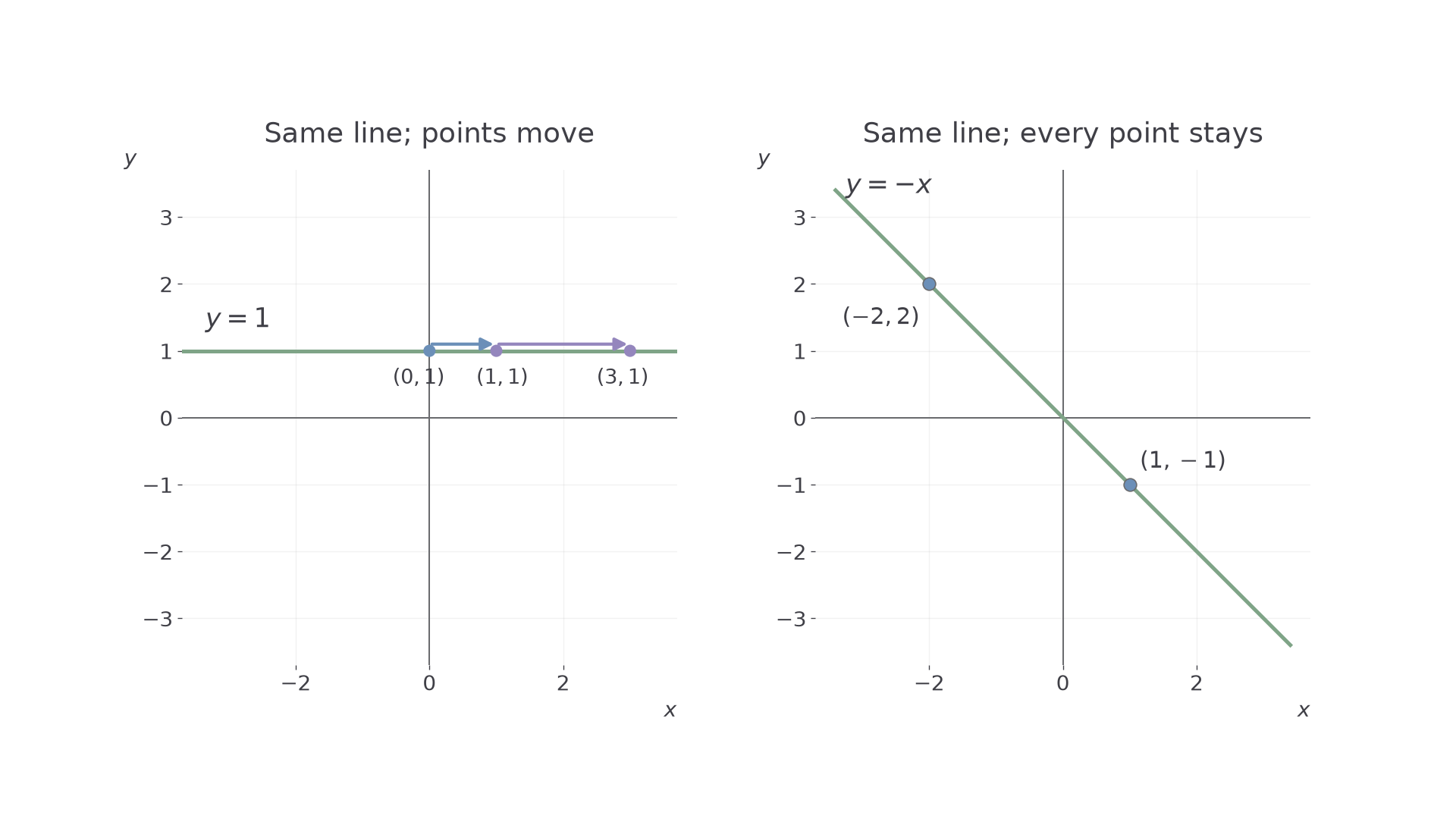
These are two kinds of invariance in one picture. The horizontal line keeps its height but its points slide; the oblique line keeps each point in place.
[DIAGRAM: asset_name: An invariant line and a line of invariant points; asset_slug: 9fm0-cp18-invariant-lines; caption: An invariant line can keep its equation while its points move; description: Two coordinate panels show the transformation with matrix (2, 1; 0, 1). On the left, y equals 1 is unchanged as a line while (0, 1) moves to (1, 1) and (1, 1) moves to (3, 1). On the right, points on y equals minus x stay in exactly the same positions.]
Exam tip
Begin with , not just , unless the question specifically asks for lines through the origin. After solving for , substitute each gradient into the constant condition. A free must appear in your final answer.
Now change the diagonal entry as well; the method is unchanged.
Vertical lines and a complete answer
The equation misses every vertical line, so a complete invariant-line calculation needs a separate check of .
For , a point has first image coordinate . To remain on for every , this requires and . Also check that the free image coordinate varies with : this requires . Otherwise every point on the vertical line maps to one point. These conditions are not in the formula booklet: derive them from the coordinate rules. As with any invariant-line calculation, check that the matrix has not collapsed the candidate line to a point; the examples here all map each accepted line onto itself.
Worked example 5: finishing a diagonal transformation
Question. Find all invariant lines of , and state which consist entirely of invariant points.
Plan. First test , then test ; compare with the fixed-point result from Worked example 1.
This gives . For a vertical line,
Why this step? Vertical lines have no finite gradient. The separate substitution finds , which the first calculation could never express.
Answer. The invariant lines are and . Neither consists entirely of invariant points: only is fixed.
Check. and , so each axis maps onto itself, while non-zero points move.
The next example changes only the second diagonal entry to . This makes every horizontal line invariant and makes one of them a line of fixed points.
Worked example 6: an entire family and one vertical line
Question. Find all invariant lines of , identifying any lines of invariant points.
Plan. Apply the same two line forms, allowing an unrestricted intercept when the equations permit it.
For , the condition is again , so . Finally,
Why this step? The invariant-line equation leaves free, whereas the invariant-point equation forces . They answer different questions.
Answer. All lines , , and the vertical line are invariant. Only consists entirely of invariant points.
Check. On , , and every image position on the line is reached. On , .
For the matrices in Worked examples 3 and 4, the upper-right entries are non-zero. A vertical input line therefore has or , which varies with : neither has a vertical invariant line. Their lists of non-vertical lines are also their complete lists.
There need not be any invariant line. For a quarter-turn, , . The condition for gives , requiring , with no real gradient. A vertical line maps to a horizontal one. The origin is still an invariant point, but there is no invariant line.
Watch out
Wrong: report as the only invariant line of . Right: also check , giving . A gradient calculation cannot detect a vertical line.
The opening reflection keeps because changing to does not change the height. Only its point stays individually fixed. That is exactly how a line can remain in place while most of its points move.
Quick Recap
- An invariant point keeps both coordinates: solve .
- For an invariant line , transform and require for every .
- Equate both coefficient and constant terms, checking the intercept separately for each gradient.
- Check vertical lines separately, and distinguish whole families of invariant lines from lines of invariant points.
Reflection in the -axis leaves invariant while moving to : the set stays the same even though the point moves.