FM1 1.2 - Momentum as a vector
A particle can keep the same speed and still receive a substantial impulse. You will retain both velocity components when finding momentum changes, recover velocities from vector impulses, and use an impulse's magnitude to find possible final motions. You will also apply equal and opposite impulses to two colliding particles.
Subtract velocities before taking a magnitude
If a particle's speed stays at , must its impulse be zero? A particle changes velocity from to . Both speeds are , but one velocity component reverses. That change has to come from somewhere.
You already know
Subtract vectors component by component, and use Pythagoras for the magnitude of a vector in perpendicular directions. The previous lesson gave momentum as mass times velocity and resultant impulse as final momentum minus initial momentum.
Throughout this lesson, and are fixed perpendicular horizontal unit vectors. Positive is drawn upwards on a component diagram; it does not represent vertical height. The forces considered supply the resultant horizontal impulse.
Vector momentum and impulse
For a particle of constant mass ,
For , its magnitude is
Momentum has units ; impulse has units . The vector and the scalar are different quantities.
Not in the formula booklet: learn it.
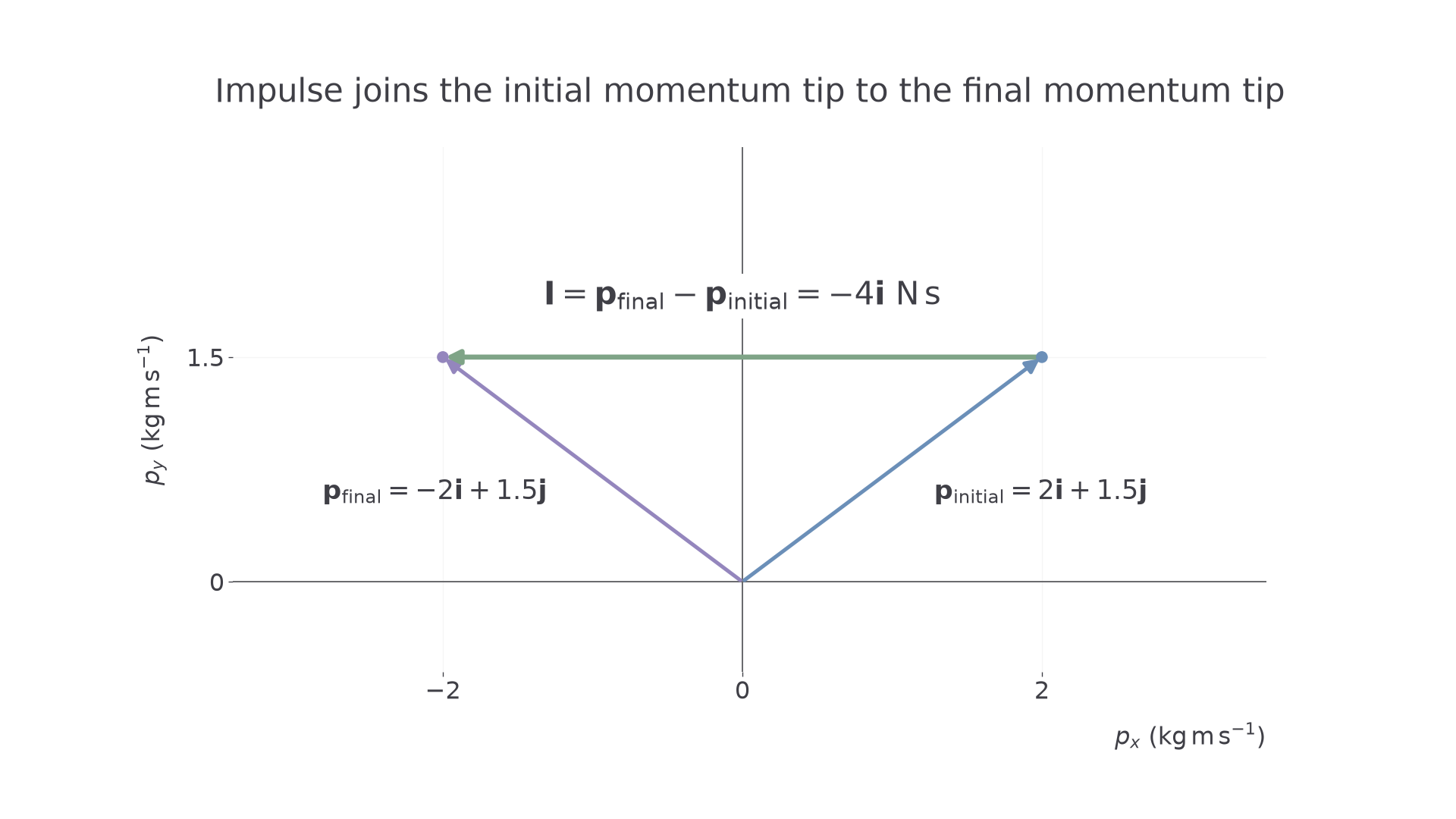
The diagram joins the initial momentum's tip to the final momentum's tip. That connecting arrow represents their difference.
[DIAGRAM: asset_name: Impulse as the difference between two momentum vectors; asset_slug: 9fm0-fm137-momentum-change; caption: The impulse runs from the initial momentum tip to the final momentum tip; description: A momentum-component diagram shows an initial vector from the origin to (2, 1.5) in blue and a final vector from the origin to (minus 2, 1.5) in lavender. A green horizontal arrow runs from the initial tip to the final tip and is labelled impulse equals final momentum minus initial momentum equals minus four i newton seconds. Both component axes have momentum units.]
Worked example 1: equal speeds, non-zero impulse
Question. A particle of mass changes velocity from to . Find the resultant impulse in form, and state its magnitude and direction.
Plan. Subtract the velocities as vectors, multiply by mass, then interpret the resulting impulse.
Why this step? The two components cancel, but the component changes by . Equal speeds do not remove that change.
Answer. , with magnitude in the negative direction.
Check. Initial momentum is . Adding the impulse gives , the required final momentum.
Change only the sign of the final component. Both components now reverse, while the initial and final speeds remain .
Worked example 2: two components change
Question. A particle of mass changes velocity from to . Find the resultant impulse in form, its magnitude and its direction.
Plan. Find both impulse components, use Pythagoras, then place the direction in the correct quadrant.
Why this step? Both components are negative, so the impulse points into the third quadrant. The acute inverse-tangent angle needs a reference direction.
Answer. , with magnitude , directed below the negative direction.
Check. Adding this impulse to gives . Both initial and final speeds are still .
The opening puzzle has its answer: unchanged speed can accompany a non-zero impulse, because velocity includes direction. In these two cases, the same pair of speeds allows impulse magnitudes and .
Watch out
Wrong: . Right: . Subtract the vectors first, then take the magnitude. Also, if the question requests form, give the final answer in that form, even if you used columns while working.
Keep both components until the subtraction is complete in this shorter calculation.
Recovering velocity and mean force
An impulse can be the given information rather than the unknown. Rearrange the vector equation before substituting; then each component follows the same calculation.
Velocity and mean force from an impulse
For constant mass , resultant impulse and duration ,
Thus . The mean force has the direction of the impulse; the final velocity need not have that direction. For a constant resultant force, its value equals the mean force.
Not in the formula booklet: learn it.
The first example gives a final velocity in the first quadrant. Keep track of the distinction between its direction and the force's direction.
Worked example 3: adding an impulse to the motion
Question. A particle of mass initially has velocity . It receives resultant impulse over . Find its final velocity and speed, its direction of motion, and the mean resultant force and its magnitude.
Plan. Divide impulse by mass to obtain the velocity change, and divide impulse by duration to obtain mean force.
Why this step? is the change in velocity, so it must be added to the initial velocity; it is not the final velocity by itself.
Answer. The final velocity is , with speed , directed above positive . The mean force is , with magnitude .
Check. , recovering the given impulse. Multiplying the mean force by gives the same impulse.
Change only the sign of the impulse's component. The impulse magnitude is unchanged, but the final motion changes substantially.
Worked example 4: the impulse points downwards
Question. A particle of mass initially has velocity . It receives resultant impulse over . Find its final velocity and speed, its direction of motion, and the mean resultant force and its magnitude.
Plan. Apply the same two vector divisions, then use the final velocity components for speed and direction.
Why this step? The negative impulse makes an already negative velocity more negative. The initial must remain in the addition.
Answer. The final velocity is , with speed , directed below positive . The mean force is , with magnitude .
Check. . Also, , so .
The two mean forces have equal magnitudes. Their different directions produce different final speeds because the initial velocity contributes too.
Watch out
Wrong: when the particle is already moving. Right: . Also, dividing a scalar impulse magnitude by time gives a force magnitude, not a vector force with components.
Use a different impulse and check whether one final velocity component vanishes.
When the impulse magnitude is given
A given magnitude does not supply the two impulse components separately. Write the vector impulse first, then impose its magnitude. This often produces a quadratic and more than one possible motion.
For example, if , and , then
The magnitude involves both components, including the initial . A condition on becomes a scalar equation only after taking the norm of this vector.
Continue this lesson.
You’re previewing NovaLearn without an account. Create a free account to read the rest.
Create free account