CP 5.1 - Volumes of revolution from Cartesian equations
Rotating a region around an axis builds a solid from circular slices. You will derive the volume formulae for rotation about both coordinate axes, choose the radius and limits correctly, and subtract inner discs when the solid has a hole.
Building a solid from circular slices
Drill a cylindrical hole straight through the centre of a sphere, leaving a ring whose height is units. Could its volume be the same whatever the original sphere's radius? It sounds unlikely: a larger sphere leaves a wider ring. Slicing the solid will reveal what compensates for that extra width.
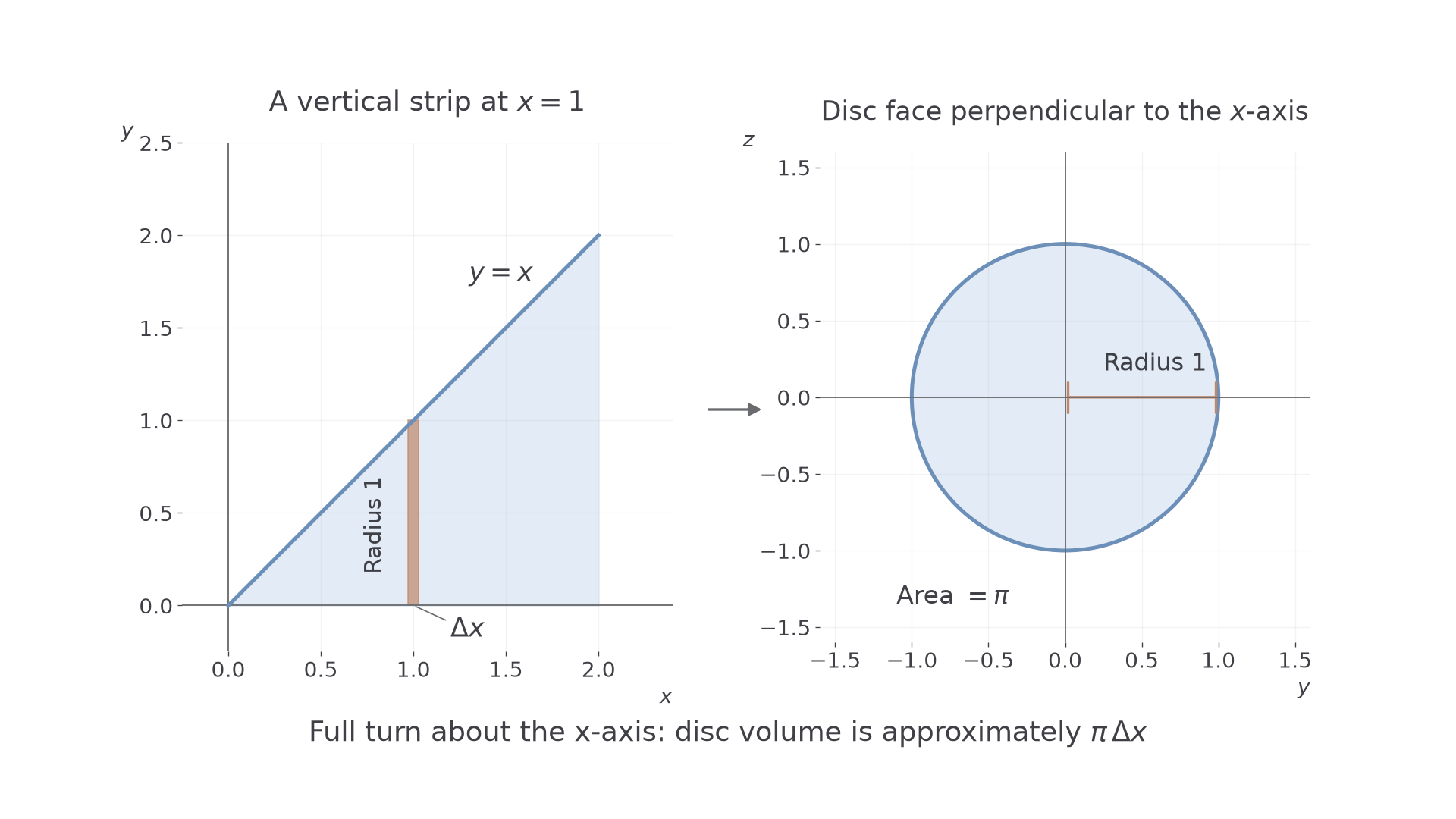
Begin with a simpler solid. Rotate the region under , from to , through a full turn about the -axis. A vertical strip becomes a thin circular disc. Its radius is the strip's height, , and its thickness is the small horizontal width . Near , that disc has cross-sectional area ; near , the area is .
You already know
A circle of radius has area , and a cylinder's volume is cross-sectional area multiplied by length. A definite integral adds limiting contributions over an interval; evaluate it by subtracting the antiderivative at the lower limit from its value at the upper limit.
For a general boundary , a slice perpendicular to the -axis has radius . Its area is : squaring handles either side of the axis. A thin disc contributes approximately . Summing many such contributions, then letting the largest slice thickness tend to zero, gives the integral.
[DIAGRAM: asset_name: A thin strip becomes a circular disc; asset_slug: 9fm0-cp32-discs; caption: Cross-sectional area times a small axial thickness gives a small volume; description: Two equal-scale coordinate panels show the region beneath y equals x from x equals zero to two, with a vertical strip at x equals one, and the corresponding circular slice with radius one. A labelled arrow indicates rotation about the x-axis. The disc has cross-sectional area pi and axial thickness delta x.]
Volume about the x-axis
If a region between and the -axis, from to , is rotated through about the -axis, then
Here , and each cross-section is a disc with radius . Not in the formula booklet: learn it.
This formula measures a three-dimensional volume, so coordinates measured in centimetres give an answer in . Integrating alone would add rectangular strip areas instead of circular cross-sectional areas.
Key idea
Slice perpendicular to the rotation axis. The integrand is a circular area, , and the differential measures thickness along the axis.
A short error check separates a volume calculation from an area calculation.
Calculating volumes about the x-axis
For rotation about the -axis, square the curve's -coordinate before integrating with respect to .
Write down the region's boundaries first. The limits are horizontal positions, not heights, and the solid includes every circular slice between them. If the equation already gives , you can use it directly without taking a square root first.
Worked example 1: a straight boundary makes a cone
Question. Find the exact volume when the region bounded by , and is rotated through about the -axis.
Plan. The radius is , so integrate from to .
Why this step? A slice at position has radius , not the final cone radius . Using radius throughout would calculate the enclosing cylinder.
Answer. cubic units.
Check. A cone of height and base radius has volume .
The second example changes the boundary to , keeping the same interval. Squaring the radius now removes the root.
Worked example 2: a curved boundary
Question. Find the exact volume when the region between , the -axis and is rotated through about the -axis.
Plan. Substitute directly into the disc formula.
Why this step? The formula contains , so integrating would calculate the wrong quantity even if the integration were flawless.
Answer. cubic units.
Check. The enclosing cylinder has radius , height and volume . The solid occupies half of that volume, consistent with its cross-sectional area increasing linearly from zero to .
Keep outside the integral until the final exact value. If a decimal is requested, evaluate that exact expression once, at the end.
Watch out
Wrong: . You must square each slice's radius before adding the slices. Right: .
The next question changes the scale in the curve, while preserving the same disc method.
Calculating volumes about the y-axis
For rotation about the -axis, use horizontal slices: the radius is the horizontal distance , and the thickness is measured in .
A strip of height becomes a disc of area . Adding its volume contributions and taking the same limiting process as before gives the second required formula.
Volume about the y-axis
If a region between and the -axis, from to , is rotated through about the -axis, then
Here , and each slice has radius . Not in the formula booklet: learn it.
Notice the two linked changes: use for the radius squared and for the slice thickness. Your limits must now be heights. This can make a difficult-looking curve pleasantly simple.
Worked example 3: a sideways parabola
Question. The region bounded by , the -axis and is rotated through about the -axis. Find its exact volume.
Plan. Use horizontal discs with , between heights and .
Why this step? The distance to the -axis is , so a vertical-axis rotation does not use .
Answer. cubic units.
Check. The enclosing cylinder has radius and height , giving volume ; the linearly growing disc areas again give half that value.
The second example changes the radius-squared profile from linear to quadratic. It makes a familiar solid, giving a strong independent check.
Worked example 4: a hemisphere
Question. The region bounded by , the non-negative coordinate axes and is rotated through about the -axis. Find its exact volume.
Plan. Use , and integrate between the two heights.
Why this step? The equation describes a circle of radius . Rotating its first-quadrant region makes the upper hemisphere, so the limits cover half a sphere.
Answer. cubic units.
Check. Half the sphere volume is .
A radius can decrease as height increases. It is the order of the heights, rather than whether the boundary slopes upwards, that determines the integral's sign.
Watch out
Wrong: use for the hemisphere in Worked example 4. The radius about the -axis is , not the height . Right: use .
Writing the radius and thickness together also makes the rotation axis clear to the examiner.
Exam tip
Write the substituted volume integral with its differential: about the -axis, or about the -axis. Omitting or the differential can lose Pearson's formula mark even when later integration is correct.
Try a different hemisphere, using its squared radius directly.
Subtracting the hole from each slice
When the rotating region does not reach the axis, a perpendicular slice is a ring-shaped annulus rather than a full disc.
If the outer and inner radii are and , its area is . The gap is a radial thickness, not a circle's radius: would describe a different area.
Annular slices
For a full rotation about a coordinate axis, with non-negative outer radius and inner radius ,
Use about the -axis or about the -axis. The outer radius must be at least the inner radius throughout each interval; split the region if the boundary ordering changes. Not in the formula booklet: learn it.
Identify the two distances from the axis before subtracting. The same idea also allows you to find a hollow solid's material volume by subtracting its cavity volume from its external volume.
Worked example 5: a fixed outer radius
Question. The region between and , for , is rotated through about the -axis. Find the exact volume.
Plan. Each slice has outer radius , inner radius , and area .
Why this step? The hole has radius , so its area is . Subtracting the radii before squaring would not remove that hole.
Answer. cubic units.
Check. The external cylinder has volume , and the removed solid has volume . Their difference is .
The second example changes the outer radius from to . The intersection height determines a new horizontal limit.
Worked example 6: finding the meeting point
Question. The region enclosed by , and the -axis is rotated through about the -axis. Find the exact volume.
Plan. Find where the two boundaries meet, then subtract the inner disc area from the outer disc area.
Why this step? The limit is , not : the point where the curves meet has height but horizontal position .
Answer. cubic units.
Check. The enclosing cylinder has volume ; the cavity has volume , leaving the same volume of material.
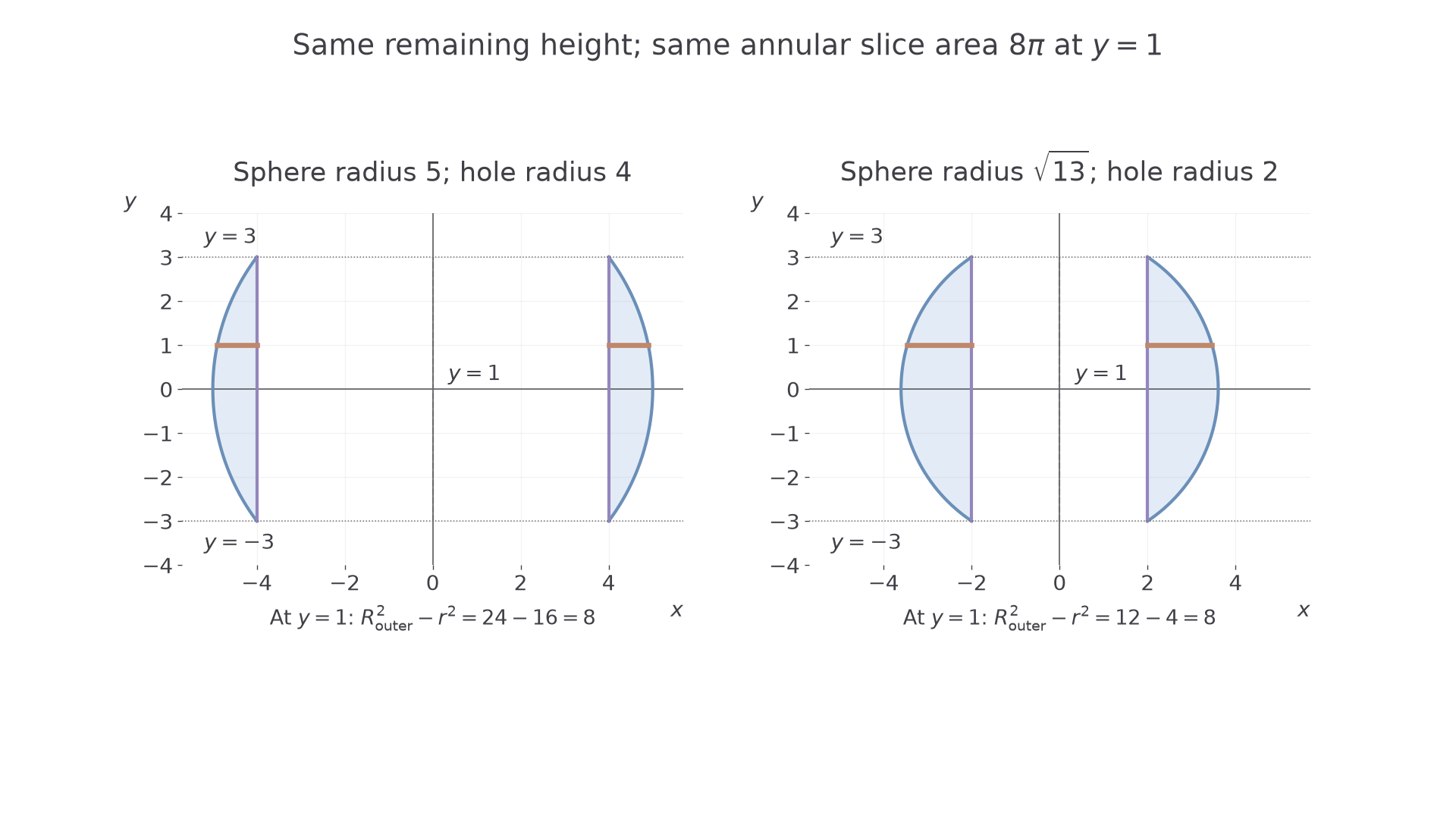
Now return to the drilled sphere. Let its radius be , the hole radius be , and the remaining height be . At height , the sphere has outer radius squared . At the top of the ring, Pythagoras gives . Consequently each remaining slice has area
This is independent of . Integrating from to gives
So every such ring of height has volume , whatever the original sphere's radius. A bigger sphere needs a bigger hole to keep that height, and the slice areas balance exactly. This result is derived here; it is not in the formula booklet.
[DIAGRAM: asset_name: Equal-height drilled spheres have equal remaining slice areas; asset_slug: 9fm0-cp32-napkin-ring; caption: The outer and inner squared radii differ by the same amount at each height; description: Two central cross-sections show a sphere of radius five drilled by a cylinder of radius four and a sphere of radius root thirteen drilled by a cylinder of radius two. Both remaining rings extend from y equals minus three to y equals three. A horizontal slice at y equals one labels outer squared radius minus inner squared radius equals eight in each case. The vertical axis is the rotation and drilling axis.]
Watch out
Wrong: use for an annulus. For example, outer radius and inner radius give , not . Right: subtract the squared radii.
The outer boundary can be curved too. Track the two squared radii in the final check.
Quick Recap
- Circular slices give about the -axis and about the -axis.
- Square the distance from the axis before integrating, and use bounds for the integration variable.
- A hollow slice has area ; subtract squared radii, and split intervals if necessary.
- Give cubic units, preserve exact values and show the substituted integral before evaluating it.
The drilled-sphere puzzle has a definite answer: height means volume , regardless of the original sphere radius.