CP 8.3, 8.4 - Inverse hyperbolic functions as logarithms
Define the inverse hyperbolic functions with their correct domains and ranges (CP 8.3), then derive and use their logarithmic forms (CP 8.4). The logarithms make exact values accessible, while branch restrictions explain which solutions are allowed.
Choosing a one-to-one branch
Why is , rather than ? An inverse can reverse a function only when each output comes from one permitted input. The full graph has two opposite inputs for every output above , so we must choose a branch.
The functions and are strictly increasing on the real line, so they are already one-to-one. For , choose the increasing branch . Its outputs cover , and its inverse therefore takes inputs in that interval and returns non-negative values.
You already know
From A-level Mathematics, an inverse exchanges a function's domain and range and reflects its graph in ; it is not a reciprocal. The hyperbolic ranges are for , for , and for .
Use Pearson's inverse names , and . Some calculators display an inverse using a superscript, but the function is distinct from , or .
Inverse hyperbolic functions
The inverse relations are
For example, , while has no real value. The inverse returns a single non-negative value, not a pair.
Their graphs reflect the appropriate original graphs, including the restriction on . The two horizontal asymptotes of become vertical asymptotes of , at .
[DIAGRAM: asset_name: The inverse hyperbolic graphs and their domains; asset_slug: 9fm0-inverse-hyperbolic-graphs; caption: Inverse graphs exchange the permitted inputs and outputs of the original functions; description: Three separate panels show arsinh x increasing through the origin with domain all real numbers, arcosh x starting at the included point (1,0) and increasing in the first quadrant, and artanh x increasing through the origin with dashed vertical asymptotes x equals minus 1 and x equals 1. Domain and range statements appear below each panel.]
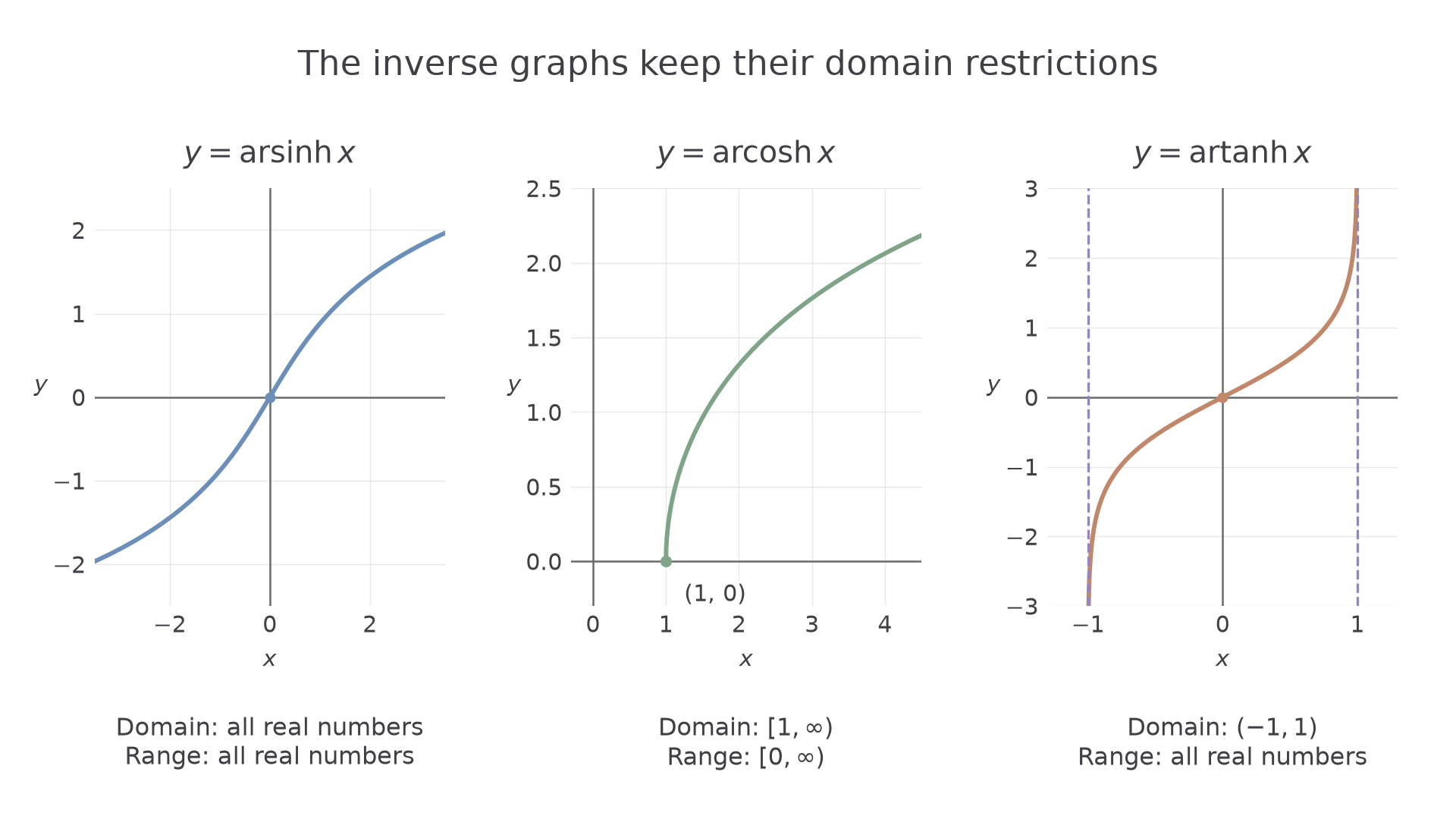
The permitted branches give and for all real . For hyperbolic cosine, however, . These domain, range and branch conventions are knowledge to learn; the booklet supplies the logarithmic forms and their input restrictions.
Key idea
A real equation has two opposite solutions, but names only the non-negative one.
Check the branch before using a formula.
Deriving the logarithm for arsinh
The equation becomes a quadratic in the positive quantity , and exactly one quadratic root is admissible.
Let . Then
Because , the plus choice is positive and the minus choice is negative for every real . Rejecting the negative value is essential: it cannot equal a real exponential. Taking the logarithm of the positive value gives the inverse.
Logarithmic form of arsinh
For every real ,
The logarithm's argument is positive even when , because .
In the formula booklet.
There is an elegant symmetry hidden inside this apparently asymmetric formula:
The two positive quantities are reciprocals, so their logarithms are opposites. This proves directly from the logarithmic form.
Worked example 1: an exact positive inverse
Question. Express as a simplified natural logarithm.
Plan. Substitute into the logarithmic form and simplify the square root before adding.
Why this step? The radical is the positive square root ; the inverse's sign comes from the logarithm, not from attaching a second square-root sign.
Answer. .
Check. .
Change only the input's sign. The logarithm remains real; its argument becomes the reciprocal of the previous one.
Worked example 2: an exact negative inverse
Question. Express as a simplified natural logarithm.
Plan. Keep the same square root and subtract the input's magnitude.
Why this step? A negative inverse value is allowed: it comes from taking the logarithm of a positive number below .
Answer. .
Check. Odd symmetry gives , as required.
A derivation must explain the rejected exponential root, rather than simply erase it between two lines.
Watch out
Wrong: . The minus choice is always negative, so its real logarithm does not exist. Right: use alone.
Try another exact square root.
Deriving arcosh and choosing its branch
For , both exponential roots can be positive, so positivity alone does not select the inverse: the condition makes the decision.
Continue this lesson.
You’re previewing NovaLearn without an account. Create a free account to read the rest.
Create free account