FM2 3.1 - Composite rigid bodies
A composite body may join solids of different densities, combine a shell with a solid, or contain a cavity. You will replace each piece by its mass at its own centre, express every centre in one coordinate system, and combine signed mass moments. You will also work backwards from a required centre to a density ratio.
Read standard centres from the correct reference
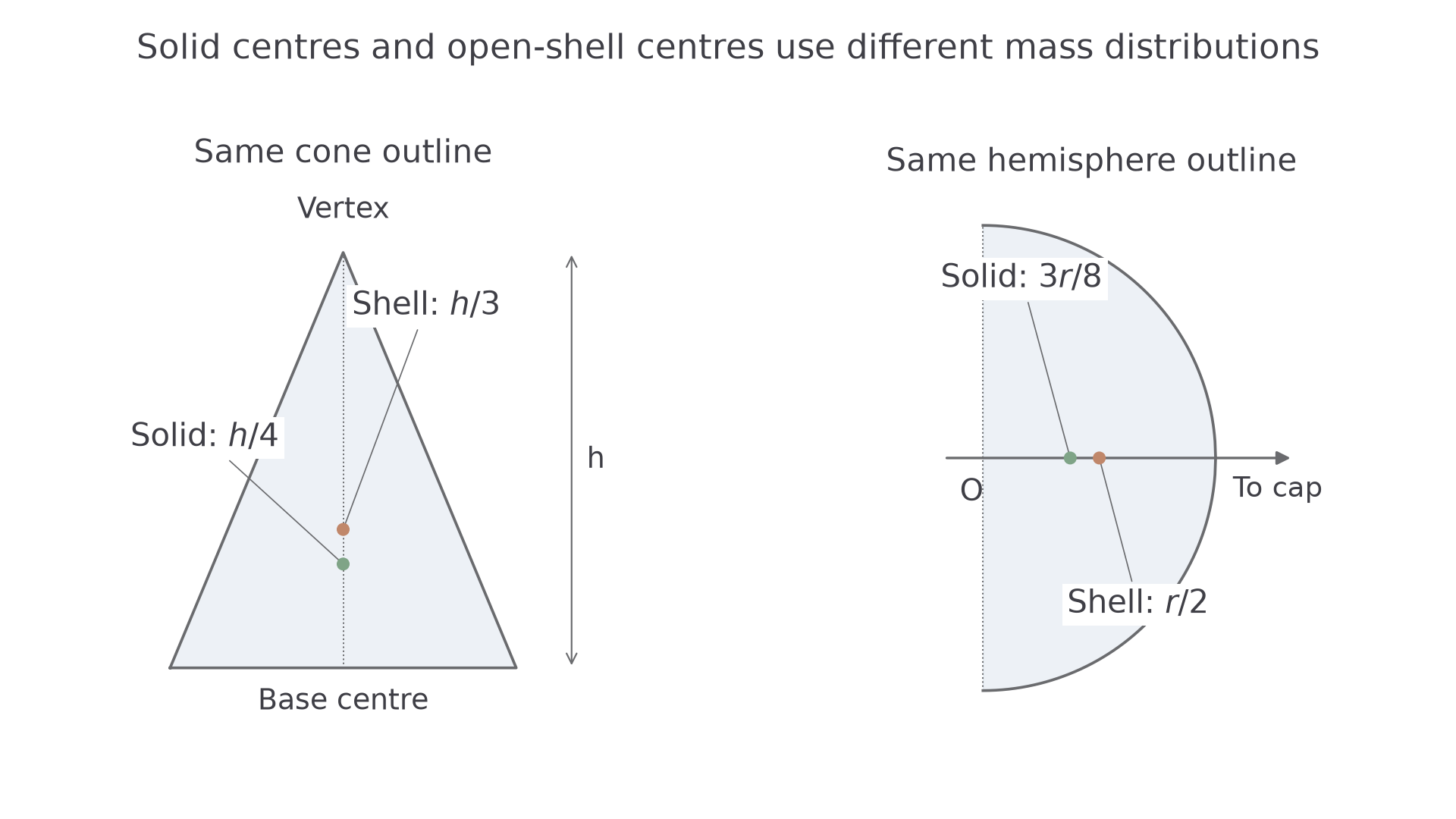
Can a body keep exactly the same outside shape while its centre of mass moves? Yes: remove material from an off-centre cavity. The outer surface has not changed, but the mass distribution has. Even without a cavity, replacing a solid hemisphere by a uniform thin hemispherical shell moves its centre from to from the sphere centre. We will keep track of the material, rather than trusting its silhouette.
You already know
For separate masses, . Integration locates a continuous piece's centre when necessary. A uniform solid has mass , while a uniform thin shell has mass . Use symmetry of the mass distribution to identify an axis containing the centre.
A printed centre distance is local to its own body. Translate it to the common coordinate used for the composite. The words “from the base” and “from the sphere centre” carry mathematical information.
Standard uniform body centres
Each centre lies on the body's symmetry axis.
| Body | Centre position |
|---|---|
| Solid hemisphere of radius | from the sphere centre towards the curved cap |
| Thin hemispherical shell of radius , with no flat base | from the sphere centre towards the curved cap |
| Solid cone or solid pyramid of perpendicular height | from the base towards the vertex |
| Thin conical shell of perpendicular height , with no base disc | from the base towards the vertex |
The material must be uniform within the stated solid or shell. These are centre distances, not mass formulae. Quote them unless the question requires a proof or integration.
In the formula booklet.
For a uniform cylinder, symmetry puts its centre halfway between its circular ends. For a sphere it puts the centre at the sphere centre. These elementary symmetry conclusions are not separate printed centre formulae. A cone and a pyramid share the solid height fraction even though their cross-sections have different shapes.
[DIAGRAM: asset_name: Standard body centres and their origins; asset_slug: 9fm0-fm154-standard-centres; caption: Measure the printed fractions from the stated base or sphere centre towards the vertex or cap; description: Axial sections compare a solid cone and thin conical shell with the same base and vertex, marking h over four and h over three above the base. A separate hemisphere section marks solid three r over eight and shell r over two from the sphere centre, distinguishing solid material from curved surface material.]
Worked example 1: a cone based away from the origin
Question. A cone's base centre is at , and its vertex is farther along the positive x-axis. Find the axial centre coordinate for (a) a uniform solid cone and (b) a uniform thin conical shell without a base disc.
Plan. Choose the appropriate booklet distance and add the base coordinate.
Why this step? The printed fractions start at the base. Neither nor is the coordinate from the chosen origin.
Answer. The centres are at and , respectively.
Check. Both lie between base and vertex , with the shell centre farther towards the vertex. The solid contains relatively more mass near the broad base.
Change only the perpendicular height, from to .
Worked example 2: a taller cone with the same base reference
Question. The base centre remains at , but the vertex is now farther in the positive x direction. Find both centre coordinates for the solid cone and the open conical shell.
Plan. Retain the reference translation and replace the height in each appropriate fraction.
Why this step? The change in height changes the local centre distance; it does not change the coordinate of the base.
Answer. for the solid and for the shell.
Check. Both coordinates are between and . The two distances from the base have ratio , independent of height.
A shell's flat base, if present, is another piece with its own mass and centre. The open-shell booklet result does not silently include it.
Watch out
Wrong: using as a solid cone's distance from its base. Right: from the base, or from the vertex. Translate the chosen distance into the same common coordinate as every other piece.
Change only the height again.
Join bodies using masses and a common coordinate
Joining pieces does not alter each piece's internal mass distribution. Replace each by its mass at its centre and combine their moments. For different densities, volume alone cannot supply the weights.
Composite mass moments
For disjoint pieces with positive masses and centre coordinates , all measured from the same reference,
Use for a uniform solid piece and for a uniform thin shell. Use corresponding sums for other coordinates. A piece's non-uniform density may first require the preceding lesson's integrals.
Not in the formula booklet: learn it.
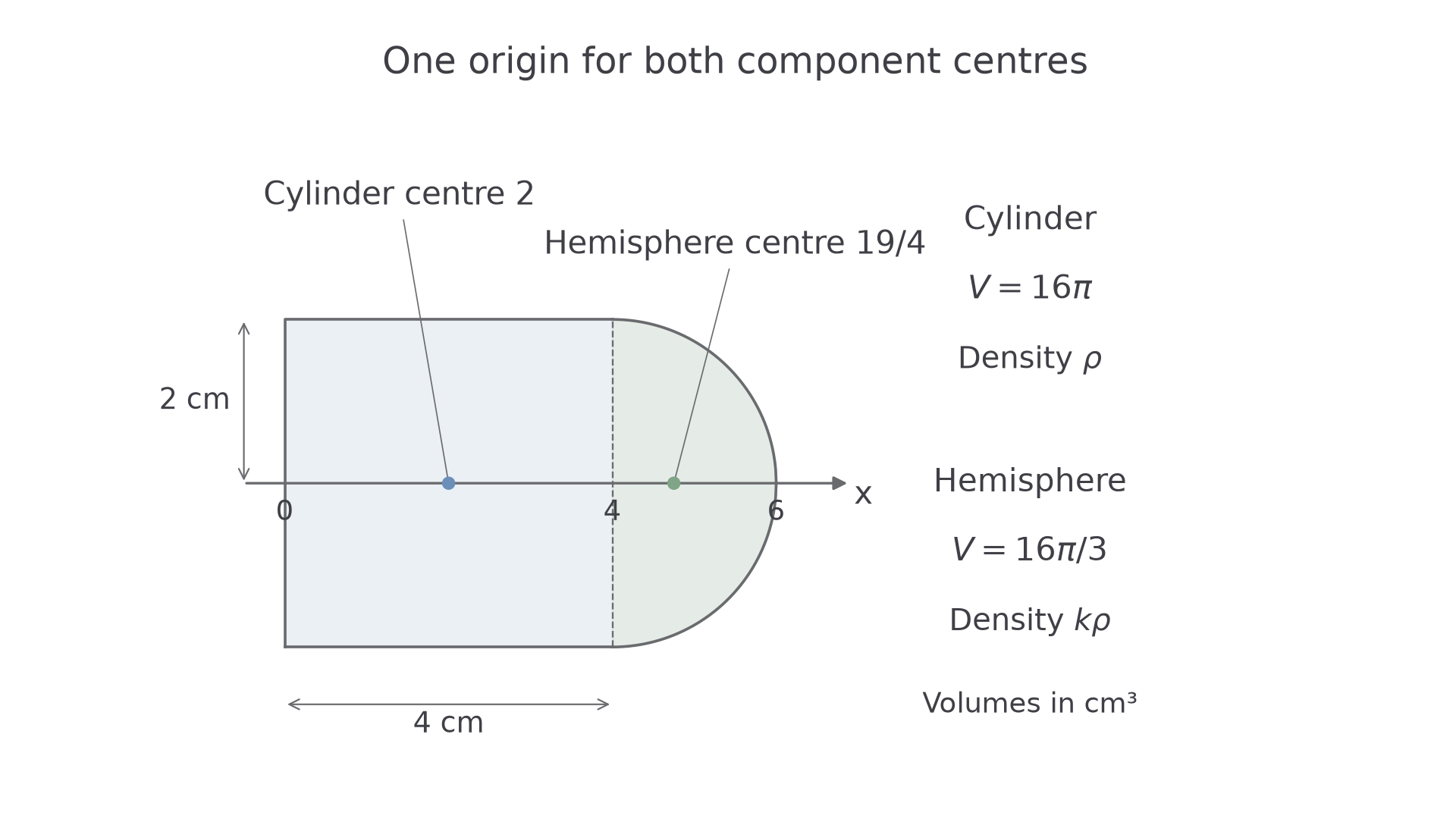
For the next body, let the cylinder occupy . The hemisphere's flat circular face is at , with its cap extending to . Therefore its centre coordinate is , not just .
[DIAGRAM: asset_name: Joined cylinder and hemisphere; asset_slug: 9fm0-fm154-joined-solids; caption: Each solid contributes its own mass at a centre expressed from the same left-hand end; description: An exact axial section shows a radius-two cylinder from x zero to four and an attached radius-two solid hemisphere with cap at six. The cylinder centre at two and hemisphere centre at nineteen quarters are marked on the common axis. A table lists volumes sixteen pi and sixteen pi over three, with separate density symbols.]
Worked example 3: the same density throughout
Question. A uniform solid cylinder of radius and length is joined to a solid hemisphere of radius . The circular faces coincide. Both have volume density . Find the composite centre distance from the cylinder's other end.
Plan. Calculate volumes, use the standard centres, and form a table from the common origin.
| Piece | Mass | Centre coordinate , in cm | Mass moment |
|---|---|---|---|
| Cylinder | |||
| Hemisphere |
Here cylinder volume is , and hemisphere volume is . These elementary volume formulae are not printed in the booklet.
Why this step? Equal densities let the common density cancel, but the unequal volumes still give unequal masses.
Answer. The centre is from the cylinder's unjoined end, on the common axis by symmetry.
Check. , between the component centres, and closer to the heavier cylinder's centre.
Change only the hemisphere's density from to .
Worked example 4: a denser cap
Question. The same cylinder has density , while the hemisphere now has density . Find the composite centre from the same end.
Plan. Keep both centre coordinates and volumes, but double the hemisphere's mass and moment.
Why this step? Density changes the weight assigned to the hemisphere, not the location of its own uniform centre.
Answer. The composite centre is from the unjoined cylinder end.
Check. It has moved from towards , as the cap became heavier. It still lies between the component centres.
If a composite includes both a shell and a solid, calculate each mass in its own way before combining. Areal and volume densities have different units and cannot be treated as interchangeable weights.
Watch out
Wrong: averaging centre coordinates without masses, or using volumes when densities differ. Right: build a mass–coordinate–moment table. Cancel a density only when it is a genuine common factor in every contribution.
Change only the hemisphere density once more.
Continue this lesson.
You’re previewing NovaLearn without an account. Create a free account to read the rest.
Create free account