CP 2.8 - De Moivre's theorem
Find integer powers of a complex number by raising its modulus and multiplying its angle. You will see why de Moivre's theorem works, use it for large positive powers and extend it carefully to zero and negative powers.
A power repeats the same rotation
Can you find exactly without expanding twenty brackets? Its answer is a small-looking real number, even though most of the intermediate powers have imaginary parts. The useful picture is repeated rotation.
You already know
Multiplying complex numbers multiplies their moduli and adds their arguments. The number has modulus and an argument ; angles differing by represent the same direction.
Start with . Multiplying by rotates a point anticlockwise through without changing its distance from the origin. Thus
Here is a pleasing consequence: is not real, but its cube is real and its sixth power is . Powers need not become more complicated as they grow.
[DIAGRAM: asset_name: Successive powers as equal rotations; asset_slug: 9fm0-cp08-equal-rotations; caption: Multiplying by w adds the same angle each time; description: A unit circle on an Argand diagram has the six points 1, w, w squared, w cubed equals minus 1, w to the fourth and w to the fifth spaced anticlockwise by pi over 3. Blue radial lines and sage curved arrows show the repeated rotation, with w to the sixth returning to 1. A side panel states modulus remains 1 and each multiplication adds pi over 3.]
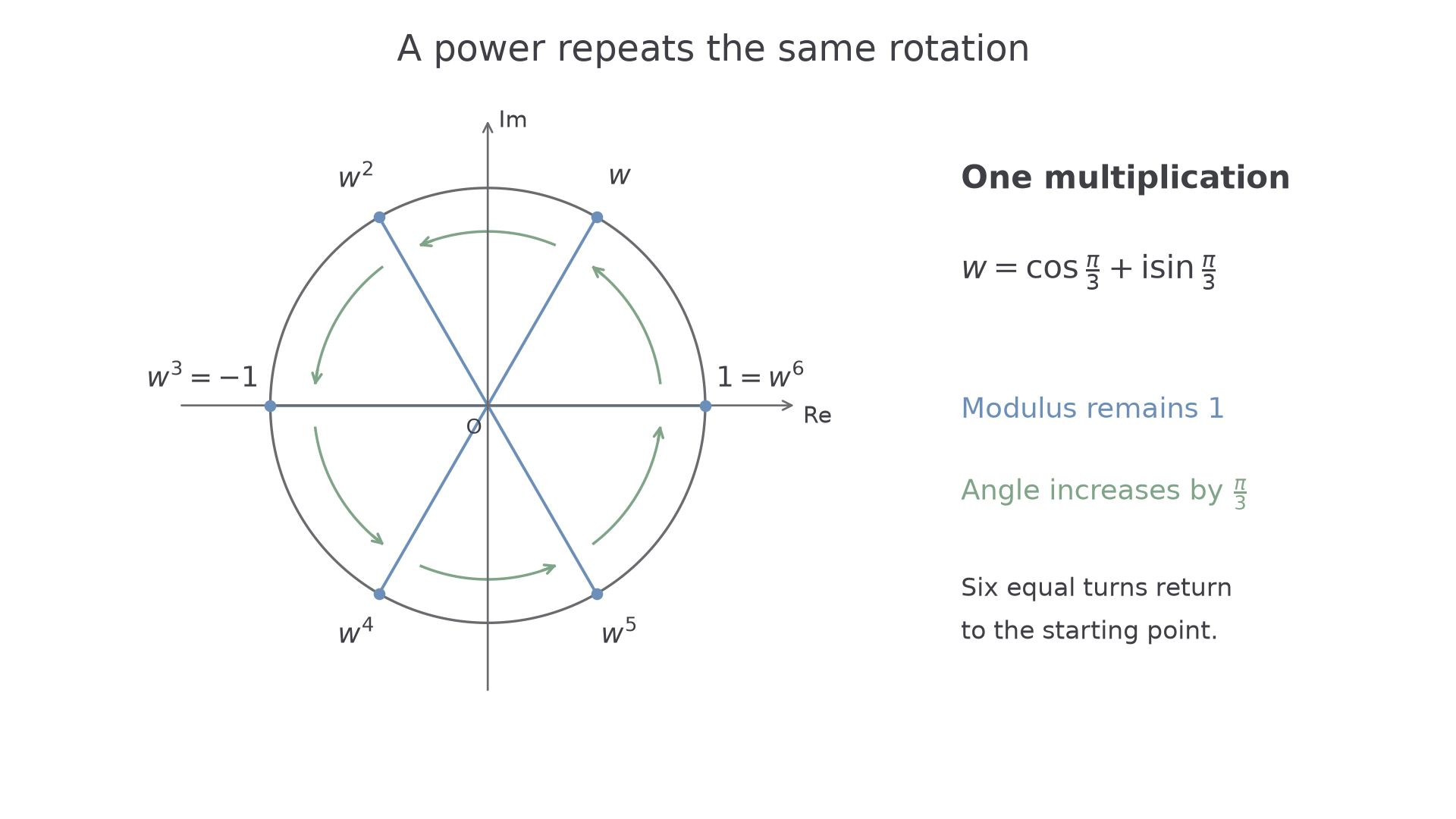
For a general number , a product of copies of has modulus multiplied by itself times, and angle added times. This proves the positive-integer case directly from the product rule.
De Moivre's theorem
For real , and any integer ,
For positive , the formula also works when . Zero and negative powers require .
In the formula booklet.
We have explained positive powers; the last part will justify the other integer powers. For now, notice what is being multiplied: is the angle, while is the modulus. The theorem says nothing about replacing these by or .
Key idea
A complex power has two separate jobs: raise the modulus to the power and multiply the angle by the power.
The following choices separate those two jobs.
Finding positive integer powers
Write the number in modulus-argument form before applying the power; then simplify the trigonometric values and return to Cartesian form if requested.
Take . Its modulus is , and its argument is , so
An angle such as is perfectly usable inside sine and cosine. Only if you are asked for the principal argument must you reduce it to . This distinction lets you keep the power calculation tidy.
Worked example 1: a power on an axis
Question. Use de Moivre's theorem to find .
Plan. Use modulus and angle , raise the modulus and multiply the angle.
Why this step? Multiplying the angle first reveals that the answer lies on the positive imaginary axis, so its real part must be zero.
Answer. .
Check. , and multiplying once more gives .
The next example changes only the exponent, from to . The answer now lies in the second quadrant, so neither component vanishes.
Worked example 2: an exact Cartesian answer
Question. Use de Moivre's theorem to find , giving your answer in the form , where and are exact real numbers.
Plan. Keep the same modulus-argument form, apply the fifth power and evaluate the angle .
Why this step? The reference angle is , but the cosine is negative in the second quadrant. Using the first-quadrant sign would change the answer.
Answer. .
Check. The modulus is , and the signs place the answer in the second quadrant.
Exact trigonometric values turn the polar calculation into the prescribed final form. Decimal approximations would throw away information the question asks you to retain.
Watch out
Wrong: . The power applies to the entire complex number. Right: .
Show the modulus and multiplied angle in your working, especially when the question requires all stages. They make the method visible even if an exact-value slip follows.
Zero and negative integer powers
A negative power means a reciprocal. In modulus-argument form, taking a reciprocal replaces by and reverses the angle.
To see why, multiply by . The moduli multiply to , and the angles add to , so the product is .
Reciprocals and negative powers
If , then
for a positive integer . Also, .
These are the negative- and zero-integer cases of de Moivre's theorem. In the formula booklet.
This completes the justification for every integer exponent. It does not make fractional powers single-valued: for example, both and square to . Finding all roots is a later lesson.
Worked example 3: a negative power
Question. Find in exact Cartesian form.
Plan. Use the same modulus and angle , with exponent .
Why this step? The exponent changes both the size and the direction. Keeping the angle positive would give the conjugate of the required answer.
Answer. .
Check. Multiply by the square: .
Change only the exponent from to . This puts the reciprocal power on an axis and provides a quick sign check.
Worked example 4: a reciprocal on an axis
Question. Find .
Plan. Apply de Moivre's theorem with , then evaluate the angle .
Why this step? A reciprocal reverses the direction of the positive-power angle. Since the cube is , the reciprocal must point downwards.
Answer. .
Check. .
Now return to the opening question. Since ,
The rotation picture explains the real answer: twenty turns of half a right angle make five half-turns. As an algebraic check, , so and .
Watch out
Wrong: . A negative exponent means reciprocal, so . The negative sign in controls the angle; it does not make the modulus negative.
A useful final check is that a negative power of a number with modulus greater than must have modulus less than .
Quick Recap
- De Moivre's theorem raises the modulus to and multiplies the angle to .
- Use exact sine and cosine values to give a Cartesian answer.
- Angles may make several turns; reduce them only as needed, and use when a principal argument is requested.
- Zero and negative integer powers require ; a negative exponent means reciprocal modulus and reversed angle.
The opening power is : the multiplied angle lands on the negative real axis.