CP 6.1 - Equations of lines in 3-D
A straight line in space needs a point and a direction. You will describe it in vector and Cartesian forms, handle directions with a zero component, and decide whether two lines meet, run parallel or miss each other in three dimensions.
A point and a direction determine a line
Two straight routes cross on a floor plan: must they meet in space? A bridge over a road suggests the answer, but equations will let you prove it.
Start at and repeatedly add the displacement . One step reaches , two reach , and half a step reaches . Allowing every real number of steps traces the complete line.
You already know
From A-level Mathematics, a position vector records a point's coordinates, , and scalar multiplication changes a vector's size and possibly its direction. These are the vector representation and position-vector methods you already use.
The parameter counts displacement steps; it need not represent time or distance.
Vector equation of a line
The line through position vector , parallel to non-zero , has equation
For two distinct points , use as a direction vector. The parameter runs over all real values for a line, or for the segment from to when that direction is . Not in the formula booklet: learn it.
The same line has many equations: you can start at another point on it or multiply its direction vector by any non-zero scalar.
Worked example 1: the line through two points
Question. Find a vector equation of the line through and .
Plan. Subtract the position vectors to obtain a direction, then attach it to .
Why this step? A direction vector specifies a ratio of changes, so scaling it preserves the line.
Answer. , for real .
Check. gives ; gives .
The second example changes only the second point's height, showing how the third direction component records that change.
Worked example 2: a changed height
Question. Find a vector equation through and .
Plan. Recalculate the displacement and simplify its common factor.
Why this step? Only the vertical change differs; reusing the old direction would give the wrong spatial line.
Answer. .
Check. gives .
A curious consequence is that multiplying a direction vector by a million produces exactly the same infinite line. It changes the parameter values needed to reach points, not the points available.
Watch out
Wrong: the direction of is . Right: it is . A complete equation also needs ; a bare pair of vectors is not a line equation.
Use the same construction with one more height change.
Cartesian equations and zero direction components
Cartesian equations remove the parameter by equating the coordinate expressions that all represent the same parameter value.
For , the coordinate equations are , and .
Cartesian form of a line
When are all non-zero,
Each ratio equals . If , keep that coordinate as a fixed equation instead of dividing by zero. The displayed ratio form is supplied. In the formula booklet.
Keeping a fixed coordinate is essential: dropping it would usually describe a plane instead of a line.
Worked example 3: eliminating the parameter
Question. Write in Cartesian form.
Plan. Make the subject of each coordinate equation.
Why this step? The three coordinates must arise from one parameter value, not three unrelated choices.
Answer. .
Check. At , each expression equals .
Worked example 4 changes only the middle direction component to zero. The -coordinate is now fixed.
Worked example 4: a line with fixed y
Question. Write in Cartesian form.
Plan. Eliminate using , and retain the equation for .
Why this step? is undefined. The information it was meant to convey is the valid equation .
Answer. , together with .
Check. The point satisfies both equations and occurs at .
If two direction components are zero, two coordinates are fixed and the third is free: is simply . A completely zero direction would describe one point, so it is excluded.
Watch out
Wrong: cancelling a zero direction component by deleting its coordinate. Right: write its fixed-coordinate equation. Without , the relation contains points with every value of .
The next line fixes a different coordinate.
Intersecting, parallel and skew lines
Two spatial lines meet only if one pair of parameter values makes all three coordinates equal.
Use different parameters for the two lines: two travellers need not take the same number of steps to reach the crossing point. First compare direction vectors. Proportional directions mean parallel or coincident lines; otherwise solve coordinate equations and check the unused equation.
[DIAGRAM: asset_name: Three possible relationships between spatial lines; asset_slug: 9fm0-cp39-line-relations; caption: A crossing in projection need not be a shared point in space; description: Three mathematical spatial sketches show two intersecting lines with a shared point, two distinct parallel lines with proportional directions, and two skew lines on different horizontal levels whose projected paths cross. Each panel is labelled with the defining relationship and the skew panel has a vertical separation guide]
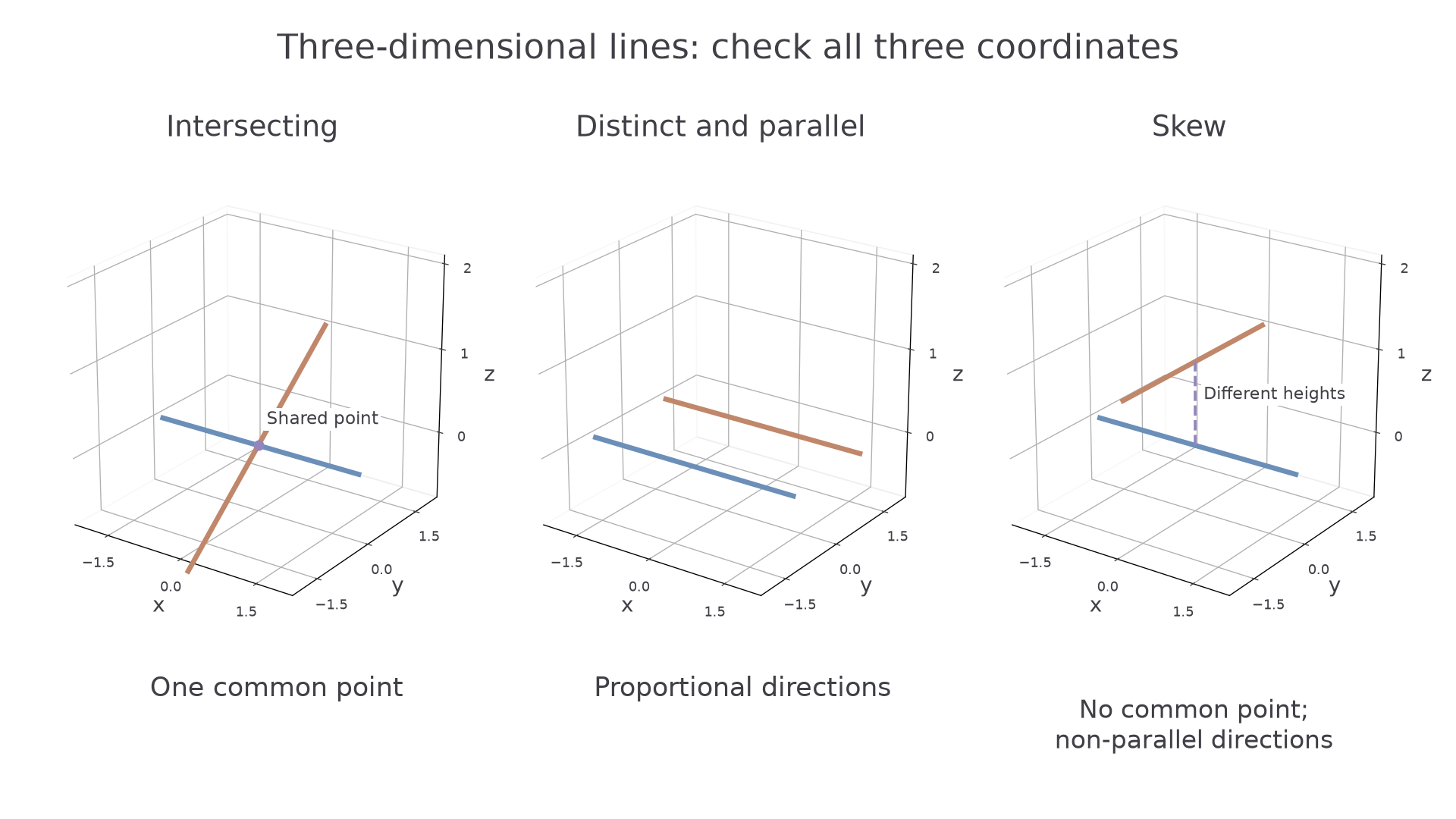
The following classification prevents the common mistake of calling every non-intersecting pair parallel.
| Directions | Common points | Relationship |
|---|---|---|
| Proportional | Every point on both lines | Coincident: one line written twice |
| Proportional | None | Distinct parallel lines |
| Not proportional | One | Intersecting lines |
| Not proportional | None | Skew lines: not in one plane |
Worked example 5: a projected crossing only
Question. Determine whether the lines and intersect.
Plan. Solve the equations, then test the resulting parameters in .
Why this step? Agreement in two coordinates proves only that the projected lines cross; the heights still have to agree.
Answer. The directions are not proportional and the heights differ, so these lines are skew.
Check. Both projected points are , but their heights differ by .
Worked example 6 changes only the second line's starting height, from to . The projected crossing stays fixed, so only the final check changes.
Worked example 6: making the projected crossing real
Question. Keep , but let . Find their intersection.
Plan. Use the same parameters and compare the new heights.
Why this step? Checking the unused coordinate establishes a shared spatial point, rather than assuming one from a drawing.
Answer. The intersection is .
Check. Substitution into both vector equations produces that same coordinate triple.
For proportional directions, test one anchor point. For example, and coincide because the second anchor occurs at . Changing its -coordinate to makes the lines distinct and parallel. These classification tests are not in the formula booklet; learn the reasoning.
Watch out
Wrong: “The simultaneous equations have no solution, so the lines are parallel.” Right: also compare directions. Non-proportional directions with no common point mean skew lines.
The floor-plan puzzle is settled: crossing projections can hide different heights. Check all three coordinates in the final problem too.
Quick Recap
- A line is , with .
- Cartesian ratios equal the same parameter; a zero direction component instead gives a fixed coordinate.
- Proportional directions identify parallel or coincident lines; a common anchor distinguishes them.
- Non-proportional lines either meet in all three coordinates or are skew.
Routes that cross on a floor plan can still miss in space: their projected crossing does not guarantee equal height.