CP 2.2, 2.3 - Complex number arithmetic and the conjugate
The equation has no real solution, so mathematicians created a number that solves it. In this lesson you build the complex numbers from that one idea: you add, subtract, multiply and divide numbers of the form (CP 2.2), use the complex conjugate to make division work (the first part of CP 2.3), and solve equations by comparing real and imaginary parts.
The imaginary unit and complex numbers
In 1572 the Italian engineer Rafael Bombelli wrote about a puzzle that ordinary numbers could not explain, and this lesson gives you the tools to solve it.
The equation has the solution , because and . Yet the formula for cubic equations, published by Gerolamo Cardano in 1545, gives an answer that looks nothing like 4:
How can a formula built from the square root of a negative number produce the ordinary number 4? Bombelli's idea was to treat as a number in its own right and calculate with it. Keep the question in mind: you will answer it at the end of the lesson.
A number whose square is negative
Start with a smaller case. The equation has no real solution, because the square of every real number is positive or zero. Now suppose there is a number with . Then
so has two solutions, and . In the same way, and .
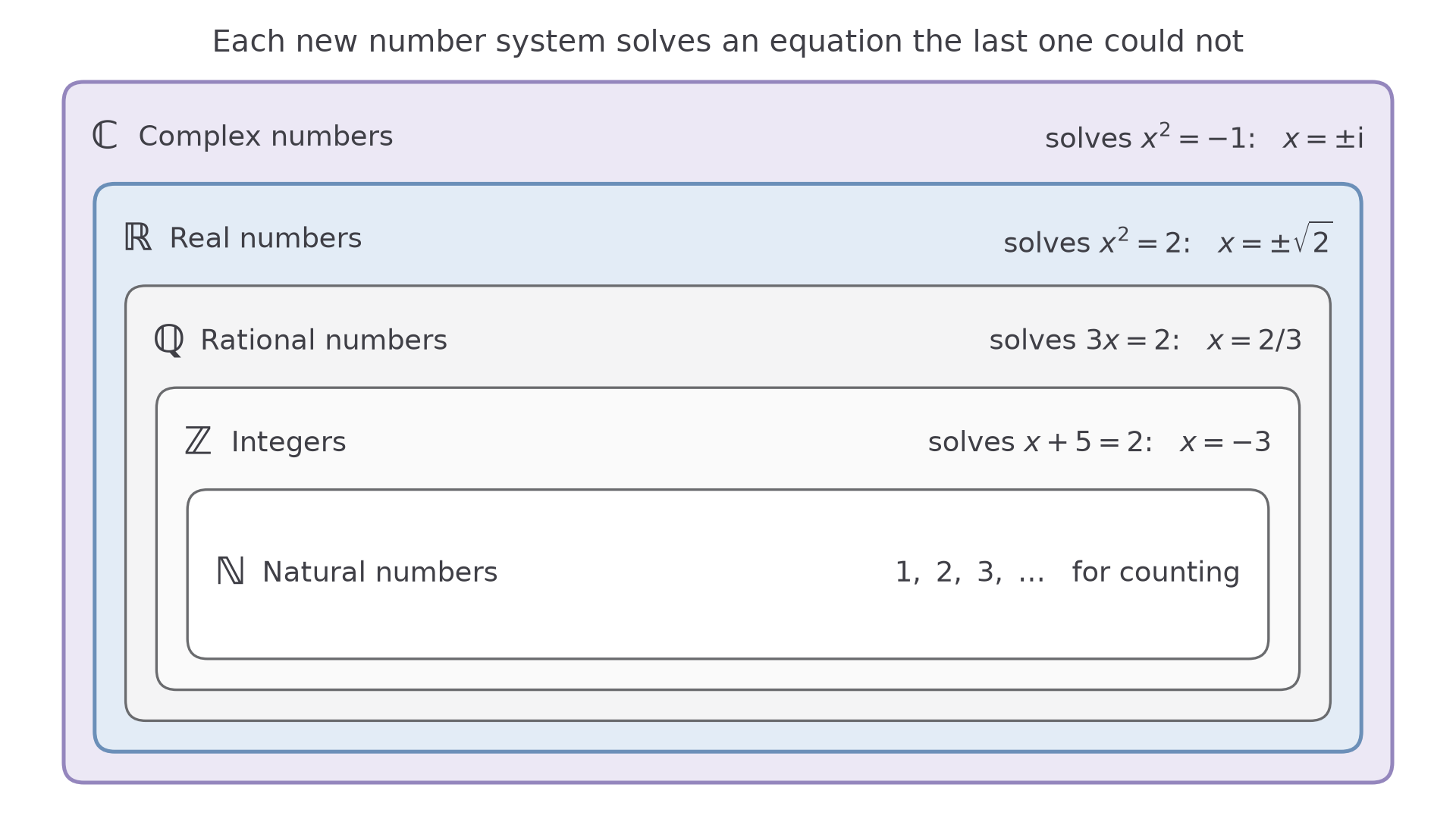
This is not the first time numbers have been extended. Whenever an equation had no solution, mathematicians enlarged the number system so that it did. The picture shows the chain you already know, with the complex numbers on the outside.
[DIAGRAM: asset_name: Nested number systems from the natural numbers to the complex numbers; asset_slug: 9fm0-number-systems; caption: Each new number system solves an equation the last one could not; description: Five nested rounded boxes. The innermost is the natural numbers 1, 2, 3 and so on, used for counting. Around it are the integers, which solve x plus 5 equals 2 with x equals minus 3, then the rational numbers, which solve 3x equals 2 with x equals 2 over 3, then the real numbers in blue, which solve x squared equals 2 with x equals plus or minus root 2, and outermost the complex numbers in lavender, which solve x squared equals minus 1 with x equals plus or minus i]
Imaginary unit
is the number with , so . For any real number , . For example, . Not an example: is not , because .
Combining real numbers with real multiples of gives every number you need in this course.
Complex number
A complex number is a number of the form , where and are real. The real part of is and the imaginary part is . The set of all complex numbers is . For example, has and . Not an example: is not ; the imaginary part is the real number .
Two special cases matter. If , then is real, so every real number is also a complex number. If and , then is called purely imaginary, for example or . Exam questions use this phrase often: “ is purely imaginary” means and .
Key idea
For , write as before you add, multiply or simplify anything else.
Adding, subtracting and multiplying
Complex numbers follow the algebra you already use: collect like terms, expand brackets, and then replace every by .
You already know
Expanding brackets: . The binomial expansion: .
Now put in place of . The expansion is exactly the same; the only new step is :
Adding and subtracting are simpler still: combine the real parts and combine the imaginary parts, so . A real multiple multiplies both parts: .
Sums and products
For real numbers , , and :
Use the method (expand, then replace by ) rather than memorising the product line. Not in the formula booklet: learn it.
Powers of
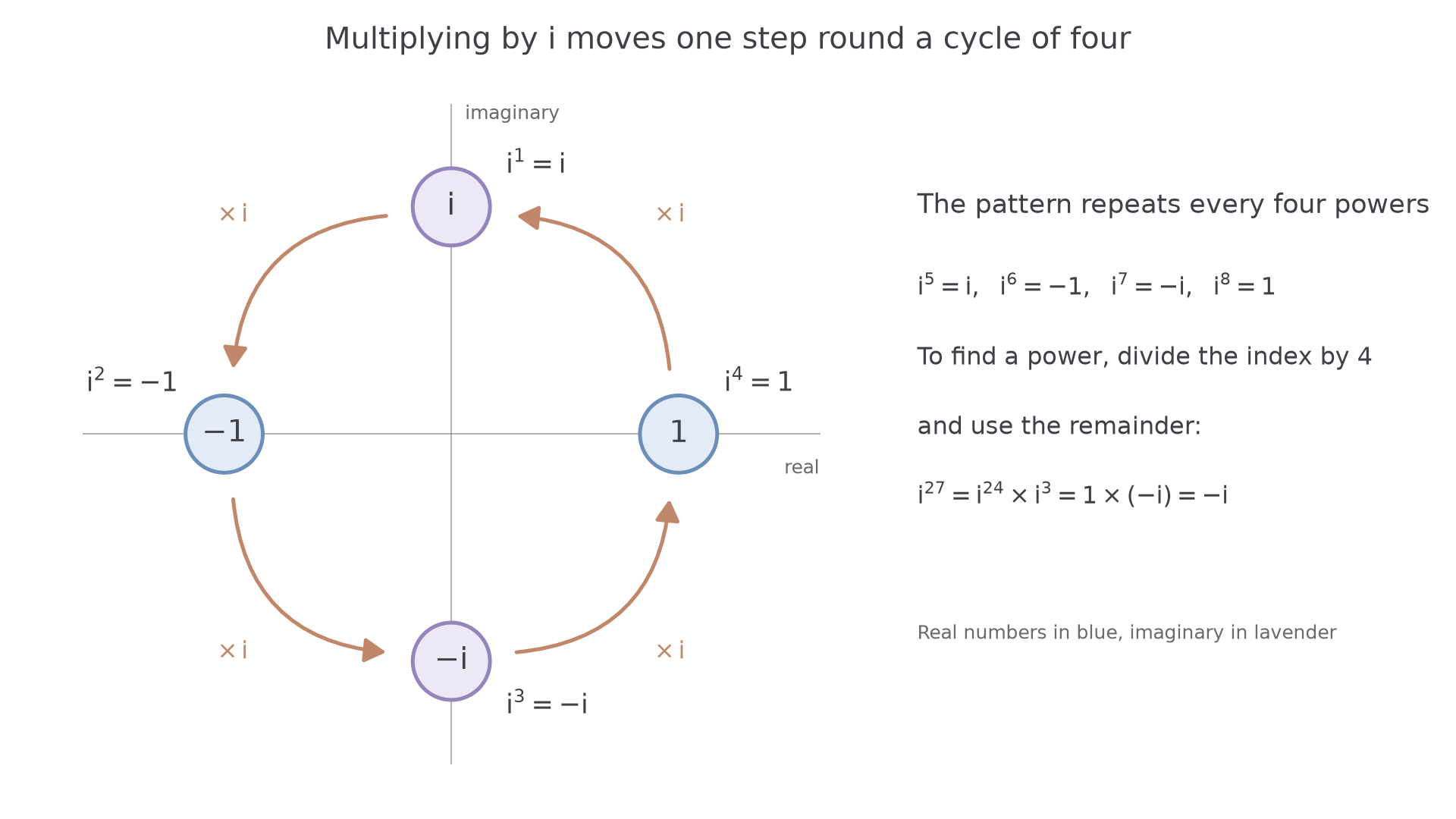
Powers of repeat in a cycle of four, because :
Each multiplication by moves one step round the cycle. Later in the course you will see that this is a genuine quarter-turn about 0.
[DIAGRAM: asset_name: The four-step cycle of powers of i; asset_slug: 9fm0-powers-of-i; caption: Multiplying by i moves one step round a cycle of four; description: The numbers 1, i, minus 1 and minus i sit at the right, top, left and bottom of a cross of faint real and imaginary axes, with real numbers in blue and imaginary numbers in lavender. Curved arrows labelled times i go anticlockwise from 1 to i to minus 1 to minus i and back to 1, with labels i to the 1 equals i, i squared equals minus 1, i cubed equals minus i and i to the 4 equals 1. A side note shows i to the 5 equals i up to i to the 8 equals 1, and i to the 27 equals i to the 24 times i cubed equals minus i]
Worked example 1: a difference and a product
Question. Given that and , express (a) and (b) in the form .
Plan. For (a), double and collect real and imaginary parts; for (b), expand the brackets and then replace by .
Why this step? The term is real, since , so it joins the real part.
Answer. (a) , which is purely imaginary. (b) .
Check. The product rule with , , , gives and
Worked example 2 changes one thing: a power instead of a product. The binomial expansion now does the bookkeeping, and you need both and , which is where most sign errors happen.
Worked example 2: a cube in exam style
Question. In this question you must show all stages of your working. Solutions relying on calculator technology are not acceptable. Express in the form , where and are real.
Plan. Use with and , simplify each power of , then collect real and imaginary parts.
Why this step? : two minus signs make the term positive.
Answer. , so and .
Check. Square first, then multiply: , and
Watch out
Wrong: . The last term was , and turns it into . Right: . Write the term down before you replace it.
Many complex-number questions carry an instruction about calculators, because some calculators can do complex arithmetic.
Exam tip
When a question says “Solutions relying on calculator technology are not acceptable”, an answer with no expansion scores no marks. Show the expanded line with its and terms, then the simplified line: the method marks are for that working.
The complex conjugate
Changing the sign of the imaginary part of a complex number gives its conjugate, and a number multiplied by its conjugate is always real.
Take . Its conjugate is . Combine the two:
The sum and the product are real, and the difference is purely imaginary. In the product the two middle terms cancel, and adds to the .
Complex conjugate
The complex conjugate of is : the same real part and the opposite imaginary part. For example, and . Not an example: the conjugate of is not ; only the imaginary part changes sign.
The same working with letters shows why the product is always real:
This is the difference of two squares, , with , so . The result is a sum of squares of real numbers: it is real, it is never negative, and it is zero only when .
A picture of the conjugate
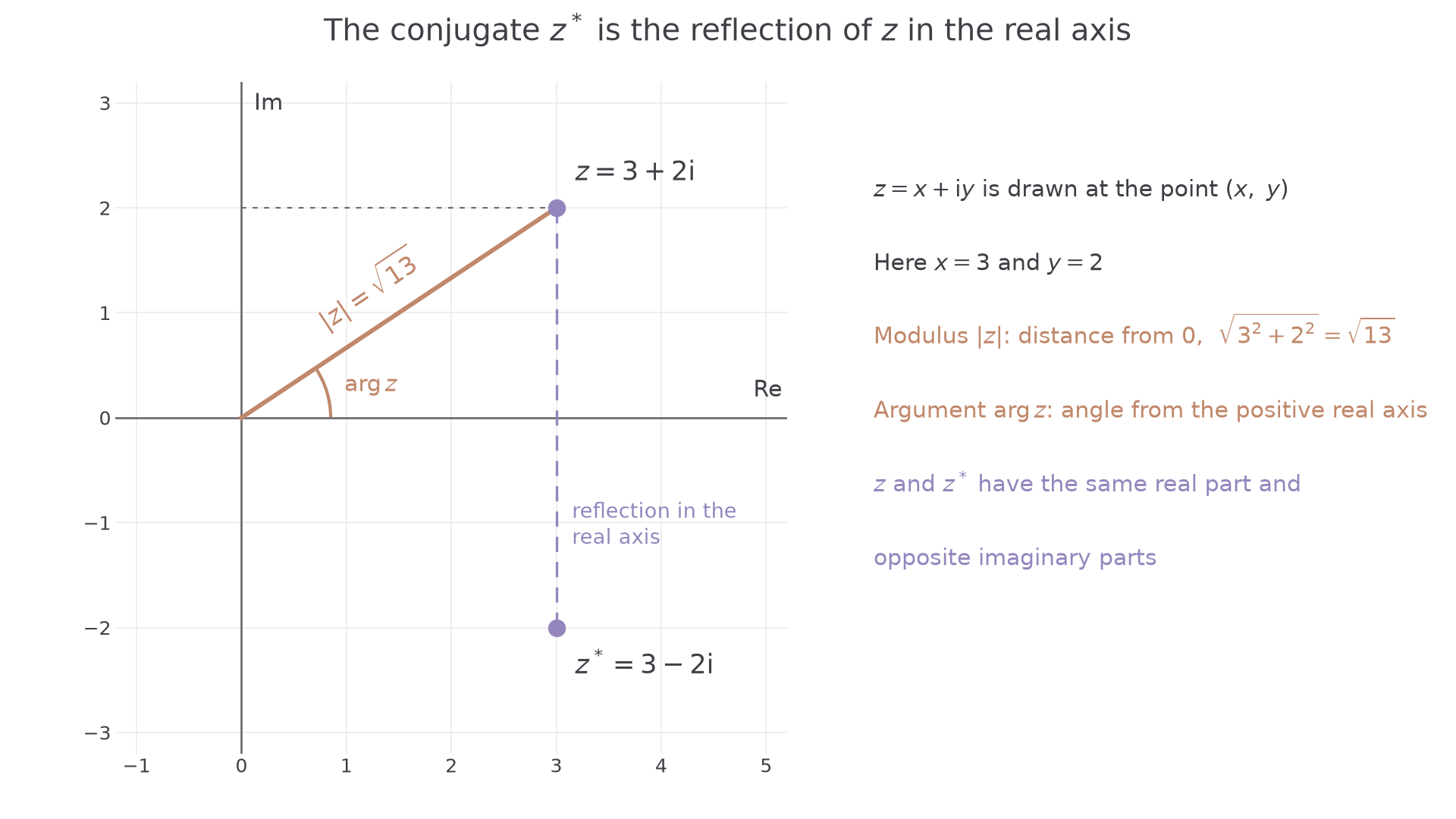
Plot as the point , with real parts across and imaginary parts up; you will work with this picture, the Argand diagram, in CP 2.4. The conjugate is then the mirror image of in the horizontal axis, and by Pythagoras' theorem the distance from 0 to is .
[DIAGRAM: asset_name: The conjugate as a reflection, with modulus and argument; asset_slug: 9fm0-conjugate-modulus-argument; caption: The conjugate is the reflection of z in the real axis; description: Axes labelled Re across and Im up. The point z equals 3 plus 2i is plotted at (3, 2) and its conjugate z star equals 3 minus 2i at (3, minus 2), joined by a dashed vertical lavender line labelled reflection in the real axis. A clay segment from 0 to z is labelled modulus of z equals root 13, and a clay arc at 0 between the positive real axis and the segment is labelled arg z. A side note says z equals x plus iy is drawn at the point (x, y), the modulus is the distance from 0, the argument is the angle from the positive real axis, and z and z star have the same real part and opposite imaginary parts]
Modulus and argument
The modulus of is , the distance from 0 to the point . The argument, , is the angle that the line from 0 to makes with the positive real axis, positive anticlockwise and negative clockwise, in radians with . For example, and . Not an example: is not ; it is .
Putting these together gives the results you will use most often.
Results with the conjugate
For with and real:
So is real exactly when , and a non-zero is purely imaginary exactly when . Not in the formula booklet: learn it.
Conjugating sums and products
Taking the conjugate replaces by everywhere. Because as well, the arithmetic is identical after the swap, so every line of a calculation stays true. So the conjugate of a sum or product is the sum or product of the conjugates: and . For example, with and from Worked example 1, , and
The same holds for powers, . In the next lesson you will see that this is why non-real roots of polynomial equations with real coefficients come in conjugate pairs.
Key idea
is always real and never negative, so multiplying a non-zero complex number by its conjugate always gives a positive real number.
Dividing complex numbers
To divide by a complex number, multiply the top and bottom of the fraction by the conjugate of the bottom; the new denominator is real, so the answer splits into a real part and an imaginary part.
You already know
Rationalising a denominator: . The difference of two squares removes the surd from the bottom.
Division by works the same way, with the conjugate playing the part of . Multiplying the top and bottom by the same non-zero number does not change the value of the fraction, only its appearance, and the bottom becomes .
Division
For real , , , with :
Not in the formula booklet: learn it.
Worked example 3: dividing by a complex number
Question. Express in the form .
Plan. Multiply the top and bottom by , the conjugate of the denominator, then simplify.
Why this step? The conjugate is chosen because is real; any other multiplier would leave in the denominator.
Answer. .
Check. Multiply back:
Worked example 4 changes one feature: the number you want, , is unknown and is multiplied by another complex number. Dividing finds it, and this time the answer has fractions, so the final form matters.
Worked example 4: finding z in exam style
Question. Solutions relying on calculator technology are not acceptable. Given that , find in the form , where and are rational.
Plan. Divide by , multiply the top and bottom by , then split the result into its real and imaginary parts.
Why this step? The question asks for the form , so the last line splits the single fraction into its real part and its imaginary part.
Answer. .
Check. , so
Watch out
Wrong: . The last term is . Right: . A quick test: is always positive.
Mark schemes give the first method mark for the conjugate step itself, so make it visible.
Exam tip
Write the multiplication by the conjugate in full, as in : that line earns the method mark. Then give the answer in the form asked, with exact fractions such as , not decimals.
Equating real and imaginary parts
Two complex numbers are equal only when their real parts are equal and their imaginary parts are equal, so one complex equation gives you two real equations.
Why is this true? Suppose , where all four numbers are real. Rearranging gives , and squaring both sides gives
The left side is never negative and the right side is never positive, so both are zero: and .
Equal complex numbers
For real , , and :
Not in the formula booklet: learn it.
This turns a problem about complex numbers into a pair of simultaneous equations. A neat first use is finding the square roots of a complex number.
Worked example 5: square roots of a complex number
Question. Find the two square roots of , giving your answers in the form , where and are real.
Plan. Write a root as , square it, equate real and imaginary parts with , and solve.
The second equation gives . Substitute it into the first:
So , giving , or , giving .
Why this step? is rejected because was defined to be real; it would give , which is not in the required form.
Answer. The square roots of are and .
Check. . The other root is the negative of this one, so it has the same square.
Worked example 6 changes one feature: the equation contains both and . The method is the same, but you substitute for both before you equate parts.
Worked example 6: an equation in z and z* in exam style
Question. Find the complex number that satisfies .
Plan. Put and , expand, equate real and imaginary parts, and solve the simultaneous equations.
So , and then .
Why this step? You must substitute for as well as : the term adds to the real part and to the imaginary part.
Answer. .
Check.
Back to Bombelli
You can now answer the question from the start of the lesson. Since , Cardano's formula says
Look, as Bombelli did, for a cube root of of the form with and integers. Expand and equate parts:
In the first equation must divide 2, and in the second must divide 11. Try and : and . So , and taking conjugates, . The two cube roots are and , and
The imaginary parts cancel and the real solution appears. Complex numbers began like this, as a route to real answers. Every non-zero complex number has three cube roots (you will find them in CP 2.10); Cardano's formula needs a pair whose product is , and .
Watch out
Wrong: “, so and the square root is .” Taking only the positive value of loses a solution, because gives . Right: both and . When a question asks for all the values of , the last accuracy mark needs every one of them.
Examiners also look for the two equations themselves.
Exam tip
State that and (or and ) are real, then write the two equations on separate lines labelled “real parts” and “imaginary parts”. The method mark is for equating both parts, and a correct pair of equations earns it even if a later slip costs the answer.
Quick Recap
- , for , and the powers of repeat every four.
- has real part and imaginary part , and both are real numbers.
- Add, subtract and multiply as in ordinary algebra, then replace by .
- The conjugate gives the real product ; to divide, multiply the top and bottom by the conjugate of the bottom.
- Equal complex numbers have equal real parts and equal imaginary parts, so one complex equation gives two real equations.
Bombelli's puzzle: and , so the cube roots in Cardano's formula are and , and their sum is the real solution .