FM1 4.1 - Newton's law of restitution
Conservation of momentum alone usually leaves two unknown velocities after a collision. Newton's law of restitution supplies the missing relationship through relative speeds. You will combine the two laws, use the permitted coefficient range to interpret directions, and calculate the total kinetic energy lost.
Restitution compares separation with approach
Can a stationary target leave a collision faster than the incoming sphere, without energy being created? A heavier sphere striking a lighter one can produce exactly that result. To explain it, you need a rule about how the spheres move relative to each other, rather than a rule saying their individual speeds are conserved.
You already know
In a direct collision, choose one positive direction and conserve the total signed momentum when the external impulse is negligible. Each sphere's impulse is its own final momentum minus initial momentum; the two contact impulses are equal and opposite.
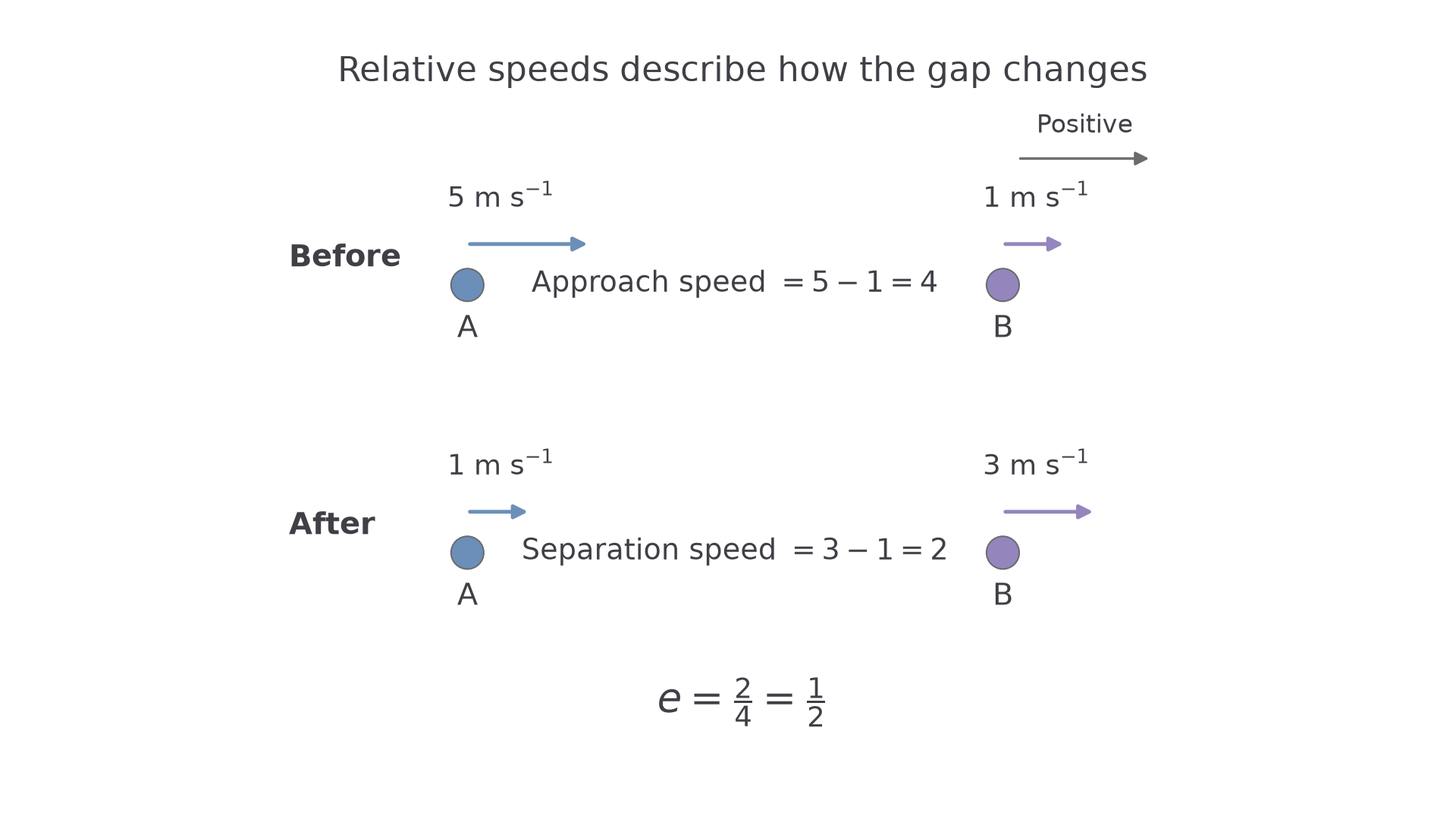
Suppose is behind , with both moving right. If moves at and at , their gap closes at , not . If they instead move towards each other at those speeds, the gap closes at .
Coefficient of restitution
For a direct impact, the coefficient of restitution is the relative speed of separation immediately after impact divided by the relative speed of approach immediately before impact. In this model . A perfectly elastic impact has ; at , the spheres have the same velocity immediately after impact. They need not remain attached permanently.
Smooth elastic spheres in an exam question need not have . “Perfectly elastic” is the condition that identifies this endpoint.
Newton's law of restitution
Let be to the left of , with right positive. Write their velocities immediately before impact as , and immediately after as . For approaching spheres, , and
Both sides describe non-negative relative speeds. Use signed velocities in the differences. The coefficient belongs to the pair of bodies and the stated model; it is not the ratio of one sphere's final and initial speeds.
Not in the formula booklet: learn it.
The following before-and-after measurements give the coefficient without requiring the masses.
[DIAGRAM: asset_name: Relative speeds in a same-direction collision; asset_slug: 9fm0-fm142-relative-speeds; caption: Subtract the two velocities in the correct order to describe the changing gap; description: Before impact, A is on the left moving right at five metres per second and B on the right moving right at one, with approach speed five minus one equals four labelled between them. After impact, A moves right at one and B right at three, with separation speed three minus one equals two. A fixed positive-right arrow and the ratio e equals two over four equals one half are shown.]
Worked example 1: catching a sphere ahead
Question. Immediately before a direct collision, is to the left of and their velocities are and , both rightwards. Immediately afterwards their velocities are and , both rightwards. Find the coefficient of restitution.
Plan. Use the rate at which the gap closes before impact and the rate at which it opens afterwards.
Why this step? Both spheres move in the same direction, so their relative speed is a difference, not the sum of their speeds.
Answer. .
Check. The separation speed is half the approach speed, and the coefficient lies in .
In a second collision, change only 's initial direction in the supplied velocity data. The initial relative speed changes even though the two initial speed magnitudes do not.
Worked example 2: opposite initial directions
Question. Immediately before a direct collision, is to the left of . moves right at and left at . Immediately afterwards moves right at and right at . Find the coefficient of restitution.
Plan. Take right as positive, so , and form the two signed differences.
Why this step? Subtracting the negative initial velocity adds the two approach-speed magnitudes automatically. The signed formula handles both geometries.
Answer. .
Check. The spheres approach at and separate at , a one-to-three ratio.
The direction convention prevents you having to memorise a separate sign pattern for every picture.
Watch out
Wrong: with initially on the left and right positive. That numerator is the negative of the separation speed. Also, interchanging approach and separation would give in these examples, outside the permitted model.
Change only the leftward incoming speed of .
Solve momentum and restitution together
For two unknown final velocities, write two equations: one for total momentum and one for relative motion. Keep the same signed unknowns in both. A negative answer then tells you a sphere reverses; it is not a reason to change the equation halfway through.
Two equations for a direct impact
For isolated direct impact of two spheres modelled as particles,
The restitution equation uses the ordering left of and right positive, with . The horizontal external impulse is negligible on a smooth horizontal plane.
Not in the formula booklet: learn it.
The first example has a moving heavier sphere and a stationary lighter target.
Worked example 3: a partially elastic collision
Question. A sphere of mass moves right at and collides directly with a stationary sphere of mass on a smooth horizontal plane. The coefficient of restitution is . Find their velocities immediately afterwards.
Plan. Conserve momentum and use restitution to express one final velocity in terms of the other.
Why this step? Substitution removes one unknown while preserving the two laws. Neither momentum alone nor restitution alone determines both velocities.
Answer. moves right at , and right at .
Check. Final momentum is . The separation speed is , half the approach speed.
Change only the coefficient to . The impact is now perfectly elastic.
Worked example 4: a target leaves faster than the striker arrived
Question. A sphere , moving right at , collides directly with a stationary sphere on a smooth horizontal plane. The coefficient of restitution is . Find the velocities immediately afterwards.
Plan. Retain the momentum equation and change the relative separation speed to the full approach speed.
Why this step? preserves the relative-speed magnitude, not either sphere's individual speed. A light target can receive enough energy to exceed the striker's initial speed.
Answer. moves right at , and right at .
Check. Momentum is . Initial kinetic energy is ; final kinetic energy is . The faster target has not created energy.
That resolves the opening puzzle. A greater speed for one sphere does not imply a greater total kinetic energy for the pair.
Watch out
Wrong for these two-sphere impacts: . This ignores 's motion after impact; restitution concerns relative speeds. Right: solve together with .
Show both unsimplified equations before solving. Pair every mass with its own signed velocity, and use the same assumed directions in both equations. Finish by interpreting each sign as a direction.
Change only the restitution coefficient once more.
Continue this lesson.
You’re previewing NovaLearn without an account. Create a free account to read the rest.
Create free account