FP1 5.1 - The vector product
The vector product makes a perpendicular vector from two directions, while its magnitude measures an area (FP1 5.1). You will choose its orientation, calculate its components and use it to find exact areas in three dimensions.
A perpendicular vector with an orientation
Can two arrows determine both the area of a sloping shape and which way its face points? The vector product packages those two pieces of information into one vector.
Place two non-parallel vectors tail to tail. They span a plane, so there are two opposite perpendicular directions. Their order selects one of them: curl the fingers of your right hand from the first vector towards the second through the smaller angle; your thumb points along their vector product.
You already know
A vector has a magnitude and a direction. The scalar product is a number, and zero scalar product tests perpendicularity for non-zero vectors. Two non-parallel directions span a plane.
The vector product, also called the cross product, is written . Its answer is a vector; is the length of that vector.
Geometric definition of the vector product
For non-zero, non-parallel vectors, with angle ,
Here is the unit normal fixed by the right-hand rule from to . Hence
If either vector is zero, or if the vectors are parallel, their vector product is ; its direction is then undefined.
In the formula booklet.
In a right-handed coordinate system, , , and . Reversing either order reverses the answer. The product of a basis vector with itself is . These basis rules and the right-hand orientation must be known; the booklet supplies the general product formula.
[DIAGRAM: asset_name: Reversing the order reverses the normal; asset_slug: 9fm0-fp1-cross-orientation; caption: The same two directions give opposite normals when their order is reversed; description: Two exact projected three-dimensional coordinate diagrams show the right-handed i, j and k axes. In the left panel an arc turns from positive i to positive j and the product arrow points along positive k. In the right panel the arc reverses from positive j to positive i and the product arrow points along negative k. The same pale patch in the i-j plane makes clear that the plane and product magnitude are unchanged.]
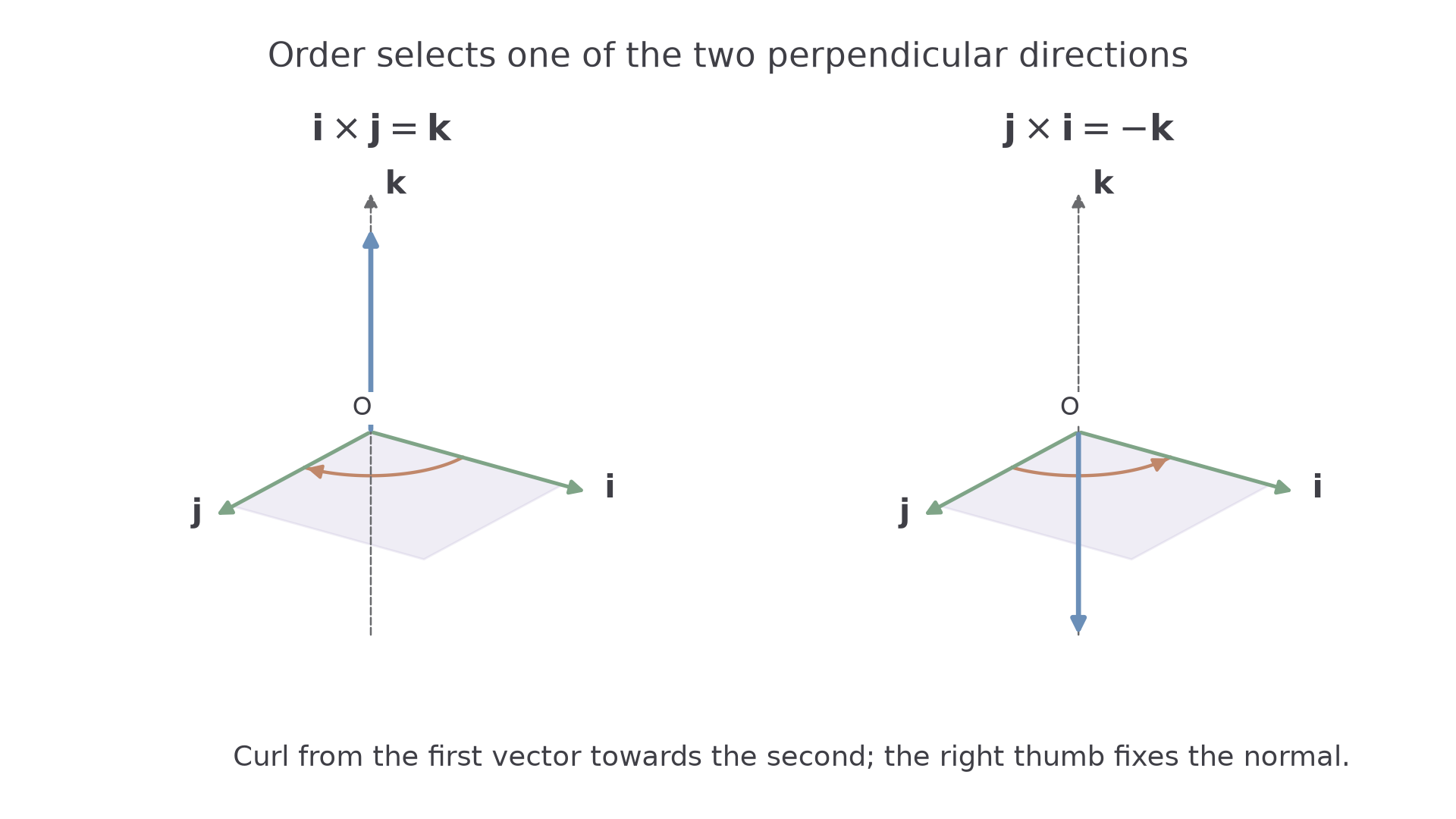
Worked example 1: a right-handed axis pair
Question. Find , and state its magnitude.
Plan. Multiply the lengths and use the orientation .
Why this step? A magnitude of alone cannot identify which of the two opposite normals is the vector product.
Answer. The vector product is , with magnitude .
Check. Its scalar product with both and is zero, and its direction agrees with the right-handed axes.
Change only the second vector from to . Its length stays the same while the normal reverses.
Worked example 2: one reversed input
Question. Find , and state its magnitude.
Plan. Keep the angle magnitude and reverse the orientation of the second input.
Why this step? The negative sign changes the vector direction; it does not make the vector's length negative.
Answer. The product is , with magnitude .
Check. It is still perpendicular to both input directions. Reversing the changed vector again restores .
The general rules are and . The product distributes over addition, and scalar factors can be taken outside it. These algebraic consequences of the coordinate rule are not separately printed in the booklet.
Watch out
Wrong: “a zero vector product means perpendicular”. Right: for two non-zero vectors it means parallel. Perpendicular non-zero vectors have the largest product magnitude for their fixed lengths.
Keep the type of answer and its orientation separate in this check.
Calculating components and unit normals
The coordinate rule calculates the same directed normal without requiring a reliable three-dimensional sketch.
Use a right-handed orthonormal basis . Expanding the product of and , using the basis rules, groups the surviving terms into three components.
Coordinate vector product
The first display is the usual determinant expansion mnemonic: the middle cofactor has a minus sign.
In the formula booklet.
For a non-zero result , the unit normal in its orientation is ; the opposite unit normal is its negative. This normalising rule is not printed separately in the booklet: it is the previously learnt unit-vector method.
Worked example 3: a directed unit normal
Question. For and , find and the unit normal in that orientation.
Plan. Calculate all three signed components, then divide the result by its magnitude.
Why this step? The vector product is perpendicular to the inputs but is not usually a unit vector.
Answer. , with directed unit normal .
Check. and . The squared length of the unit normal is .
Change only the last component of from to . Recalculate rather than reversing the entire previous product.
Continue this lesson.
You’re previewing NovaLearn without an account. Create a free account to read the rest.
Create free account