CP 3.5 - Determinants and scale factors
A matrix moves points, but its determinant tells you what happens to an entire shape. You will calculate determinants of two by two and three by three matrices, then interpret their size and sign as information about area, volume and orientation.
The determinant as signed area
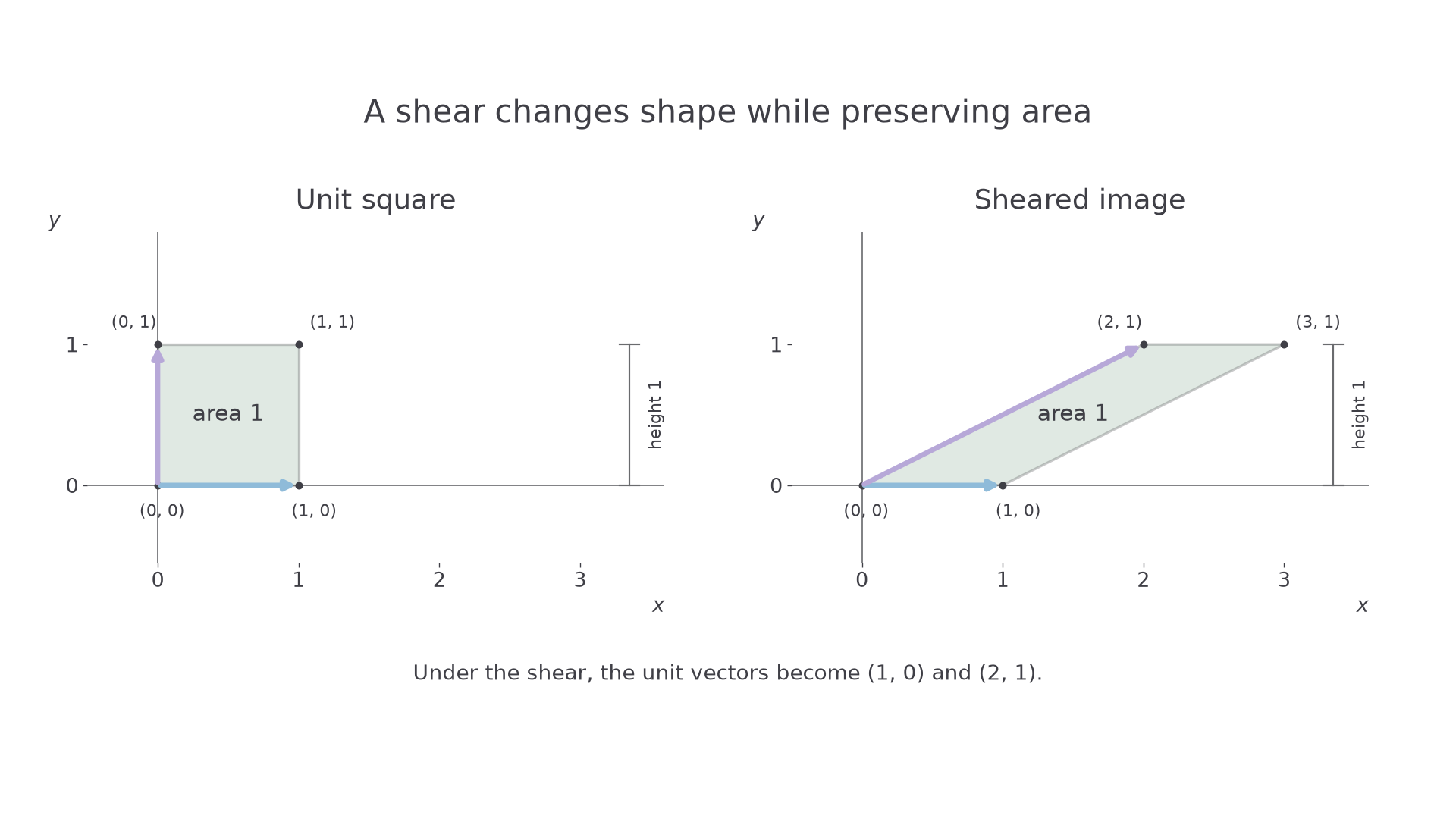
Can a transformation move corners of a square while leaving its area unchanged? Consider the matrix . It fixes and , but moves the upper corners to and . The square becomes a sloping parallelogram. Its base and perpendicular height are still both , so its area is still .
You already know
For a linear transformation, the columns of are the images of the coordinate unit vectors. Matrix multiplication gives the image of any other point. In a product , acts first.
The determinant measures this change of area without requiring you to draw every transformed shape. To see where its formula comes from, let the columns be and . The image of the unit square has vertices , , and . Subtracting the triangles outside this parallelogram, or using the coordinate area formula, gives the signed area .
[DIAGRAM: asset_name: A unit square and its sheared image; asset_slug: 9fm0-cp35-shear-area; caption: The square and its sheared image both have base 1 and perpendicular height 1; description: Two coordinate panels show the unit square with vertices (0,0), (1,0), (1,1), (0,1), then its image with vertices (0,0), (1,0), (3,1), (2,1) under S with rows (1,2) and (0,1). Blue and lavender arrows show the images of the first and second unit vectors. Each panel labels area 1 and perpendicular height 1.]
Determinant
The determinant of a square matrix is a single number, written or . For a two by two transformation matrix, its modulus is the area scale factor; its sign records orientation. For example, . A determinant is a number, not a matrix.
Orientation means the order in which you travel round corresponding labelled vertices. If are anticlockwise and their images are clockwise, orientation is reversed. A positive determinant preserves orientation; a negative determinant reverses it. A rotation through preserves orientation even though every non-zero position vector points the opposite way afterwards.
For , replacing by any real number still gives determinant . You can shear the top of a square as far sideways as you please without changing its area. Lengths and angles change; area survives. This is why determinant does not mean “a rotation”.
Key idea
The modulus of the determinant measures area change; the sign measures orientation change. Neither tells you the complete transformation.
The next check separates an area statement from a statement about lengths.
Calculating two by two determinants
For a two by two matrix, multiply down the main diagonal and subtract the product on the other diagonal. Keep the subtraction visible when entries are negative.
Two by two determinant
For ,
Not in the formula booklet: learn it.
The vertical bars are an alternative notation for the determinant, so means , not a matrix with different brackets.
Worked example 1: a positive determinant
Question. Find the determinant of .
Plan. Calculate the main-diagonal product minus the other-diagonal product.
Why this step? The order of subtraction fixes the sign, which carries geometrical information.
Answer. .
Check. The image unit vectors are and . They occur in anticlockwise order, consistent with a positive determinant.
Worked example 2 changes the sign of one entry. This time subtracting a negative product is the decision to watch.
Worked example 2: a negative entry
Question. Calculate , where .
Plan. Use the same two products, including the negative sign in the second entry.
Why this step? The minus in belongs to the determinant formula; it does not replace the minus already inside .
Answer. .
Check. Changing from to changes from to , increasing the determinant by , from to .
An entry and the formula's subtraction can supply separate minus signs.
Watch out
Wrong: . Right: . Write the signed product in brackets before simplifying.
Change the sign of the other off-diagonal entry in your own calculation.
Calculating three by three determinants
A three by three determinant reduces to three two by two determinants. The alternating signs do the bookkeeping; choosing a row containing a zero reduces the arithmetic.
Deleting the row and column of an entry leaves a two by two matrix. Its determinant is the entry's minor. For expansion along the top row, the signs are plus, minus, plus.
Expansion along the first row
For ,
Not in the formula booklet: learn it.
Each coefficient multiplies the minor obtained by deleting its own row and column. You may expand along any row or column, with signs from the checkerboard . These signed minors are called cofactors; they will reappear when you find inverses.
Worked example 3: using a zero
Question. Calculate the determinant of .
Plan. Expand along the first row, where the zero removes the third term.
Why this row? One zero means only two minors need evaluating; the matrix itself is unchanged.
Answer. .
Check. Expanding down the first column gives as well.
Worked example 4 changes only the top-right entry, from zero to a negative number. All three terms now contribute.
Worked example 4: all three terms
Question. Find the determinant of .
Plan. Expand along the first row, keeping its separate from the cofactor signs.
Why this step? The third cofactor sign is positive, but the entry multiplying that minor is . The minor is also , so the contribution is .
Answer. .
Check. The first-column expansion is .
The common failure is to handle the middle term as positive, especially when its coefficient is already negative.
Watch out
Wrong: . Right: the middle term is . Write before inserting entries, then evaluate each minor separately.
One more change to the top-right entry gives a closely matched check.
Area, volume and orientation
Once you have the determinant, interpreting it is often shorter than calculating it. Keep the signed determinant and the positive scale factor as separate statements.
Geometrical scale factors
For a real square transformation matrix ,
A positive determinant preserves orientation; a negative determinant reverses it. A zero determinant collapses area or volume to zero, so orientation is no longer defined for that image.
Not in the formula booklet: learn it.
In three dimensions, orientation distinguishes right-handed and left-handed arrangements of three independent directions. A reflection in a coordinate plane reverses orientation. A rotation preserves it. A three-dimensional determinant scales volume, not the area of every surface: a flattened box can have zero volume while retaining a non-zero face area.
Worked example 5: recovering an original area
Question. The matrix maps a triangle to a triangle of area . Find the original area and state the effect on orientation.
Plan. Calculate the determinant, divide the image area by its modulus, then interpret its sign.
Why divide? The given area belongs to the image, so .
Answer. The original area is square units; orientation is reversed.
Check. , and neither area is negative.
Worked example 6 changes the dimension. The same interpretation now concerns volume, and the determinant comes from three directions.
Worked example 6: recovering a volume
Question. A solid is transformed by . Its image has volume . Find the original volume and state the effect on orientation.
Plan. Multiply the diagonal entries to find the determinant, then divide by its modulus.
Why this step? The separate stretches multiply volume by , and ; the negative entry reverses one direction and therefore reverses orientation.
Answer. The original volume is cubic units; orientation is reversed.
Check. A unit cube becomes a box with side lengths , , , whose volume is .
A negative determinant changes orientation without making a geometric volume negative.
Watch out
Wrong: the original volume is . Volumes scale by the modulus of the determinant, so the correct calculation is . Use the negative sign separately to state that orientation is reversed.
For successive transformations, the scale factors multiply. In determinant notation, ; this result is not in the formula booklet. Two negative determinants therefore give a positive determinant: reversing orientation twice restores it. For an enlargement with length scale factor , the determinant is in two dimensions and in three dimensions. A determinant is rarely a length scale factor.
Exam tip
If asked for an area or volume scale factor, give the modulus. State the orientation separately. For example, determinant means volume factor , with orientation reversed.
The opening shear now has a numerical explanation: its determinant is , so every area, not just the square's area, is preserved.
Quick Recap
- For a two by two matrix, .
- For a three by three matrix, expand along a row or column using signed two by two minors.
- is the area factor in two dimensions and the volume factor in three dimensions.
- A positive determinant preserves orientation; a negative determinant reverses it; a zero determinant collapses dimension.
Yes, the opening shear moves corners without changing area: .