FP2 6.3 - Proving closed forms by induction
Prove that a proposed formula gives every term of a recurrence (FP2 6.3). You will choose enough base cases, state the right inductive assumptions and use the recurrence to build the next closed form.
Use the recurrence to prove the next formula
Why does one recurrence proof need one starting case, while another needs two? The number of earlier terms used by the rule determines how much established information the induction step needs.
You already know
Induction checks a starting case, assumes a statement at an arbitrary permitted index and proves its successor. A closed form expresses directly in . Finding that form by an auxiliary equation is a different task from proving it by induction.
Write for the statement . For , the recurrence converts the assumed into
Your algebra must then reach .
First-order recurrence induction
For a rule beginning at index :
- check ;
- assume for an arbitrary integer ;
- use the recurrence to prove .
Then the formula holds for every integer .
Not in the formula booklet: learn it.
Checking many terms still does not replace that implication. Add to any proposed formula: the values at indices to stay unchanged, but the value at changes by . A hundred successful checks can hide a false next term.
Worked example 1: build the next power
Question. A sequence satisfies , . Prove by induction that
Plan. Check index , assume the closed form at , then substitute it into the next-term rule.
At , , so the base case holds.
Assume for an arbitrary integer . Then
Why this step? The recurrence gives an established equation for ; the formula for is the result to prove, not another assumption.
Answer. If the formula is true at , it is true at . It is true at , so it holds for every integer , by mathematical induction.
Check. At , direct iteration gives , and the formula gives . This checks the arithmetic, not the general implication.
Change only from to ; the coefficient in the proposed closed form changes accordingly.
Worked example 2: the changed base case
Question. For , , prove that
Plan. Check the new initial value and run the same implication with its new coefficient.
At , .
Assume for an arbitrary integer . Then
Why this step? Both the base case and the assumed statement must use the new proposed formula; the recurrence itself has not changed.
Answer. The formula is true at , and truth at any implies truth at . It therefore holds for all integers , by induction.
Check. Direct iteration gives ; the formula gives these same values.
A proof must follow the requested method. Solving the recurrence again may establish the formula by another argument, but it is not a proof by induction.
Watch out
“Assume and ” assumes the target. For this first-order proof, assume only the formula, then derive the formula using the recurrence.
Change the initial value once more and supply the whole proof.
A second-order proof starts with two consecutive cases
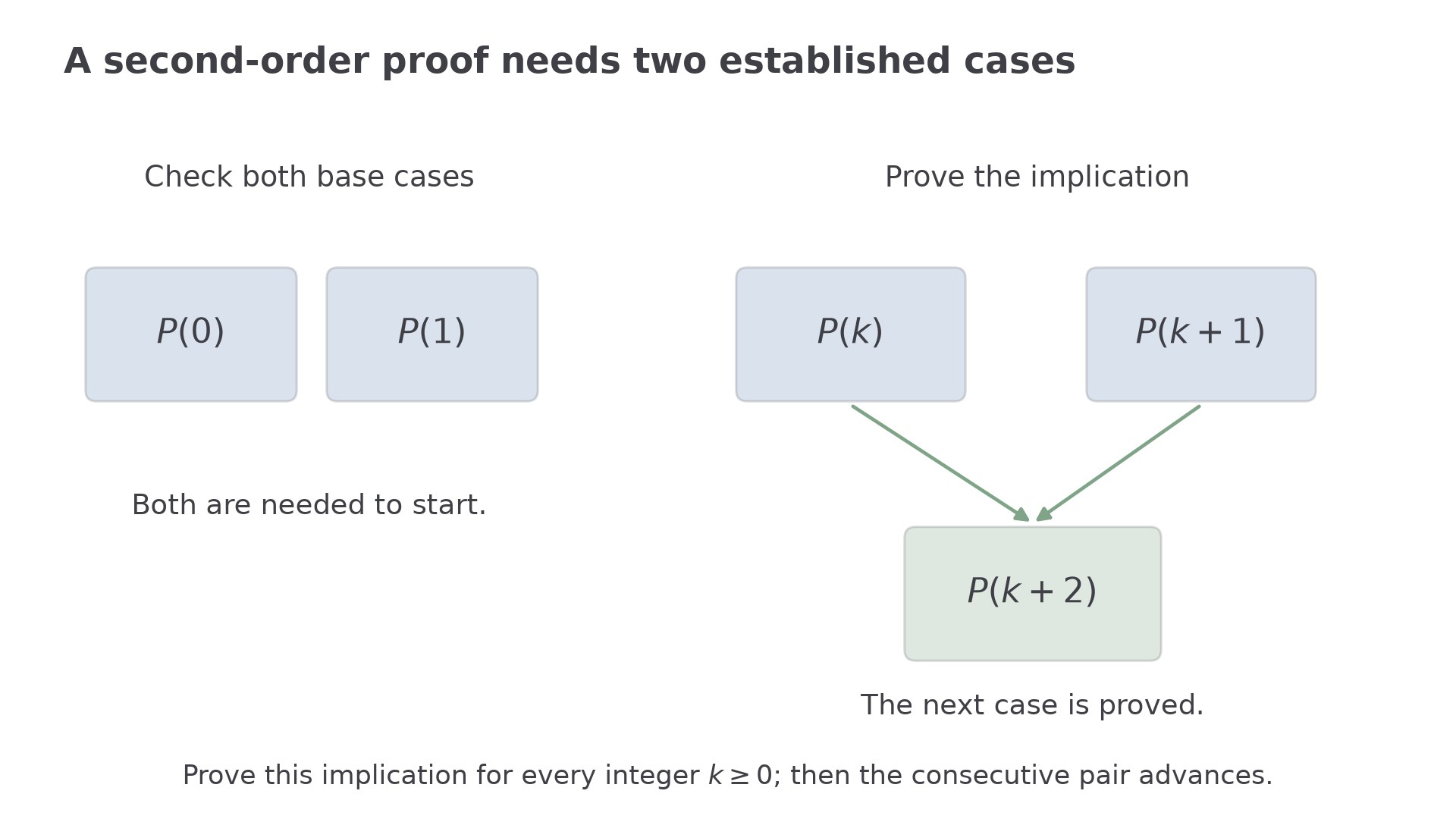
For a second-order rule, the next term depends on two earlier terms. The induction step therefore assumes the proposed formula at two consecutive indices, then proves it at the following index.
Two-case recurrence induction
For a second-order recurrence starting at , check
Assume and , for an arbitrary integer . Use the recurrence to prove .
The two initial cases start the chain; the step advances the established consecutive pair.
Not in the formula booklet: learn it.
For example, the pair establishes ; the pair then establishes . Neither the second starting value nor the second assumption is optional.
[DIAGRAM: asset_name: Two established cases advance an induction proof; asset_slug: recurrence-two-case-induction; caption: A second-order rule uses two consecutive established cases to prove the next one.; description: The left panel contains two blue boxes P(0) and P(1) under the instruction Check both base cases. The right panel has two blue input boxes P(k) and P(k+1), whose arrows meet and lead to one sage box P(k+2). A dark-ink footer states that the implication must hold for every integer k at least0. All labels have generous clear spacing.]
The starting index is not automatically . Here the data begin at , so check and .
Worked example 3: two power terms
Question. Let , . Prove that
Plan. Check both initial indices, assume both consecutive closed forms and combine like powers in the recurrence.
At , . At , .
Assume and , for an arbitrary integer . Then
Why this step? A common power lets you combine coefficients explicitly; merely writing the target after substitution leaves the important algebra unshown.
Answer. Truth at implies truth at . Both have been checked, so the formula holds for every integer , by induction.
Check. The recurrence gives , agreeing with .
Change only from to ; the resulting closed form changes, but the proof still needs two starting cases.
Continue this lesson.
You’re previewing NovaLearn without an account. Create a free account to read the rest.
Create free account